

Short answer
Group health insurance in Qatar is a company-arranged policy that covers employees under one contract, and under Law No. 22 of 2021 the employer must provide at least the MoPH basic package for expatriate staff. Beyond that baseline, benefits, networks and waiting periods depend on the insurer and the plan you choose.
Under Law No. 22 of 2021, health insurance is mandatory for expatriates and visitors; the visitor phase has applied since February 2023, while the resident and employee phase follows MoPH implementation decisions. For employers, corporate health insurance in Qatar can organize employee cover through a group policy, while the benefits and access depend on the selected plan. Policy terms, such as waiting periods for pre-existing conditions, vary by insurer.
Free 2026 checklist: Set up a company and move to Qatar, six phases on six pages.
A policy’s value is measured when employees need care, not just when they enroll. Access to hospitals and clinics, reimbursement for out-of-network treatment, and benefits such as maternity or day care all affect how useful the cover is for your team.
This guide explains how group insurance works for employees in Qatar, what waiting periods for pre-existing conditions mean, and how provider networks and direct billing affect access to care. It also explains how mandatory insurance rules relate to employers’ practical choices when arranging employee benefits, helping you compare coverage more clearly.
Key Takeaways
- Compare pre-existing condition terms and waiting-period rules so employees understand when eligible claims may be covered.
- Match benefits to your team’s needs, including hospitalisation, ambulance, day care and maternity care.
- Assess network reach and direct-billing arrangements alongside coverage breadth, since out-of-network treatment may require reimbursement.
- Understand how Qatar’s insurance requirements apply to employees, then align the cover arrangement with your business setup.
Pre-existing condition coverage and waiting periods
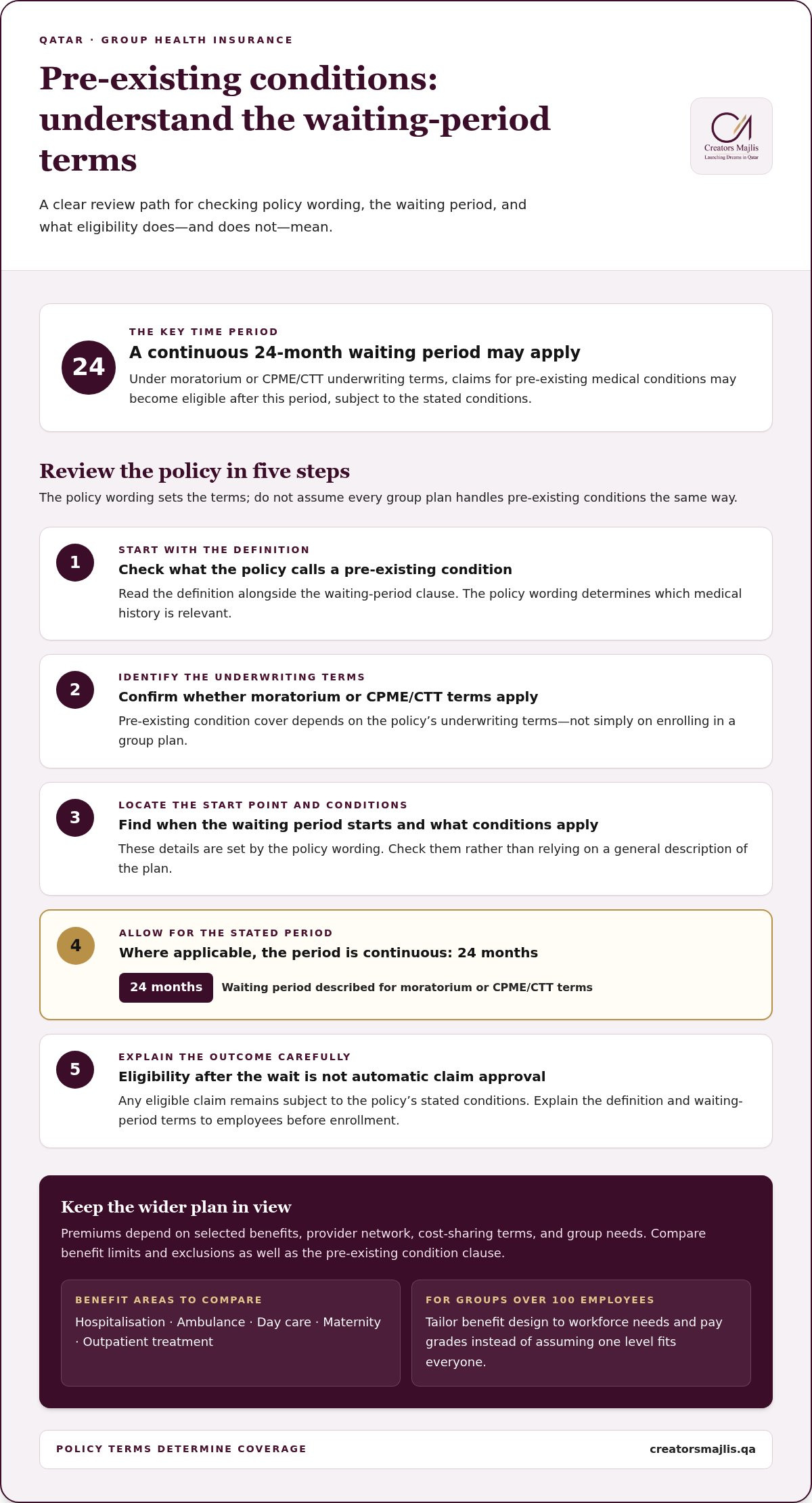
Pre-existing condition cover depends on the policy’s underwriting terms, not simply on enrolling in a group plan. Under some insurers’ moratorium or CPME/CTT terms, claims for pre-existing medical conditions may become eligible after a continuous 24-month waiting period, subject to the stated conditions. This is a waiting period, not automatic approval of every claim.
Read the definition of a pre-existing condition alongside the waiting-period clause. The policy wording determines which medical history is relevant, when the waiting period starts, and which conditions apply. Explain these terms before enrollment so employees understand how a past diagnosis may affect a claim.
Group health insurance premiums in Qatar depend on the selected benefits, provider network, cost-sharing terms, and the group’s needs. Compare these factors with your workforce’s likely needs rather than paying for benefits that may not suit your employees.
Benefits and exclusions vary by plan. Compare hospitalisation, ambulance, day care, maternity, and outpatient treatment, then review the exclusions and limits for each benefit. Dental and optical cover may be optional additions; check the policy wording for details of any repatriation benefit.
For a group with over 100 employees, tailor the benefit design to workforce needs and pay grades instead of assuming one level fits everyone. Qatar-based employers may arrange cover through a single provider, and employee cover may depend on pay grade. Clear benefit tiers can help staff understand their individual entitlements.
COVID-19 treatment and quarantine are not interchangeable benefits. Qatar’s visitor policy has no waiting period and includes COVID-19 cover; quarantine costs depend on the policy wording. Visitor policies also set limits for emergency medical assistance and accident care. Those visitor terms should not be assumed to apply to an employee group policy, where the schedule sets covered services and limits.
Group health insurance for Qatar-based employees
Group cover places employees under a company-arranged policy, with benefits shaped by workforce needs and the plan’s terms. In Qatar, compare the practical scope of cover, not just the headline premium.
Insurer Options and Plan Comparisons
Insurers operating in Qatar offer corporate plans, but a useful comparison focuses on benefits, provider networks, coverage breadth, and quality ratings. An insurer’s name alone does not show whether a plan suits your employees. Review hospitalisation, ambulance, day care, maternity care, exclusions, and cost-sharing together.
Compare these benefits with employee needs, then assess access to hospitals and clinics. Visitors have separate insurance requirements, so visitor cover should not be treated as a substitute for employee group insurance.
Employer Duties and Coverage Requirements
Law No. 22 of 2021 makes health insurance compulsory for expatriates and visitors in Qatar; it is being introduced in phases, starting with visitors, and cover becomes a condition for issuing and renewing visas and residence permits. Employer-provided cover can depend on an employee’s pay grade and may be arranged through a single provider.
Under Law No. 22 of 2021, the employer carries the legal duty to provide at least the MoPH basic health package for its expatriate employees; benefits above that package can vary by grade. Compare the services and limits covered by each policy, then align employee enrollment with the applicable visa and employment arrangements.
Costs and Noncompliance Risks
Per-employee premiums depend on the selected benefits, network, cost-sharing terms, and the group’s needs. The price is determined case by case and provided after a quote request. Broader benefits or lower out-of-pocket costs may affect the premium.
Failing to arrange required insurance can create visa issuance or renewal difficulties for expatriate employees. Qatar’s mandatory health insurance framework is established under Law No. 22 of 2021 regulating health services in the country.
Coverage for Dependents and Domestic Staff
Cover for dependents and domestic staff depends on who is enrolled and which benefits the policy schedule includes. Keep their details separate from employee records, identify their relationship to the employee, and confirm the applicable coverage category during enrollment.
Enrollment commonly involves providing the insurer with employee and dependent information needed to identify members and administer cover. Set a clear process for reporting additions or changes, so household members aren’t confused with employee-only benefits. For help coordinating insurance as part of a wider Qatar business setup, discuss your business setup requirements.
Provider network and direct billing
A provider network is the group of hospitals, clinics, and medical professionals linked to an insurance plan. Direct billing allows an employee to receive eligible care at a participating facility without paying the full bill upfront. The insurer settles eligible charges with the provider, while the policy determines any employee contribution. For corporate health insurance in Qatar, understanding this process helps employees know what to expect when seeking treatment.
Network reach matters across the country. A clinic near an employee’s workplace may be convenient during the week, while a hospital closer to home may better suit family needs. Compare facilities, covered services, and quality ratings alongside the premium. A lower premium may be less useful if the network does not match employees’ locations or care needs.
For direct billing, an employee typically presents their insurance details at a network facility. The provider checks eligibility and bills the insurer for eligible treatment. The employee may still owe a deductible or copayment if the plan includes one. For example, a covered consultation may be billed directly, while the member pays the stated share at the clinic.
Out-of-network care may follow a different process. Depending on the policy, employees may need to pay the provider first and submit a reimbursement claim afterward. Overseas treatment may also require reimbursement rather than direct settlement. Employees should keep invoices, medical reports, and proof of payment to support a claim. These details matter when comparing corporate health insurance plans in Qatar.
Use a practical comparison before selecting a network:
- Match hospitals and clinics to where employees live and work.
- Review whether common services, such as consultations and hospitalisation, are covered.
- Compare direct-billing access with reimbursement rules for out-of-network or overseas care.
- Read cost-sharing terms so employees understand possible charges at treatment.
A concise network guide can help employees find participating facilities and understand the process for out-of-network treatment.
Is employer-provided health insurance mandatory for employees in Qatar?
Yes, private health insurance is compulsory for expatriates in Qatar. The obligation is being introduced in phases, starting with visitors. Qatar’s mandatory healthcare system was created under Law No. 22 of 2021 regulating health services in the country.
That requirement does not mean every employee receives the same employer-arranged plan. Employer-provided cover may vary by pay grade and may be arranged through a single provider. For example, employees at different grades could have different benefits within one company.
This distinction matters when setting expectations across your workforce. Private insurance is compulsory for expatriates, while Qataris and expatriates without private insurance are covered through public health entities. Identify which employees have private cover and understand how the arrangement applies to their visa requirements.
For a practical review, map employee categories to their insurance arrangements. Record each employee’s pay grade, whether they are an expatriate, and the cover that applies. Then compare the plan’s benefits and limits with employee needs, including hospitalisation, ambulance, day care, and maternity care. These categories affect the care employees can access under their policies.
Visitors have a separate requirement: insurance applies to visa issuance and renewal, with an exemption for eligible visa-on-arrival visitors during their first 30 days after entry. This visitor rule shouldn’t be confused with an employee’s group policy. Keep visitor arrangements distinct from staff enrollment records.
For businesses planning operations in Qatar, connect the insurance arrangement with the workforce and visa structure. A clear review helps identify which employees need private cover and how pay-grade arrangements affect enrollment. Discuss your Qatar business setup as you plan these requirements.
Employers choosing cover should assess employees’ health needs and select suitable coverage rather than paying for coverage beyond those needs. Separately, visitors to Qatar need mandatory health insurance; the premium is modest and set by the authorities, so confirm the current premium and cover limit before travel.
Creators Majlis: Company Formation
Creators Majlis supports founders with company formation and business setup in Qatar. Once you understand how employee insurance requirements affect your workforce plans, connect your business structure with the practical steps involved in establishing operations.
Creators Majlis’ Company Formation and PRO Services support can help progress your setup and manage related administrative requirements. This support is useful when preparing to launch, entering the Qatar market, or aligning your company setup with plans to hire employees. A clear business foundation helps organize the decisions that follow, including how employee benefits fit your operations.
For guidance on setting up your business in Qatar, contact Creators Majlis.
Build a Stronger Foundation for Your Team
Employee benefits work best as part of a wider plan for building and operating your business. As your workforce changes, revisit how your people strategy, administrative processes, and business structure fit together. This forward planning helps you make considered decisions about corporate health insurance in Qatar and keep employee needs aligned with your company’s next stage.
Creators Majlis supports businesses through Company Formation, PRO Services, and Business Set Up in Qatar. If you are preparing to launch or organize your operations, consider how these practical requirements fit into your broader business plans. Clear coordination can help you move forward with greater focus.
Contact Creators Majlis to discuss your Qatar business plans, and take the next step with confidence.
What does a locally compliant group health plan mean in Qatar, the UAE or Saudi Arabia?
“Locally compliant” means the policy satisfies the host country’s mandatory health-insurance rules, not just that it pays claims. An international plan bought abroad can be excellent cover and still fail this test.
In Qatar, a compliant plan is usually issued by an insurer registered under the mandatory scheme, includes at least the MoPH basic package, has a provider network inside Qatar, and is accepted when residence permits are issued or renewed. The employer is responsible for expatriate employees; family members are generally the responsibility of the sponsoring resident unless the employer extends cover as a benefit.
| Country | Who must insure employees | What to check |
|---|---|---|
| Qatar | Employer, for expatriate staff | MoPH basic package, registered insurer, link to residence permits |
| UAE | Employer, under emirate-level rules (Dubai, Abu Dhabi and others) | Emirate-specific minimum benefits and approved insurers |
| Saudi Arabia | Employer, for private-sector employees and usually dependants | Approved policy under the national health-insurance regulator |
Regional groups often run one master programme with a local compliant policy in each country. Confirm each country’s current rules with the insurer before renewal.
Workmen’s compensation and other company insurance for employees in Qatar
Health cover is only one part of employee benefits insurance. Qatar’s Labour Law makes the employer responsible for treatment and compensation after work injuries and occupational disease, whatever insurance is in place.
- Workmen’s compensation / employer’s liability: transfers that legal exposure to an insurer. Main contractors and government clients frequently require it in contracts, especially in construction and site work.
- Group life and personal accident: common for professional and management staff, often tiered by grade.
- Business travel cover: useful where staff travel regularly, since local group medical plans may limit treatment abroad.
Align these policies with your hiring plan and the employer duties in our Ministry of Labour compliance guide.
Frequently Asked Questions
How do claims, provider networks, and reimbursement work under Qatar corporate health insurance?
At a participating network facility, eligible treatment may be billed directly to the insurer under the policy’s terms. For example, an employee receiving care outside the network may need to pay first and submit a reimbursement claim; QIIC says its policyholders must do this for out-of-network or overseas treatment. The insurer assesses the claim against covered benefits, limits, and cost-sharing rules, so keep relevant bills and treatment records.
What are the minimum health insurance coverage requirements in Qatar?
Health insurance is mandatory for expatriates and visitors under Law No. 22 of 2021, which is being phased in, so check the current status of the resident phase. Employers must provide at least the MoPH basic health package for expatriate employees, and benefits above that package depend on the policy.
What documents are required to enroll employees in a Qatar corporate health plan?
Enrollment commonly requires employee and dependent information to identify members and administer cover. Record dependents separately and note their relationship to the employee.
How many employees do you need for group health insurance in Qatar?
Insurers set their own minimums, and several offer SME schemes for small teams. Very small groups are often underwritten on standard benefit tables rather than a tailored design, so the choice of plan is narrower than for larger workforces.
Is group health insurance cheaper than individual policies in Qatar?
Usually per person, because risk is pooled and administration is centralised, but pricing depends on group size, age profile, benefits, network and past claims. Ask for quotes on the same benefit schedule so the comparison is like for like. Our health insurance service can coordinate this.
Do employers in Qatar have to insure employees’ families?
The employer’s legal duty generally covers the expatriate employee. Dependants are usually the responsibility of the sponsoring resident, although many employers add family cover as a benefit. Family cover also matters when you sponsor your family for a Qatar residence visa.
What happens to group cover when an employee leaves?
Cover under the company policy normally ends with employment, and dependants enrolled under that employee are removed at the same time. The employee then needs cover through a new employer or an individual policy, and the employer should update the insurer when the visa is cancelled.
Planning your own setup? Our company formation in Qatar service covers the route choice, licensing and the bank account in one process.