

A family residence visa can allow eligible expatriate residents to bring immediate family members to live in Qatar, and health insurance may be part of the arrangements for their stay. The commonly cited monthly sponsor salary threshold is QAR 10,000, or QAR 6,000 when a private-sector employer provides family accommodation. These are central family residence visa requirements in Qatar, alongside the sponsor’s valid residence permit and supporting documents.
Eligibility and paperwork matter, but choosing the right visa type is just as important. This guide explains the family residence visa Qatar requirements, how residence and visit visas differ, who may qualify as a sponsor, which documents are involved, and how application and post-arrival steps fit together. It also covers where health insurance fits into the process, helping you plan your family’s move.
Key Takeaways
- Assess sponsor eligibility using residence status, employment conditions, and the applicable salary or accommodation criteria.
- Prepare supporting records such as an attested marriage certificate, employment documents, and proof of family housing.
- Plan the application route and the required post-arrival steps, including medical checks, fingerprinting, and obtaining a Qatar ID.
- Professional support can help coordinate document preparation and application procedures, while business setup needs may call for broader PRO Services.
Professional support for the Qatar family residence visa application process
Choose support that matches your application route and document needs. Metrash2 and the Ministry of Interior’s official website provide online options, while some services involve an in-person visit.
-
Choose professional support for an online or in-person application
Decide whether your case suits online handling or needs an in-person step. A professional can organize documents, check that the sponsor’s salary and permit details align, and guide the application through the relevant channel. An office visit doesn’t bypass eligibility rules or replace missing records. Regular Ministry of Interior service center hours were listed as 7:00 am to 12:30 pm in an update dated 12 August 2024.
-
Have a PRO submit the application through Metrash or MOI
Ask a PRO to coordinate the application route through Metrash2 or the Ministry of Interior’s official website. The applicant completes and submits the family visa form with required documents, while professional support can help organize the file and reduce avoidable omissions. Since February 2024, bank statements and education certificates were no longer required on Metrash for residence permit applications. That change concerns Metrash permit applications, so don’t assume it removes documents required for a family visa case.
- Plan for review time and policy changes. A family visa application may take a few days to a couple of weeks to be reviewed. A report dated 19 November 2024 described significant delays linked to a backlog. Treat older timing reports as context, not as a current processing promise; delays and application handling can change.
- Address common rejection risks before submission. Missing records, inconsistent sponsor details, or documents that do not support the stated salary or profession can weaken an application. Review the file for gaps before submitting it, keep the application and attachments consistent, and respond to any Ministry request through the stated channel.
Qatar Family Visa Requirements 2026: Who Qualifies as a Sponsor?
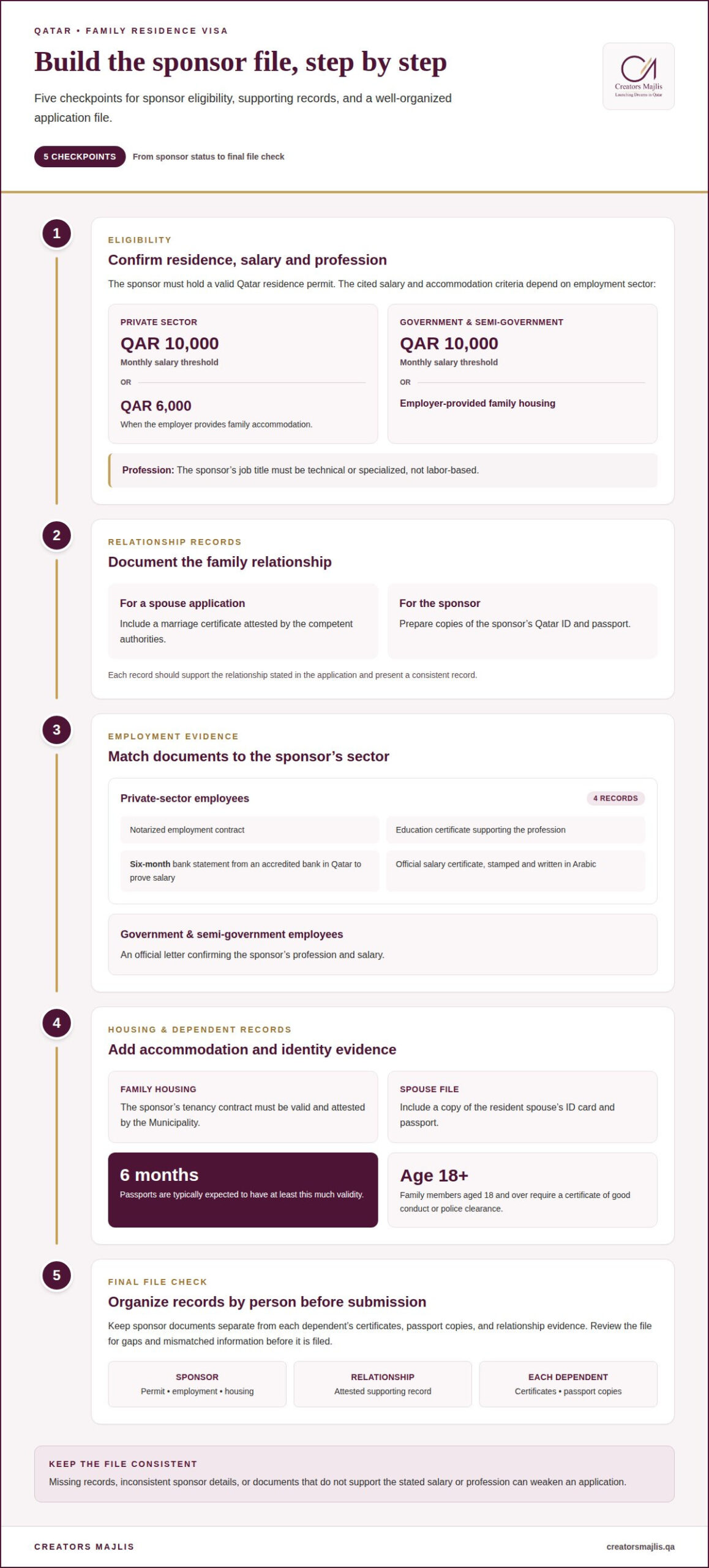
- Confirm the sponsor’s residence and employment position first. A Qatar resident must hold a valid residence permit. The commonly cited monthly salary threshold is QAR 10,000, or QAR 6,000 for private-sector employees whose employer provides family housing. Government and semi-government employees need QAR 10,000 or employer-provided family housing. The sponsor’s job title must be technical or specialized, not labor-based.
- Gather documents that establish the family relationship. A spouse’s application requires a marriage certificate attested by the competent authorities. The sponsor should also prepare copies of their Qatar ID and passport. Each document should support the relationship stated in the application and present a consistent record.
- Match employment evidence to the sponsor’s sector. Private-sector employees need a notarized employment contract and an education certificate supporting their profession. Include a six-month bank statement from an accredited bank in Qatar to prove salary. The salary certificate should be official, stamped, and written in Arabic. Government and semi-government employees need an official letter confirming their profession and salary.
- Include evidence of family housing and each dependent’s identity. The sponsor’s tenancy contract must be valid and attested by the Municipality. A spouse’s file also includes a copy of the resident spouse’s ID card and passport. Passports are typically expected to have at least six months of validity. Family members aged 18 and over require a certificate of good conduct or police clearance.
- Organize the records by person before submission. Keep sponsor documents separate from each dependent’s certificates, passport copies, and relationship evidence. This makes missing or mismatched information easier to identify before the application is filed. If your sponsorship plans depend on establishing a company in Qatar, discuss your business setup options.
What’s the Difference Between a Qatar Residence Visa and Visit Visa for Family?
A family residence visa allows an eligible expatriate resident to bring immediate family members to live in Qatar. Current requirements include a valid residence permit, qualifying salary and accommodation conditions, suitable profession, and supporting documents.
- Choose the visa according to how your family will stay. A residence visa is for eligible immediate family members living in Qatar with the sponsor. A family visit visa is temporary: it is initially issued for one month, with extensions of up to five additional months for first-degree relatives.
- Assess whether the sponsor’s employment meets residence criteria. A commonly cited salary threshold is QAR 10,000 per month, or QAR 6,000 when a private-sector employer provides family housing. The sponsor must hold a valid residence permit, and the profession must be technical or specialized rather than labor-based.
- Match housing evidence to the sponsor’s employment arrangement. Salary and accommodation provisions in the employee’s e-contract are relevant to family entry for residence or visits. A tenancy contract can support proof of family housing. Government and semi-government employees need an official letter confirming their profession and salary.
- Identify which relatives fit each route. Residence sponsorship commonly covers a spouse and children, and each family member, including infants, needs an individual residence permit. Sons sponsored for residence are generally subject to an upper age limit of 25 years. Visit applicants must be direct relatives, such as parents, siblings, children, or in-laws, subject to Ministry of Interior approval.
- Keep visit and residence age rules separate. Qatar has no age restrictions for dependents applying for family visit visas, while the residence age limit for sons is generally 25 years. Prepare relationship certificates and sponsor records for the chosen route, since visit eligibility does not itself establish residence eligibility.
Health insurance for family members
- Arrange health insurance for each family member before arrival. It is prudent to arrange health insurance for family members before travel and maintain coverage during their stay. Plan the start date carefully: coverage should begin no later than entry, not after the family has settled in. This requirement applies to children as well as adult dependents.
- Keep a separate record for each insured family member. Note each person’s name and intended entry date, and store their insurance documents with their identity and visa records. For example, keep separate records for a child and a parent. This helps prevent one dependent’s details from being confused with another’s.
- Coordinate insurance timing with the residence application and travel plan. Coverage for a residence visa holder must continue throughout the stay, so avoid a gap between entry and the start of insurance. Keep the relevant policy documents with each dependent’s records and make the policy period easy to check against the planned stay.
- Keep residence and visit visa insurance rules distinct. Family visit visa applicants need health insurance for the entire visit, and proof of coverage forms part of the visit application. For residence, coverage starts on the family member’s entry date and continues throughout their stay. A visit policy should not be treated as a substitute for arranging residence coverage.
- Make insurance part of the family’s relocation plan, not an afterthought. Confirm that every dependent, including children, has a record and that coverage dates match the expected entry period. Keep copies accessible with the family’s permit documents during the move. For support arranging health insurance alongside your relocation, contact Creators Majlis about family coverage.
Creators Majlis: Business Set Up in Qatar
If sponsoring family is part of a wider move to establish or grow a business in Qatar, Creators Majlis can help with the business side of your plans. Its Business Set Up in Qatar and Company Formation services support founders with business setup, while PRO Services cover government-related procedures. Investors can also explore an Investor Visa as part of their plans.
Turn to Creators Majlis for business setup guidance alongside your family’s relocation planning. The right support depends on your goals, business structure, and residency pathway, so consider these priorities together as you plan.
Contact Creators Majlis to discuss your next steps.
Move Forward With a Clear Family Plan
Bringing your family to Qatar is a meaningful step, and the next move is to turn the information into a plan that fits your circumstances. Use the family residence visa requirements in Qatar as a framework for coordinating your family’s relocation with your work, housing, and longer-term goals.
If you are considering how sponsorship fits with a business move or residency plans, work out the sequence before committing to travel arrangements. A clear plan keeps family priorities connected to the practical decisions ahead, rather than treating each decision in isolation.
Contact Creators Majlis for help to discuss the next step for your Qatar plans. With a focused approach, you can move ahead with greater clarity and build a strong foundation for your family’s life in Qatar.
Frequently Asked Questions
Can You Reapply If Rejected?
You can prepare a new submission after addressing the reason for rejection, rather than resending the same file unchanged. Review the decision notice and identify whether the issue concerns eligibility, missing evidence, or inconsistent details. Update the relevant documents and application information before using an available Ministry of Interior submission channel. Keep the rejection notice with your records so the next submission addresses the stated issue.
What Happens After Your Family Arrives in Qatar?
After arrival, family members may need to complete further steps as part of the residence-permit process. The medical examination must be completed within 30 days of entry. For example, a child and a parent each follow the post-arrival process individually. Children aged 6 to 18 are expected to meet the schooling condition when a residence permit is issued or renewed.
What Is the Minimum Salary Required?
The key family residence visa requirements in Qatar include a commonly cited monthly salary threshold of QAR 10,000, or QAR 6,000 for a private-sector sponsor whose employer provides family accommodation. Government and semi-government employees need QAR 10,000 or employer-provided family housing. Salary alone isn’t the only factor: profession, employment records, and accommodation evidence also affect eligibility.
What Is the Minimum Salary Required to Sponsor Family in Qatar?
For the family residence visa requirements in Qatar, the commonly cited private-sector threshold is QAR 10,000 per month, or QAR 6,000 when the employer provides family housing. Government and semi-government employees need QAR 10,000 or employer-provided family accommodation. These thresholds concern a residence visa, not a family visit visa. Salary and housing provisions in the employee’s e-contract are relevant to family entry applications.
Which Family Members Can Be Sponsored for a Qatar Residence Visa?
Eligible expatriate residents can generally sponsor immediate family members, including a spouse and children, subject to the applicable conditions. Each sponsored family member, even an infant, needs an individual residence permit. Sons are generally subject to an upper age limit of 25 years. Adult dependents aged 18 and over also require a certificate of good conduct or police clearance for the application.
What Documents Are Required for a Qatar Family Residence Visa Application?
Prepare the sponsor’s Qatar ID and passport copies, employment evidence, proof of housing, and relationship documents. A spouse’s file requires an attested marriage certificate and a statement from the spouse’s employer confirming profession. The employer’s no-objection certificate should state salary for the last 3 months and profession in Arabic. Applicants also need two passport-size photos with a blue background for fingerprint registration.
Planning your own setup? Our company formation in Qatar service covers the route choice, licensing and the bank account in one process.