

Stopping operations doesn’t close a company in Qatar. Closing a company in Qatar involves two stages: liquidation, followed by closure of the main Commercial Registration. The route depends on whether the company is solvent and closing voluntarily, facing legal or financial pressure, or needs a different deregistration process because it is a branch or commercial permit.
It’s easy to assume every company closure follows the same administrative process. In Qatar, the steps depend on the company’s legal structure and outstanding obligations. This guide explains voluntary and compulsory liquidation, the matters to resolve for employees, creditors and tax, and how closing a company differs from cancelling a branch registration or commercial permit. It also explains why stopping business activity or letting a licence expire does not formally close a company, and what is involved in its final removal from the register.
Key Takeaways
- Identify whether voluntary liquidation, court-supervised liquidation, or an administrative cancellation route fits the company’s circumstances.
- Plan the liquidation in stages: appoint a liquidator, address liabilities, and complete the steps needed to remove the main Commercial Registration.
- Include employee entitlements, creditor claims, supplier payments, tax matters, and relevant permits in the closure plan.
- Distinguish company dissolution from cancelling a branch registration or commercial permit, since each requires a different closure process.
What is Company Closure in Qatar?
Closing a company involves liquidation, followed by removal from the Commercial Register. The process depends on the company’s circumstances, legal structure and outstanding obligations.
-
Choose a liquidation route
First, determine whether voluntary or compulsory liquidation applies. Shareholders may choose voluntary liquidation when the business has fulfilled its purpose, is unprofitable, or no longer has profitable activity. A court may order compulsory liquidation when legal or financial problems prevent the company from meeting its obligations.
Insolvency is not a routine voluntary closure. A company unable to pay its debts may face different rules, so consider legal disputes, creditor claims and the company’s ability to meet its liabilities when identifying the route. Liquidation involves winding up the company’s affairs, addressing its assets and debts, and ultimately dissolving it.
-
Submit a liquidation request
Prepare the initial liquidation documents before submitting a request to the Ministry of Commerce and Industry (MOCI). The request starts the authority’s process, but does not by itself complete the closure or remove the company from the register.
Keep the Commercial Registration active during liquidation and ensure the company’s Articles of Association remain valid. Once the dissolution decision is registered with MOCI, the company may operate only for liquidation purposes. It must continue winding up its affairs rather than carrying on ordinary business.
-
Approve dissolution and appoint a liquidator
Have the shareholders formally approve the liquidation and appoint a liquidator by resolution. The resolution typically names the liquidator and sets the limits of their authority, enabling them to manage the winding-up process.
As liquidation progresses, the liquidator deals with company assets and liabilities. Shareholders also approve the liquidation outcome and confirm that amounts owed to them have been settled. Dissolution is the final stage of liquidation, not a substitute for appointing a liquidator or resolving outstanding obligations.
-
Review closure fees and costs
Identify the costs that apply to the company’s closure. What are the fees and costs to close a company in Qatar? The total depends on the company type, government fees, liquidator charges and outstanding obligations.
Consider creditor claims, employee entitlements and tax matters involving the tax authority. These affect the work required to complete liquidation and deregistration. Cancelling the main registration alone does not complete the process: liquidation and final removal are separate stages.
Voluntary, compulsory and administrative closure routes
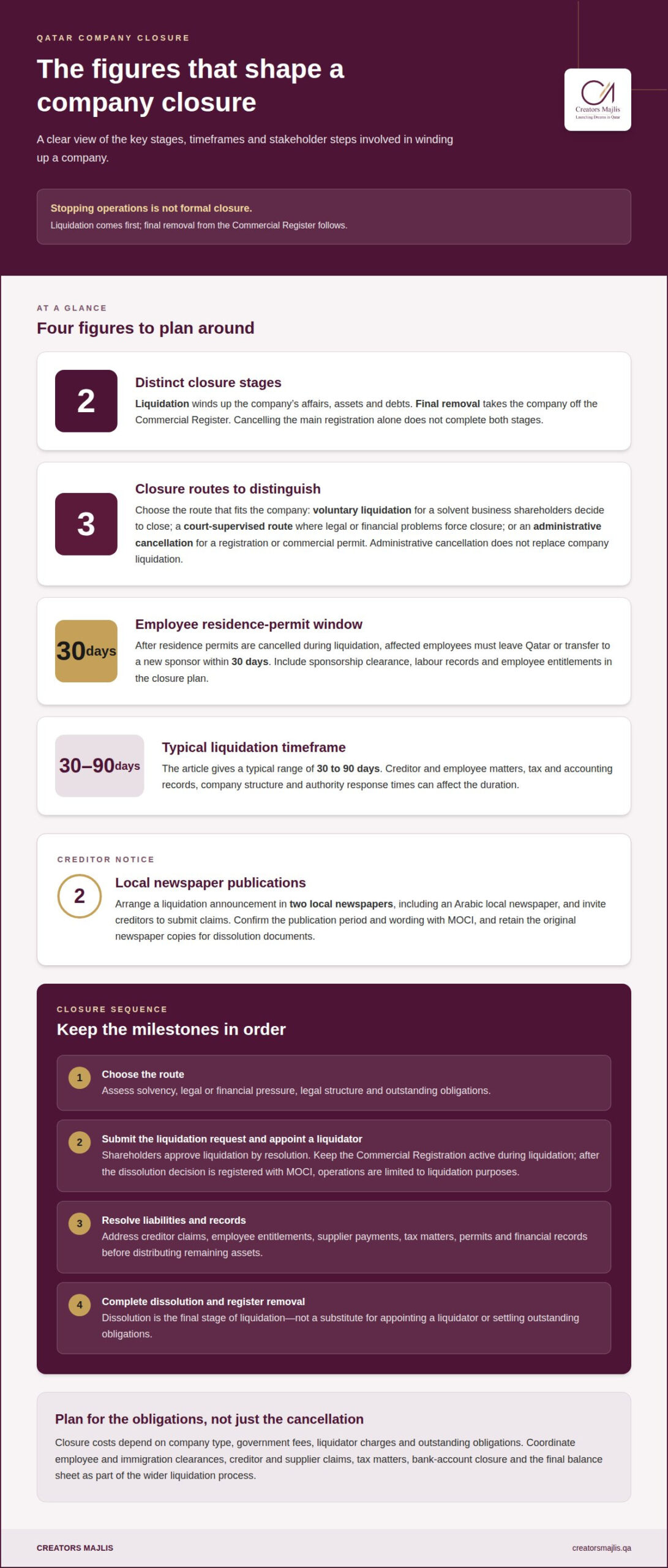
Choose the route that matches the company’s legal structure and circumstances. Simply stopping operations does not formally close a company in Qatar.
-
Select a closure route
Voluntary liquidation is used when shareholders decide to close a solvent business. A court-supervised route may apply when legal or financial problems force closure. Cancelling a Commercial Registration or commercial permit is an administrative action, but it does not replace liquidation of the company. A company is not officially closed just because it has stopped trading or let its licence expire.
-
Close employee visas and the establishment card
Arrange employee sponsorship clearance and address residence permits, the establishment card, and labour records before the final closure application. Employees whose residence permits are cancelled during liquidation must leave Qatar or transfer to a new sponsor within 30 days. Include pending employee entitlements in the closure plan; immigration clearance is part of the company’s wider deregistration process.
-
Close the business bank account
Coordinate closing the bank account with the liquidation accounts and final balance sheet. A legally appointed auditor prepares the balance sheet for submission to the Tax Authority at the Ministry of Finance. Keep the sequence clear: financial records must support the final tax and closure steps, while outstanding liabilities remain part of the liquidation.
-
Estimate the closure timeline
Allow for the full liquidation process, not only an administrative cancellation. Company liquidation in Qatar typically takes 30 to 90 days. Creditors, employees, tax and accounting records, company structure, and authority response times can affect the duration. Build those dependencies into the plan rather than treating the Commercial Registration cancellation as the only milestone.
To coordinate the closure steps with wider Qatar business requirements, discuss your company closure needs.
Creditor, staff and supplier obligations
Resolve stakeholder claims during liquidation before distributing any remaining assets. Keep creditor, employee, supplier and tax records together to support an orderly closure.
-
Announce the closure to creditors
Arrange a liquidation announcement in two local newspapers, including an Arabic local newspaper, and invite creditors to come forward. This gives creditors an opportunity to submit claims during the process. Confirm the applicable publication period and wording with the Ministry of Commerce and Industry (MOCI). Retain the original newspaper copies and any other required copies, as they may be needed for the dissolution documents.
-
Negotiate with creditors
Have the liquidator identify each creditor, record the amount claimed and discuss possible settlements where appropriate. Keep written records of proposals, responses and agreed terms; negotiations alone do not settle a debt. Compare claims with company records and available assets before deciding how to proceed. A clear schedule of creditors helps the liquidator address claims before distributing assets to shareholders.
-
Settle assets and creditor claims
Prepare an inventory of the company’s assets and liabilities, then determine which assets can be sold or otherwise liquidated. The liquidator generally pays creditors from company assets before distributing any remaining funds to owners. Keep evidence of asset transactions and payments. Selling an asset does not end the liquidation: creditor claims and outstanding obligations still need to be addressed.
-
Address staff and supplier obligations
List employee salaries, end-of-service benefits, supplier invoices and ongoing contracts for settlement. Employees under the company’s sponsorship must receive pending salaries and end-of-service benefits during liquidation. Resolve supplier payments and decide how to handle active contracts. Keep payment and termination records with the closure documents, alongside tax filings and any tax clearance required for final deregistration.
Closing a company, branch registration or commercial permit
Identify whether you are closing the legal entity, deleting a branch registration or cancelling a commercial permit. Which documents are required to close a company in Qatar? Common documents include the Commercial Registration, shareholder resolution, liquidator appointment papers, tax clearance, and relevant employee and bank clearances.
-
Identify what is being closed
Match the application to the record you intend to cancel. Closing a company involves liquidation and dissolution; deleting a branch Commercial Registration concerns that branch record. Cancelling a commercial permit is a separate administrative action and does not prove that the legal entity has been dissolved.
Check the company’s legal structure before choosing the authority and procedure. Qatar Financial Centre and free zone entities follow their respective authorities’ deregistration requirements, rather than relying on the Ministry of Commerce and Industry alone. If shareholders disagree about voluntary closure, a court process may be needed. An expired licence or inactive registration does not constitute formal company closure.
-
Prepare the required closure documents
Organize company records around the application and liquidation outcome. Common documents include a valid Commercial Registration, the registration form marked with the cancellation request, and the original and a copy of the Trade Licence and Establishment Card. Prepare the shareholders’ dissolution resolution, the liquidator’s appointment and acceptance documents, owner identification and financial statements.
Also gather the liquidator’s responsibility letter, final audit, Tax Authority no-objection certificate where required, employee clearance papers, bank account closure confirmation, company stamp and relevant licences. Dissolution papers may include the originals and copies of the two newspapers carrying the liquidation announcement. MOCI determines which documents its removal procedure requires, so organize the file to reflect the company’s route and outstanding liabilities.
Creators Majlis can help you align your closure steps with the company’s structure.
Creators Majlis: Business Set Up in Qatar
Creators Majlis can support your next business step after you understand the closure route and outstanding requirements. If you’re transitioning to a new venture, its Business Set Up in Qatar and Company Formation services can help you plan the foundations for operating in Qatar. PRO Services can support related administrative needs as you move forward. This is a natural next step when your priority shifts from winding down one entity to preparing another business, rather than a substitute for liquidation, settling liabilities, or completing deregistration with the relevant authority. Share your plans and where you are in the transition to identify which business setup support fits your next move. Contact Creators Majlis to discuss your next step.
Make your next business move with clarity
Closing one chapter can create space to reassess what comes next. Review your business priorities rather than carrying an old structure into a new plan by default. A considered approach to closing a company in Qatar helps clarify the commitments you are leaving behind and the direction you want to take.
If you’re preparing a new venture or reshaping your business plans, Creators Majlis provides Company Formation, PRO Services and Business Set Up in Qatar. These services can support your next business steps, with practical guidance on establishing operations.
Share what you’re planning next and discuss your next step with Creators Majlis. A thoughtful transition can become a strong foundation for what comes after.
Frequently Asked Questions
What does it mean to liquidate a company?
Liquidation means winding up a company’s affairs before it is dissolved. The liquidator identifies assets and liabilities, addresses creditor claims and distributes any remaining assets through the applicable process. For example, an operating company may need to account for unpaid invoices and business property before its legal existence ends. Liquidation is the winding-up process; dissolution is its final stage.
What is the liquidation process in Qatar?
In Qatar, the process depends on the company’s circumstances and legal platform. A typical voluntary case starts with a shareholder decision and appointment of a liquidator, then proceeds through settling liabilities, tax matters and other clearances. The liquidation request goes to the Ministry of Commerce and Industry, followed by the steps to remove the Commercial Registration. A court-supervised case or a QFC entity follows a different route.
Do I need tax clearance before the company is removed?
Yes, tax clearance is part of company deregistration in Qatar. The company must address pending tax filings and any tax due, then obtain the relevant clearance from the General Tax Authority. A no-objection certificate is used in the liquidation process before dissolution proceeds. Keep the final tax documents with the closure file so the deregistration application reflects the company’s tax position.
Do all shareholders have to agree?
Voluntary closure requires a formal shareholder decision, but the applicable approval depends on the company’s governing documents and structure. If shareholders disagree and cannot approve the voluntary decision, a court process may be needed. For example, an unresolved dispute about whether to close can prevent a straightforward voluntary route. The resolution should clearly record the decision and appointment of the liquidator.
How does voluntary liquidation work, step by step?
Shareholders first approve dissolution and appoint a liquidator, usually defining that person’s powers in the resolution. The liquidator then winds up the company’s affairs, including addressing debts, tax matters and assets. The company submits its liquidation request to the Ministry of Commerce and Industry and completes the required removal steps. After the decision is registered, its activity is limited to liquidation.
How is closing a free zone or QFC company different?
A free zone or Qatar Financial Centre company follows its platform’s deregistration requirements, rather than relying on the Ministry of Commerce and Industry alone. QFC entities have a winding-up route under QFC insolvency rules. The applicable authority and procedure therefore depend on where the entity was established. Identify the company’s platform first, because the mainland closure process may not fit its legal structure.