

A commercial lease in Qatar is more than a rent agreement: the premises must suit your business activity, and the contract shapes your costs and obligations. This guide to commercial lease agreements in Qatar explains what to consider when leasing offices, retail units and industrial premises before you sign.
Choosing a location is only part of the decision. Clarify rent and payment terms, maintenance, permitted alterations, renewal and early exit. Registration matters too, so understand who handles it and what fees may apply as you plan your business setup.
This guide covers practical lease clauses, Qatar’s legal framework and registration requirements, as well as costs beyond rent. Use it to assess whether a property and its contract fit your plans before making a commitment.
Key Takeaways
- Match the premises to your business activity and day-to-day needs, then weigh lease duration and renewal terms before committing.
- Clarify rent, payment timing, maintenance, alterations, permitted use and early-exit conditions in the written contract.
- Understand who is responsible for registering the lease, what fees may apply and how registration affects your business setup.
- Learn how Qatar’s leasing law shapes landlord and tenant obligations, and where Business Set Up in Qatar support can fit into your plans.
What types of commercial spaces can I lease in Qatar?
Qatar’s commercial real estate market includes offices, retail premises and industrial spaces. The right rental depends on your activity, layout and customer or delivery needs. Under Article 2, Law No. (4) of 2008 applies to residential, commercial and industrial premises. Before leasing, make sure the intended use matches the activity stated in the contract.
Commercial lease terms commonly range from 1 to 5 years, with renewal options shaped by the agreement. Some leases last 1 or 2 years, while another stated rule describes three years as the maximum standard tenancy period. Because these term descriptions differ, define the start date, expiry date and renewal mechanism clearly in writing. The contract should also state how and when either party must give notice.
How are commercial lease terms, rent increases, and renewals regulated in Qatar? Article 10 provides that landlords cannot raise rent unilaterally during a lease term unless the agreement allows it. Under Article 27, the Council of Ministers determines the rules, terms and rates for rent increases. The contract’s escalation clause therefore matters: market agreements may include annual increases of 5-10%, while stated permitted increases vary from 5% to 20% by rent band.
Renewal is a negotiation, not an assumption. Review the renewal clause and proposed rent increase before expiry; some terms allow increases of 20% or more at renewal. Begin discussions 2 months before the lease expires, so there is time to agree on rent, duration and any revised conditions. If the contract requires written notice, follow its stated method and deadline.
Expiry also affects possession. In case number 258 of 2016, Qatar’s Court of Cassation stated that tenancy normally ends when its term expires, after which the tenant must return the premises in its original condition. For very short leases of up to three months, statutory notice may be around 15 days if the contract says nothing about early termination. Set out early-exit terms explicitly to reduce uncertainty.
Commercial lease contract and legal considerations
A written contract records the tenancy terms and each party’s obligations. This guide to commercial lease agreements in Qatar explains why registration and precise clauses matter from signing through the end of the lease.
Required Details in Written Contracts
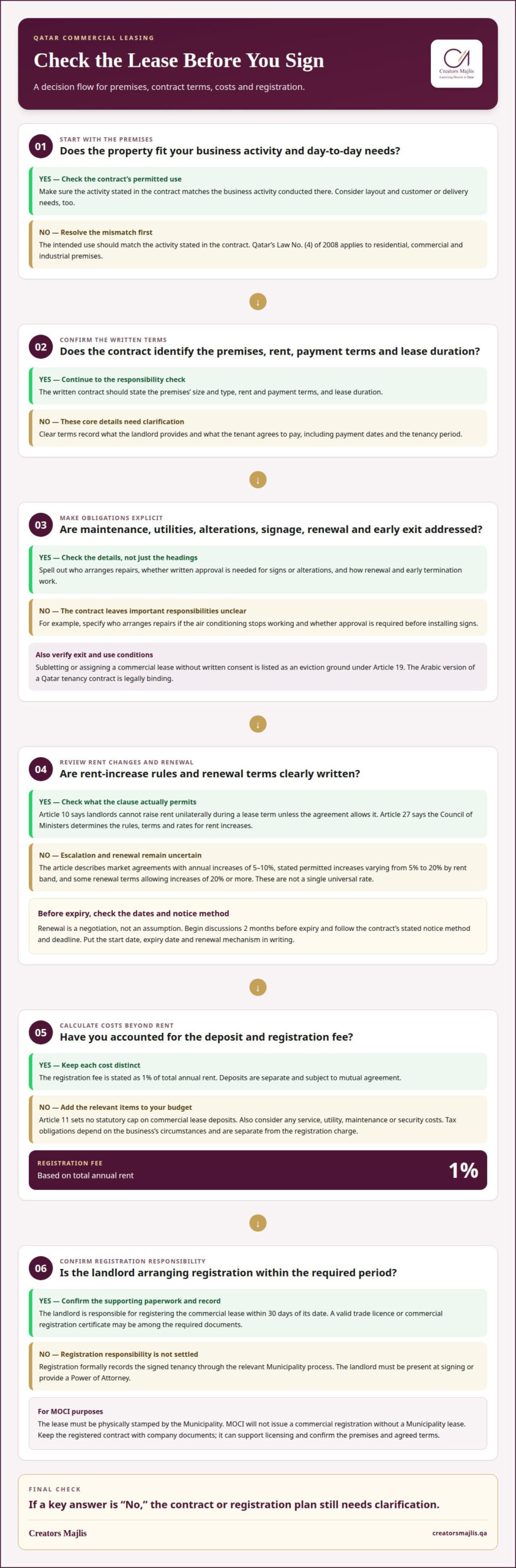
A commercial lease should identify the premises’ size and type, rent and payment terms, and lease duration. These details establish what the landlord provides and what the tenant agrees to pay. Specify the permitted business use so the tenancy record matches the activity conducted there. Clear terms can help resolve disputes about responsibilities or payment dates.
Define maintenance duties, utility payments, alterations, signage, renewal and early termination. For example, state who arranges repairs if the air conditioning stops working and whether written approval is needed before installing signs. A resident tenant or authorized signatory may need a valid Qatar ID; a foreign national may provide a passport.
Lease Registration and Contract Records
Registration formally records the signed tenancy contract through the relevant Municipality process. Landlords must register commercial lease contracts within 30 days of the contract date. How do landlords register commercial lease agreements in Qatar, and what documents are required? The landlord submits the lease for registration, with a valid trade licence or commercial registration certificate among the documents that may be required.
The landlord must be present when the commercial lease is signed or provide a Power of Attorney. For MOCI purposes, the lease must also be physically stamped by the Municipality. Keep the registered contract with your company documents: it can support licensing and confirm the premises and agreed terms. Include the registration fee in your budget alongside rent and other tenancy costs.
Essential Terms and Clause Fairness
Essential terms define payment, use, maintenance, changes to the premises and exit rights. In a guide to commercial lease agreements in Qatar, these clauses deserve attention alongside the rent amount. Commercial lease deposits are subject to mutual agreement, with no statutory cap under Article (11). That makes the deposit amount and return conditions important negotiation points.
Some leases impose penalties or eviction consequences after one week of late payment. Article 19 also lists subletting or assigning a commercial lease without written consent as an eviction ground. The Arabic version of a Qatar tenancy contract is legally binding, so ensure its terms reflect the agreement. For support connecting premises and licensing considerations, explore business setup guidance.
Lease registration responsibility, fee and penalties
Registration connects a signed commercial lease to the property’s administrative record. In Qatar, the landlord is responsible for registering the contract within 30 days of its date. The Ministry of Municipality process also matters for commercial licensing: a Municipality-stamped lease is required for Ministry of Commerce and Industry (MOCI) purposes. Treat registration as part of the lease lifecycle, not an optional filing after signing.
The registration fee is stated as 1% of total annual rent. Commercial deposits are separate: Article (11) says they are subject to mutual agreement and have no statutory cap. What fees, deposits, and taxes apply to commercial leases in Qatar? Budget for the registration charge and negotiated deposit, alongside rent and any service, utility, maintenance or security costs. Tax obligations depend on the business’s circumstances and are separate from the lease registration charge.
Registration also connects the premises to company licensing. MOCI will not issue a commercial registration without a Municipality lease, and businesses may need to present a valid trade licence or commercial registration certificate when renting commercial space. The lease should match the intended business activity and premises. If you are incorporating a company, this sequence can affect when the lease and licensing documents are ready to support operations.
Missing registration can create consequences beyond administrative delay. Law No. 8 of 2026 sets a registration fee per unit and a maximum penalty for failing to register; it also provides a route for landlords to settle an unregistered lease penalty alongside the fee. Because charges and penalties affect the cost of the lease term, include registration in the signing budget and retain the stamped contract with company records. Discuss lease-related business setup when coordinating premises and company registration.
Qatar’s commercial lease legal framework
Qatar’s lease framework sets rules for commercial premises, landlord duties and tenant conduct. Understanding how those rules interact with the written contract helps clarify each party’s responsibilities.
What are the tenant’s and landlord’s rights and obligations under Qatar commercial tenancy law? Landlords are generally responsible for major maintenance and structural repairs, while tenants must pay rent and use the premises for the agreed purpose. Article 19 identifies misuse of leased premises as an eviction ground.
How are commercial lease disputes resolved in Qatar? The Lease Disputes Settlement Committee handles disputes under Article 21. A decision may be appealed to the Court of Appeal within 15 days of issuance.
Tenant and Landlord Rights and Obligations
Rights and obligations arise from Qatar’s leasing law and the specific tenancy contract, making the contract’s permitted use and repair clauses important. Law No. (4) of 2008 applies to residential, commercial and industrial premises under Article 2. For a commercial tenant, using a space for a purpose other than the agreed activity can lead to eviction. Landlords generally handle major maintenance and structural repairs, while tenants must meet rent obligations.
Rent timing also carries consequences: failure to pay within seven (7) days of its due date is listed as an eviction ground. Specified demolition or major renovation grounds require at least six months’ advance notice, starting when required permits are issued. These rules make payment dates, use clauses and written notices practical safeguards during the lease term.
Commercial Lease Dispute Resolution
The Lease Disputes Settlement Committee is the designated forum for disputes under the property leasing law. It provides landlords and tenants with a specific route for disagreements about obligations, use or lease termination. Keep the signed contract and relevant notices together: they document the agreed terms and communications involved.
A committee decision can be appealed to the Court of Appeal within 15 days of issuance. That deadline makes prompt attention to the decision essential. The Civil Code, Law No. 22 of 2004, supplies supplementary rules where Law No. 4 of 2008 is silent. For business setup support that takes premises and licensing into account, discuss your Qatar business setup.
Creators Majlis: Business Set Up in Qatar
Creators Majlis supports founders with Business Set Up in Qatar, Company Formation and PRO Services. This support is relevant when aligning a premises decision with company incorporation and administrative setup. The lease, intended activity and business registration need to fit together, so consider these elements as part of one plan.
If you’re establishing a company or moving an existing business to Qatar, Business Set Up support can help progress the setup alongside your premises plans. It is a practical next step when registration and licensing requirements affect the sequence of your plans.
Contact Creators Majlis to discuss your business setup in Qatar.
Plan Your Next Move With Clarity
A commercial premises decision can shape how your business enters Qatar and grows from its first operating base. Use this guide to commercial lease agreements in Qatar to align your property plans with your wider business objectives. Before moving forward, make sure the premises, intended activity and company setup form a coherent plan rather than separate decisions made in isolation.
Turn the agreed direction into practical next steps. Organize the lease and business documents, identify outstanding decisions, and map the steps from planning toward operations. A clear plan keeps responsibilities visible and helps maintain momentum as your business takes shape.
Creators Majlis can support the business setup journey as you prepare to establish or grow your presence in Qatar. Contact Creators Majlis to discuss your next steps and build a considered path forward.
Frequently Asked Questions
Can foreign companies lease property in Qatar?
Yes, foreign companies can lease commercial property in Qatar with proper registration and permits. The key question is whether the premises and intended activity align with the company’s licensing route. For example, a company planning to operate from an office should account for the lease when preparing its business registration documents. Assessing this fit early helps coordinate the property decision with market entry.
How Much Does Commercial Property Rent Cost in Qatar?
Commercial rent depends on factors such as location, property grade, space type and floor area. Compare premises using the rent basis in each offer, such as a rate per square metre per month, and calculate the total for the usable area. Budget separately for service charges, utilities, maintenance or security if the contract makes these tenant costs.
How do I leave a lease?
Start with the contract’s early termination clause, which may require written notice or compensation. If the contract is silent, statutory notice periods differ by lease length: one month may apply to leases up to six months, and around two months to longer leases. Agree on a handover date, settle outstanding obligations, and document the premises’ condition when returning possession.
How long are typical lease terms?
A Qatar tenancy contract commonly runs for 12 months, while commercial terms may range from 1 to 5 years depending on the agreement. A shorter term may suit a business testing a location; a longer commitment can support investment in fit-out or equipment. Treat renewal as a separate contractual right, not an automatic continuation, and note any required notice deadline.
Index-linked rent: What does this mean and how does the adjustment work?
An index-linked clause adjusts rent according to changes in a named index, rather than applying an unexplained increase. The percentage change is calculated by dividing the new index level by the old level, multiplying by 100, then subtracting 100. For example, if the index rises, the clause uses that change to determine the rent adjustment, subject to its terms.
What Are You Actually Renting?
You’re renting the premises and the specific rights granted by the contract, not necessarily every area or facility in the building. The contract and floor plan should clearly identify the leased unit. Clarify, for example, whether parking is dedicated or shared and whether storage or common areas are included. Compare the usable layout with your operating needs, not just the advertised floor area.
Planning your own setup? Our company formation in Qatar service covers the route choice, licensing and the bank account in one process.