

A QFC trust setup separates legal ownership of assets, held through a trustee, from beneficiaries’ beneficial interests. Under Article 61A of the QFC Trust Regulations, a settlor may reserve specified powers in the trust instrument, including powers to modify the trust or appoint trustees. Under Article 19, a trust may have perpetual duration unless its instrument specifies otherwise.
Free 2026 checklist: Set up a company and move to Qatar, six phases on six pages.
These distinctions shape who controls trust assets, who benefits from them and how the arrangement may change over time. This guide explains how QFC Trust Rules address ownership and beneficial interests, which powers a settlor may reserve, and what the rules say about trust duration, variation and termination. It provides a clearer basis for considering the structure and the decisions to set out in the trust instrument.
Key Takeaways
- Understand how the trust structure distinguishes the trustee’s legal ownership from beneficiaries’ interests in the assets.
- See how the trust instrument can reserve specific powers for the settlor, including changing the arrangement or appointing trustees.
- Learn what the rules provide for trust duration and the terms that shape variation or termination.
- Identify the scope of the QFC Trust Rules and the structural decisions to consider before moving forward.
Scope and purpose of the QFC Trust Rules
The Qatar Financial Centre Trust Regulations 2007 govern trust establishment, governance and administration in the QFC. Identified as QFC Reg No 12, they provide Qatar’s Common Law-based framework for trusts. A QFC trust holds and manages assets through a trustee for beneficiaries, separating legal ownership from beneficial interests. The rules don’t apply to trusts registered under the Collective Investment Funds Rulebook.
Article 18 addresses trust purposes, while Article 22 addresses purpose trusts. The framework permits discretionary, purpose and protective trusts, supporting arrangements for wealth protection and cross-generational transfer. A purpose trust is structured around its stated purpose; other trust types can direct benefits to beneficiaries. A QFC foundation is a separate structure under the QFC Foundations Regulations, with independent legal personality. An offshore trust instead has foreign governing law, so its legal framework differs from a QFC trust.
To register a trust, the trustee submits the trust instrument and supporting documents to the QFC Authority. A QFC trust must also appoint an agent for service of process located in the QFC. The instrument sets out the trust’s purposes and terms, while the registration information includes its name, a summary of its purpose, the intended beneficiary class and trustee details. Trust documents are not publicly disclosed, although the CRO register is available at its premises. An application’s duration depends on its documentation and assessment; no fixed establishment timeline is specified.
Tax treatment depends on the trust’s circumstances and applicable rules. QFC trusts have no withholding tax obligations on distributions or payments to beneficiaries or other recipients. A trust may apply for tax-exempt status if it qualifies as a Special Investment Fund and meets the applicable regulatory and operational requirements. This status is not automatic.
Registered trusts must keep accounting records at the registered office, preserve them for at least six years, and prepare annual accounts under permitted standards. Their accounts require an auditor approved under Article 85 of the QFC Companies Regulations. Trustees should consider the compliance obligations that may apply to their arrangements. Setup and ongoing costs depend on the structure, documentation, trustee and accounting requirements; fees are given after a quote request. Key limitations include potential refusal by the CRO and continuing compliance duties.
Legal ownership and beneficial interest
Under the QFC Trust Regulations, the trustee holds and manages trust assets, while beneficiaries hold beneficial interests. The trust instrument and its beneficiary provisions determine how those interests operate.
Settlor and Trustee Roles
The settlor establishes the trust and places assets into it under the terms of the trust instrument. The trustee holds legal ownership and manages the assets for the beneficiaries. These roles are distinct: contributing assets does not make the settlor their legal owner once they are held by the trustee. To register a QFC trust, the trustee submits the trust instrument and supporting documents to the QFC Authority. The trust must also appoint an agent for service of process located in the Qatar Financial Centre.
Beneficiary Eligibility and Interests
Article 27 of the QFC Trust Regulations addresses beneficiaries. The trust instrument can identify named beneficiaries or describe an intended beneficiary class, linking each interest to the arrangement’s terms. The trustee manages the assets for those beneficiaries, but their beneficial interest differs from legal ownership. A QFC foundation follows a separate framework: a founder may benefit only to the extent approved by the QFC Authority. That distinction matters when choosing between a trust and a foundation.
To establish a trust in the Qatar Financial Centre, the trustee registers it with the QFC Authority and submits the trust instrument and supporting documentation. Article 17 addresses requirements for creating a trust, while Article 16A addresses registration. The instrument should make the trust’s structure and intended beneficiary interests clear.
The rules describe assets held and managed by a trustee but do not specify particular asset classes. The trust instrument is central to identifying the assets placed in the structure and explaining how the trustee administers them for beneficiaries.
Clear role definitions can help align the trust’s purpose, asset ownership and beneficiary interests. If you’re shaping these provisions, discuss your trust structure as part of planning the arrangement.
In the Qatar Financial Centre, a trustee holds and manages trust assets for the benefit of named beneficiaries. This is the arrangement’s basic allocation of roles: the trustee manages the assets, and the named beneficiaries are those for whose benefit they are held.
Settlor rights and powers
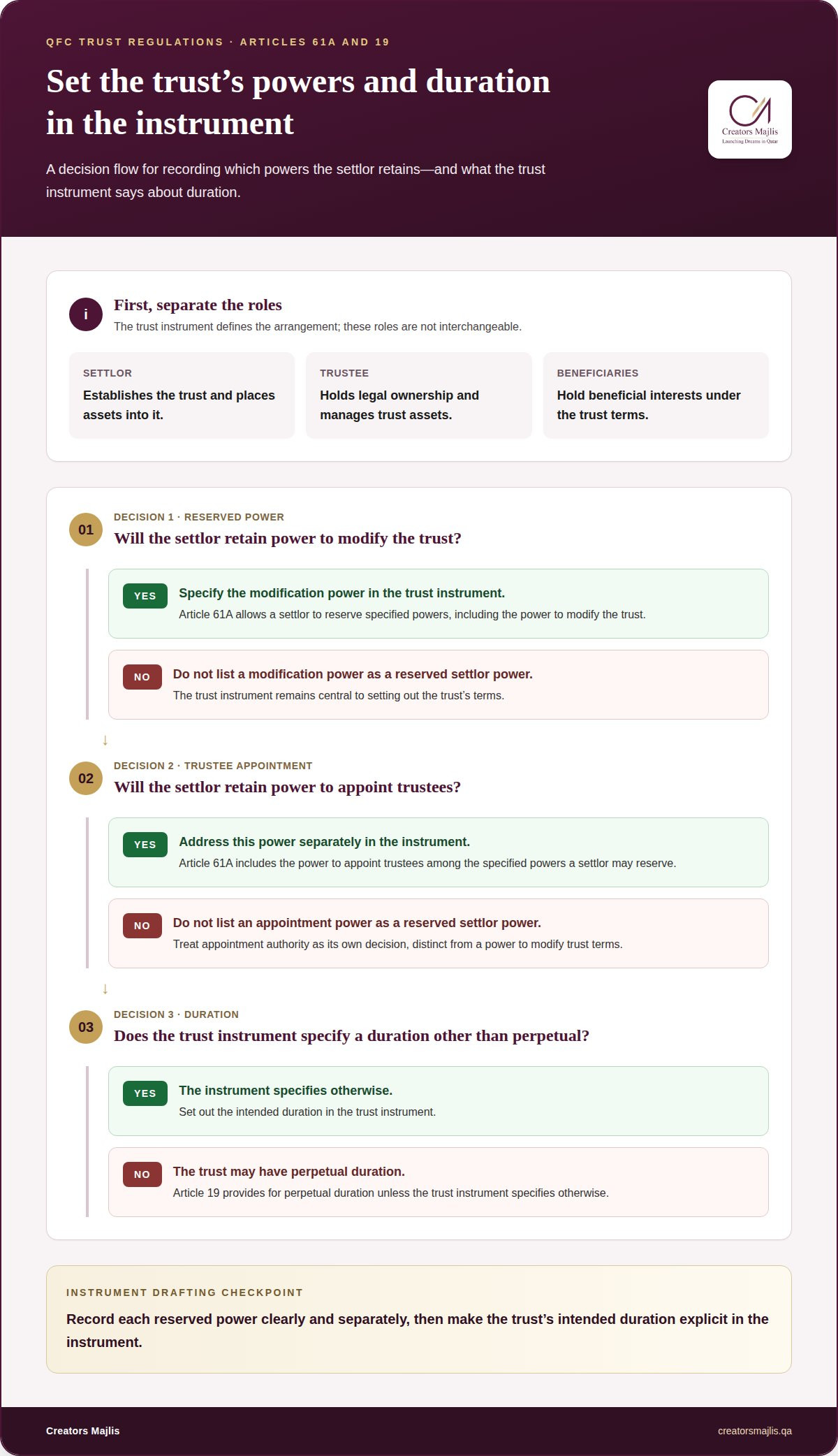
Article 61A of the QFC Trust Regulations allows a settlor to reserve specified powers in the trust instrument. These include powers to modify the trust or appoint trustees. The instrument is therefore central to defining which decisions the settlor retains after establishing the arrangement. A settlor’s reserved powers should be distinguished clearly from the trustee’s role in holding and managing trust assets.
Start by identifying the decisions that matter to your trust’s purpose. If you want to retain the ability to modify the arrangement, state that power in the instrument. If you want authority to appoint trustees, address that separately. Article 61A permits specified powers, so don’t assume a general statement preserves every decision. Clear drafting helps show which powers are reserved and how they relate to the trust’s terms.
Consider how each reserved power could affect the trust’s administration. For example, a power to appoint trustees gives the settlor a defined role in trustee changes, while a power to modify the trust concerns its terms. Treat these as separate decisions when planning the instrument, and consider how each interacts with the trustee’s responsibilities. The aim is to clarify the settlor’s role without confusing it with legal ownership of trust assets.
Keep trust powers distinct from regulatory approval. The QFC Regulatory Authority assesses applicants for regulated activities by considering the business model, governance arrangements, capital position and risk framework. This assessment concerns regulated activities, not the settlor’s reserved powers under Article 61A. Where a proposed structure involves regulated activity, understand that regulatory assessment as a separate consideration from documenting settlor rights.
Before registration, map each intended power to the relevant wording in the trust instrument. Identify who may exercise it, which decision it covers and how it supports the trust’s purpose. This helps clarify the settlor’s intended position alongside the trustee’s authority and the beneficiaries’ interests. Reviewing these provisions carefully can help avoid ambiguity in the arrangement.
A QFC foundation has independent legal personality and the capacity, rights and privileges of a natural person. It is another structure to consider when planning how rights will be allocated.
Trust duration, variation and termination
Article 19 of the QFC Trust Regulations addresses trust duration. A trust established under these regulations may have perpetual duration unless its trust instrument specifies otherwise. That default makes the instrument’s duration clause an important planning decision. For example, a settlor may provide for a defined end point rather than allowing the trust to continue indefinitely.
Article 23 addresses variation and revocation. These are separate concepts to consider when preparing trust documents: variation concerns changing the arrangement, while revocation concerns withdrawing it. The regulations identify both, but the trust instrument should make the intended approach clear. Review how any variation would relate to the trust’s purposes, beneficiaries and trustee responsibilities, and ensure the wording supports the intended change.
Article 25 addresses termination. Planning for this stage means considering what the instrument says about ending the trust and how its terms relate to the assets and beneficiaries. A defined duration, a variation mechanism and termination provisions each serve a distinct function. Aligning them helps the documents set out a coherent lifecycle, rather than leaving the trustee to reconcile conflicting directions.
Use a structured review before finalising the instrument: identify whether the trust should be perpetual or time-limited; examine how variation or revocation is addressed under Article 23; then review the termination provisions under Article 25. Read each clause in accordance with the trust’s stated purpose and beneficiary arrangements. These provisions can enable the trust to respond to planned changes while keeping its long-term direction clear. They remain part of the trust’s terms, distinct from a QFC Regulatory Authority assessment of an applicant’s regulated activities.
For a QFC trust setup, decisions about duration, variation and termination belong in the wider design of the arrangement. Discuss your trust structure to develop its terms and lifecycle through Trust & Foundation Setup.
Creators Majlis: Trust & Foundation Setup
Creators Majlis supports your trust and foundation setup in Qatar, helping you move from structural decisions toward an established arrangement. Turn to this service when you’re weighing a QFC trust against a foundation, or working through how trustee roles, beneficiary interests, settlor powers and trust duration fit together.
The process brings these choices into focus, allowing the trust’s purpose and intended terms to guide its establishment. Consider how a trust fits alongside broader business plans, including Company Formation or Business Set Up in Qatar. Each option serves a different purpose, so begin with the outcome you want the structure to support.
For a considered next step, contact Creators Majlis to discuss your trust or foundation plans.
Shape the Next Stage with Confidence
A carefully planned QFC trust setup can support a broader ownership and succession strategy. Connect the trust’s intended role with your wider plans in Qatar so its structure supports the direction you want to pursue. Creators Majlis also supports related business priorities through Company Formation, PRO Services and Business Set Up in Qatar.
Bring your goals and the decisions you are weighing to a conversation with Creators Majlis. The team can help you consider trust and foundation setup alongside your broader business plans, while keeping the purpose of the structure in focus.
Contact Creators Majlis to discuss your next step and move forward with clarity.
Frequently Asked Questions
Who can act as settlor, trustee, beneficiary, and protector of a QFC trust?
The settlor establishes the trust, the trustee administers it, and beneficiaries receive benefits under its terms. The QFC Trust Regulations address beneficiaries in Article 27 and protectors in Article 61. For registration, the trust and trustee don’t have to be located in the Qatar Financial Centre, but the trust must appoint an agent for service of process located there. Define each role clearly in the trust instrument.
What types of assets can be held in a QFC trust?
The trust instrument identifies the assets placed in the trust and explains how the trustee administers them for beneficiaries. The rules described here do not specify particular asset types.
Planning your own setup? Our company formation in Qatar service covers the route choice, licensing and the bank account in one process.