

A leadership handover is only one part of business succession planning for family companies in Qatar. A strong plan also addresses ownership, governance, estate and wealth arrangements, tax considerations, and liquidity so the business can continue through a change in leadership. Family ties matter, but they should not replace clear decisions about who is ready to lead and how control will be managed.
Free 2026 checklist: Set up a company and move to Qatar, six phases on six pages.
It is natural to focus first on choosing a successor. Yet preparing the business, its owners, and the wider family for the transition is just as important. This guide explains how succession planning works for family businesses in Qatar, what to consider when developing future leaders, and how governance and contingency arrangements can support continuity. It also explores tax, estate, wealth, and liquidity considerations that may shape a transition, and how they fit together in a practical plan.
Key Takeaways
- Map leadership, ownership, and governance together so the transition supports both family priorities and business continuity.
- Build a successor’s readiness over time, with clear capability criteria, mentoring, and a plan for unexpected changes.
- Consider how inheritance, tax, wealth structures, and liquidity needs may affect the transfer of business ownership and control.
- Use family governance arrangements to clarify roles, decision-making, and conflict resolution as the business moves between generations.
What Is Succession Planning for Family Businesses?
Succession planning coordinates leadership, ownership, governance, and wealth arrangements for a family business. In Qatar, it helps clarify how decisions and responsibilities can carry on across generations.
Family Business and Wealth Management
Family business and wealth management align company operations with the family’s investments and assets. This matters because ownership, financial decisions, and leadership can affect one another during a transition. A practical plan can document who oversees operations, how investment decisions are made, and how family wealth supports continuity. For example, owners can distinguish responsibility for running the company from decisions about its assets and long-term strategy.
Family Values and Modern Management
Balancing family values with modern management means turning shared principles into clear governance and business practices. This matters when a company grows, welcomes a new generation, or faces changing market conditions. A family can document its values while setting expectations for transparent decision-making, financial reporting, and family members working in the business. Clear policies can help address perceived favoritism and differing views on reinvestment or dividends.
Professional Managers and Family Dynamics
Professional managers bring specialist expertise to specific functions while family members retain strategic oversight. This can separate operational performance from family dynamics without removing the family’s role in setting direction. Define the manager’s responsibilities, reporting line, and decision-making authority, then document how these duties fit with family governance. Clear roles can reduce misunderstandings about hiring, performance, and control, particularly when relatives have different levels of experience.
Qatar Succession Challenges and Resources
Qatari and foreign-owned businesses can face different inheritance considerations: Qatar Law No. 22 of 2006 governs familial relations involving Qatari nationals, while Islamic Sharia inheritance provisions provide an estate-distribution framework. Valuation and planning fees depend on scope, asset types, ownership complexity, and document review; a quote request establishes the cost. Risks include disputes, unclear authority, and an owner’s incapacity or death; documented governance and contingencies help address them. The QFC Single Family Office Regulations provide a framework for eligible families; a QFC single-family office requires at least $5 million in investable or liquid assets.
Succession planning and leadership transition
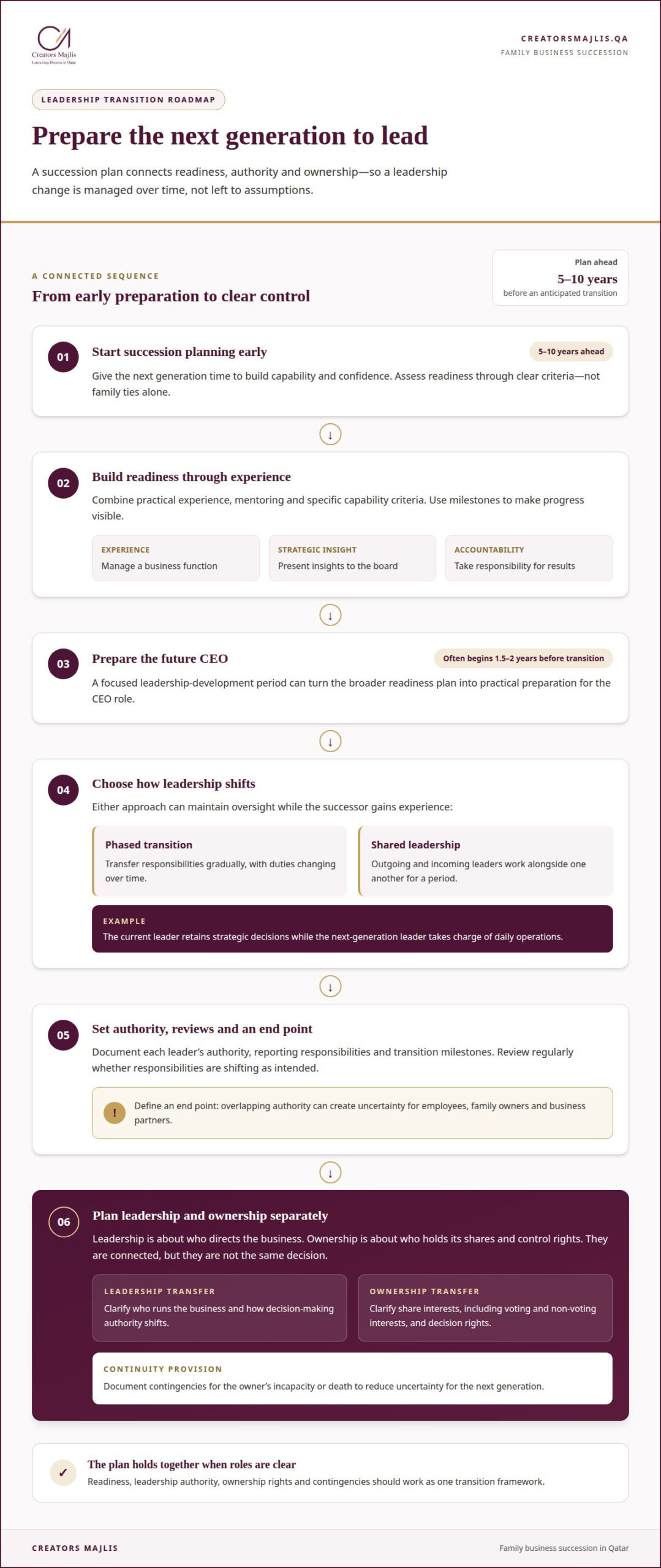
A succession plan turns a future leadership change into a managed transition. For a family business in Qatar, it should link leadership development, decision-making authority, and ownership transfer.
Leadership Development and Preparation
Leadership development prepares a successor through experience, mentoring, and clear readiness criteria. Family ties alone do not show that someone is ready to lead a growing business. Owners are advised to begin succession planning five to ten years before an anticipated transition, giving the next generation time to build capability and confidence.
Leadership development for a future CEO often begins 1.5-2 years before a transition. A plan can set milestones such as managing a business function, presenting strategic insights to the board, and taking responsibility for results. These steps help the family assess readiness through performance, not assumptions.
Phased and Dual Leadership Transitions
A phased transition transfers responsibilities gradually, while a period of shared leadership lets outgoing and incoming leaders work alongside one another. Both approaches can preserve oversight as the successor gains experience. For example, the current leader might retain strategic decisions while the next-generation leader takes charge of daily operations.
Set out each leader’s authority, reporting responsibilities, and transition milestones in the succession plan. Regular reviews can reveal whether responsibilities are shifting as intended or the arrangement needs adjustment. A defined end point also helps prevent overlapping authority from creating uncertainty for employees, family owners, or business partners.
Leadership and Ownership Transfer
Leadership transfer concerns who directs the business; ownership transfer concerns who holds its shares and control rights. Keeping these decisions distinct helps families plan for successors who may lead without owning equal shares, or owners who do not manage daily operations.
A plan can distinguish voting and non-voting ownership interests, clarify decision rights, and include contingencies for the owner’s incapacity or death. Documenting these provisions supports continuity and reduces uncertainty for the next generation. To develop a transition framework around your business structure, start a succession planning discussion.
Tax, estate, wealth, and liquidity planning
A succession strategy should connect estate arrangements with business ownership, tax planning, and available cash. Coordinating these elements helps preserve the family’s vision while preparing for a transition.
Estate and Will Planning
Estate planning sets out how personal assets and business interests should be managed and distributed. It matters because an owner’s death can affect both family wealth and the company’s ability to make decisions. Islamic Sharia inheritance provisions provide a framework for distributing an individual’s estate after death. Owners can document their assets, ownership interests, intended arrangements, and contingency plans together.
A will is one element of a broader estate strategy. Review how its provisions relate to company ownership records and family arrangements so that the documents support a coherent plan.
Inheritance and Business Ownership
Inheritance planning considers how an owner’s shares may pass to heirs and what that could mean for control. In Qatar, shares may devolve to an owner’s heirs upon death, which can affect decision-making if ownership becomes divided.
Qatar Law No. 22 of 2006 governs matters including inheritance and wills concerning Qatari national familial relations. The implications for business ownership make it important to consider heirs’ interests alongside the company’s governance and continuity. A plan can address how ownership, voting rights, and management responsibilities relate, rather than treating them as interchangeable.
Legal Requirements for Succession
Legal planning accounts for applicable inheritance provisions and the documents that govern company ownership. Qatar’s relevant framework includes Sharia inheritance provisions; Law No. 22 of 2006 covers specified familial matters for Qatari nationals. Business owners should coordinate estate documents with corporate records and ownership arrangements.
Tax and liquidity planning also shape the transition. The QFC corporate tax rate is 10%; Qatari-owned qualifying single-family offices may access a 0% concessionary QFC tax rate, subject to applicable criteria. A liquidity strategy considers whether the business and heirs can meet financial needs without disrupting operations. Map potential cash requirements against available assets, then align the approach with ownership and estate arrangements. This connects tax structures to practical continuity, rather than treating tax as a separate decision.
Family business succession planning
Effective business succession planning for family companies in Qatar connects family governance with company ownership and long-term direction. A written family constitution can establish shared values, succession rules, ownership policies, and conflict-resolution processes.
To prepare a plan, assess the business structure, ownership, key assets, and risks. Agree on how family members may work in the business, how decisions are made, and how disputes are handled. Then document successor criteria, communication arrangements, and contingency plans. This creates a practical reference for family discussions and future decisions.
Governance becomes more important as family relationships and business responsibilities grow more complex. Set clear policies for family employment, dividends, and strategic decisions. For example, assess members seeking management roles against agreed qualifications and performance criteria rather than family status alone. Regular communication can help owners discuss investment priorities and raise concerns before disagreements affect operations.
Ownership arrangements should support workable decision-making. Family charters can record expectations for involvement, decision-making authority, and conflict resolution. Where several heirs hold interests, defined governance processes help them understand their rights and obligations. Advisory input can help a family assess whether its existing legal structure supports its intended approach to managing and operating the business.
If no family member is ready to lead, owners may consider professional management, an internal buyout, a partial sale, or an external exit. These options let them weigh continuity against family priorities, investment needs, and the company’s future direction. A robust approach to business succession planning for family companies in Qatar assesses each option against the family’s objectives and the business’s ability to operate under it.
Bring family priorities and business structure into focus with a succession planning discussion.
Creators Majlis: Business Set Up in Qatar
Creators Majlis supports business owners establishing a company in Qatar as part of wider transition planning. When a family decides to create a new operating entity, Company Formation and Business Set Up in Qatar can help establish that business foundation. PRO Services can support related administrative processes.
These services are relevant when a family moves from a succession strategy to setting up a company, such as establishing a new venture for the next generation. They address business setup needs, not estate or inheritance advice. Share your plans and questions with Creators Majlis to discuss the next step.
Make the Next Chapter a Deliberate One
A family business’s future takes shape through decisions made before a transition begins. Treat business succession planning for family companies in Qatar as an ongoing governance priority, not a document to revisit only when leadership changes. Scheduled reviews can help family members keep roles, priorities, and the company’s direction aligned as circumstances evolve.
Turn the plan into practical business decisions at a pace that suits your family. If the next chapter involves setting up a company in Qatar, Creators Majlis offers Business Set Up in Qatar, Company Formation, and PRO Services to support that operational step.
Contact Creators Majlis to discuss your plans and identify a practical next move. With clear priorities and steady preparation, your family can build a stronger foundation for the business’s future.
Frequently Asked Questions
What if no family member is ready to take over the business?
The business can continue under professional management while owners consider its longer-term direction. A family can define the manager’s mandate, reporting line, and authority, then retain key ownership decisions through its governance arrangements. If a permanent transition within the family is not suitable, owners can assess an internal buyout, partial sale, or external exit against their priorities for control, continuity, and investment.
How can Qatar family companies choose and prepare the next-generation leader?
Set objective eligibility criteria before selecting a successor, then assess candidates through practical experience. One family’s criteria included working in the business for two summers, gaining two years of external work experience, and observing at least three board meetings. These examples show how families can assess commitment and judgment beyond family relationships. Pair the criteria with mentoring and progressively broader responsibilities.
What are the Qatar tax and financial implications of transferring a family business?
Tax treatment depends on the structure and applicable criteria, so include it alongside liquidity and ownership decisions. The QFC corporate tax rate is 10%, while qualifying Qatari-owned single-family offices may access a 0% concessionary QFC tax rate subject to applicable criteria. Separately, estimate the cash the business or heirs could need during a transfer, and consider how payment arrangements affect working capital and investment plans.
How can family businesses in Qatar structure ownership and governance to prevent disputes?
Separate economic ownership from decision-making authority and record each clearly. For example, voting and non-voting interests can distinguish shareholding from control, while written policies can define family employment, dividends, and how disagreements are escalated. Include minors and relatives by marriage in the ownership discussion where relevant, since their interests can affect decisions. A family constitution can provide a shared reference for these arrangements.
What Qatar-specific wills, trusts, or holding structures can support business succession?
Qatar succession planning can coordinate wills and inheritance arrangements with structures that hold family assets or company shares. A QFC Single Family Office is a private wealth management firm dedicated to one qualifying family and requires at least $5 million in investable or liquid assets. It must maintain a QFC registered office and appoint a Designated Representative ordinarily resident in Qatar. The structure’s purpose belongs in its Articles of Association.
What are the differences between succession planning for Qatari and foreign-owned companies?
Qatar Law No. 22 of 2006 governs familial matters, including inheritance and wills, concerning Qatari nationals. Qatari and foreign-owned businesses can therefore face different inheritance considerations, while Islamic Sharia inheritance provisions provide an estate-distribution framework.
Planning your own setup? Our company formation in Qatar service covers the route choice, licensing and the bank account in one process.