

The right business activity classification is the starting point for a Qatar corporate compliance checklist for 2026. Each activity is linked to specific licensing codes and may bring additional approval requirements, while commercial licences generally need annual renewal. Most companies must also submit their annual tax return within four months after the end of their financial year.
Free 2026 checklist: Set up a company and move to Qatar, six phases on six pages.
It’s easy to focus on filing dates and miss the decisions that determine which requirements apply. Preparing early helps you identify obligations linked to your company’s activities, structure and registration, and reduce the risk of administrative disruption.
This checklist explains what to prepare across licence renewals, tax returns, audits, financial records and employment compliance. It also highlights how to classify activities, identify sector-specific approvals and build a practical calendar around your company’s reporting dates, so you can approach the year with greater clarity.
Key Takeaways
- Identify whether your company’s financial position triggers an audit, and organise statements and supporting records accordingly.
- Build filing dates around your entity’s reporting calendar, including QFC requirements and any applicable sector-specific deadlines.
- Match each planned business activity to its licensing code and required approvals before operations begin.
- Distinguish VAT readiness from current registration duties: VAT has not been implemented in Qatar, so keep indirect-tax planning grounded in the rules currently in force.
Annual renewals, tax returns, audits, and employment records
Build the Qatar corporate compliance checklist for 2026 around each company’s financial year and licence expiry dates. Companies operating in Qatar generally renew commercial licences annually, including local-law and QFC companies. Most companies must file annual tax returns within four months after their financial year ends. Petroleum and petrochemical companies had a 30 April 2026 filing deadline.
Prepare annual financial statements in line with applicable accounting standards. An audit applies if company capital exceeds QAR 200,000, income exceeds QAR 500,000, or the head office is outside Qatar. Qatar entities with gross income above QAR 500,000 must submit audited statements with their tax filing. Tax-exempt companies may still need to file a simplified return documenting their exempt status.
Employers must comply with Qatar labour laws and occupational health and safety regulations. Bi-annual workplace health reporting requirements are being rolled out. For an employment-record review, organise payroll calculations, payment evidence, employee contracts and visa records together. This gives you a clear view of workforce documents without mistaking internal record-keeping for a separate filing deadline.
Use the Qatar corporate compliance checklist for 2026 to organise accounting and corporate records. Keep accounting books and supporting documents in Qatar for 10 years. Maintain incorporation documents, licences, financial records, and current registers of shareholders and directors for the periods required under applicable rules. An accounting system can link transactions to supporting documentation and annual statements.
- Gather licences, incorporation documents, ledgers, tax filings, financial statements, and supporting records.
- Match employment documentation to payroll records and relevant company information.
- Organise documents by financial year and assign responsibility for updating shareholder and director registers.
Late tax filing incurs a penalty of QAR 500 per day, capped at QAR 180,000. Late payment incurs a charge of 2% per month, or part of a month, up to the tax due. A tax-exempt company that fails to file can face QAR 10,000, while audit, bookkeeping, or record-keeping breaches can incur QAR 30,000. Late tax-card registration can incur QAR 20,000.
Annual return filing calendar and deadlines
Start with the financial year-end and the entity’s tax category. For most Qatar entities with a 31 December year-end, the 2025 tax return deadline was extended to 30 June 2026. Petroleum and petrochemical companies had to file by 30 April 2026. For other financial year-ends, annual tax returns are generally due within four months after the year closes. Record the filing date and the related tax payment date together.
Prepare the tax return alongside the financial statements, not after them. A company’s filing position in Qatar depends on its income, accounting records and applicable reporting framework. Reconcile supporting schedules with the figures in the accounts, then track submission and payment as separate calendar actions. Late payment can trigger a charge, so plan for the tax balance before the return deadline.
QFC entities follow a separate corporate filing cycle. A QFC company’s annual return must be filed within 28 days after its reporting end date and keeps information held by the CRO, including registered office, shareholders, directors, and capital structure, accurate. QFC annual returns are also filed each year on the incorporation anniversary. Put both dates in the calendar, then confirm the company’s applicable reporting end date and anniversary.
Keep ownership changes and corporate updates visible in the filing workflow. QFC companies generally must file event-driven corporate changes within 21 days of the change. Schedule financial statements for submission within 21 days of AGM approval. These dates can affect the sequence of board approvals, contract updates, and return preparation, so assign an owner to each filing task.
- Set reminders for the financial year-end, return deadline, AGM approval, and QFC anniversary.
- Match financial statements, tax calculations, ownership details, and submitted returns before filing.
- Add the first Pillar Two registration deadline, expected to be 2 November 2026, if relevant to the entity.
For help organising a filing calendar around your company’s reporting framework, discuss your compliance timeline.
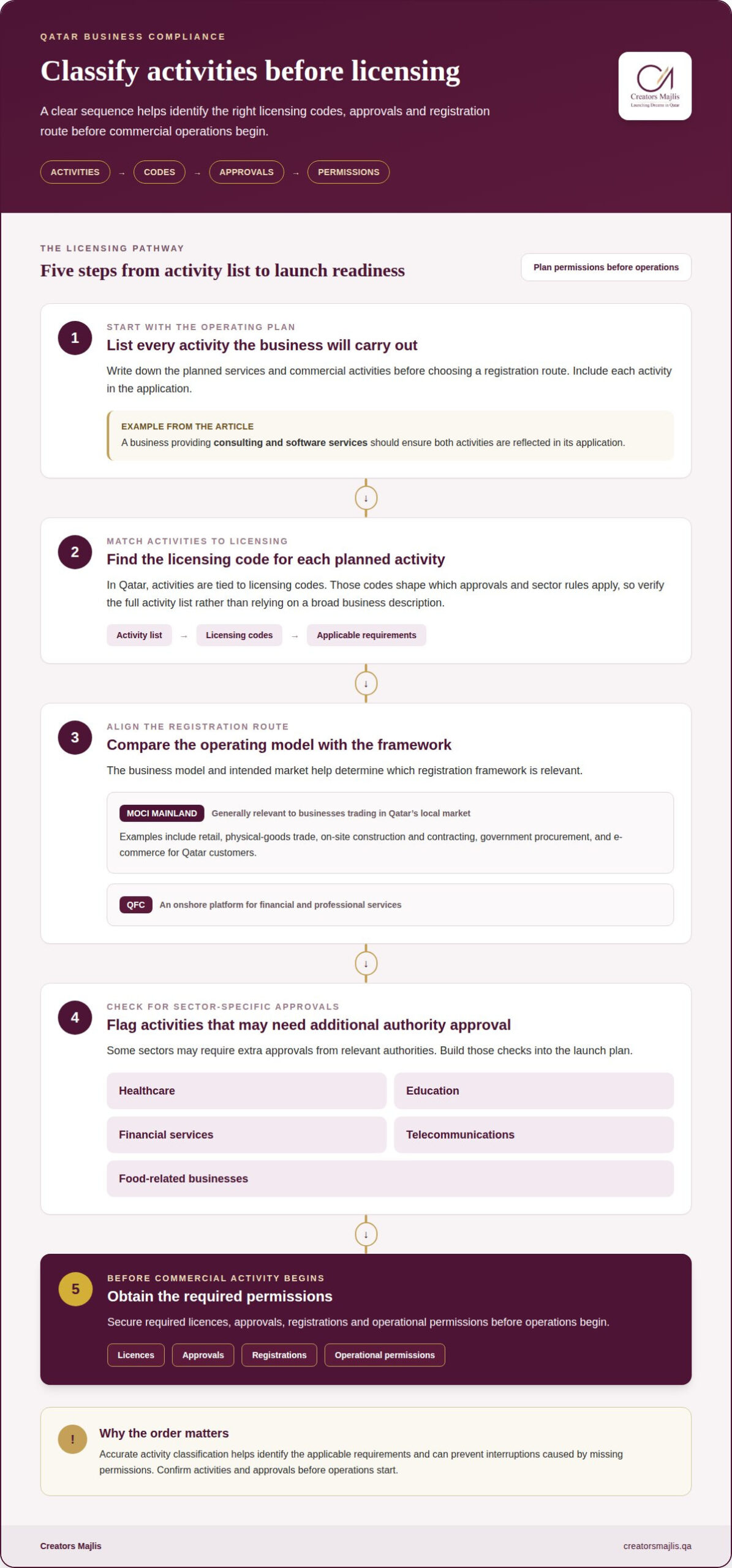
Business activity classification and licensing
Classify every planned activity before choosing a registration route. In Qatar, activities are tied to licensing codes that shape applicable approvals and sector rules. For example, a business providing consulting and software services should ensure both activities are reflected in its application. Accurate classification supports compliance and helps prevent interruptions caused by missing permissions.
Map the activity list to the operating model before finalising registration. In Qatar, businesses must obtain required licences, approvals, registrations and operational permissions before commercial activities begin. Healthcare, education, financial services, telecommunications and food-related businesses may need additional approvals from relevant authorities. Include those steps in the launch plan so operations do not begin before the necessary permissions are in place.
The registration framework matters, too. MOCI Mainland is generally relevant to businesses trading in Qatar’s local market, including retail, physical-goods trade, on-site construction and contracting, government procurement, and e-commerce for Qatar customers. The Qatar Financial Centre (QFC) is an onshore platform for financial and professional services. The Qatar Free Zones Authority (QFZA) operates free zones at Ras Bufontas and Umm Alhoul. Compare the frameworks against your activities, customers and operating model before choosing where to register.
Foreign businesses should distinguish between a branch and a representative office. An eligible foreign company can use a branch to conduct approved activities without creating a separate legal entity. A representative office can promote products or services but cannot undertake commercial trading. These structures serve different objectives, so align the proposed activities with the intended presence in Qatar.
- Prepare a clear activity list that matches the actual services, products, and operating model.
- Map each activity to its licensing code, required approvals, and reporting responsibilities.
- Reflect changes to activities, ownership, or registration details in the application before registration is finalised.
For a Qatar company compliance review, treat activity classification as the foundation for later licensing and reporting. Revisit the activity list when the business expands, adds a service or changes ownership. A new activity may bring different approval requirements, so update the company’s registration details before carrying it out.
Which Qatar entities must register for VAT or other indirect taxes in 2026, and what are the thresholds?
VAT has not yet been implemented in Qatar. A standard rate of 5% is expected, but no VAT registration threshold applies under the current 2026 position. Businesses should distinguish future VAT preparation from tax registrations and filings already required under Qatar’s existing framework.
For example, a company selling services in Qatar should not treat the expected 5% rate as a current VAT charge. Instead, prepare the accounting trail that will help identify taxable sales and purchases if VAT takes effect. Businesses preparing for VAT are advised to balance sales and purchase books monthly and retain supporting records for several years.
Separate VAT readiness from registration with the General Tax Authority (GTA). Businesses must register with the GTA within 60 days of starting activity or receiving a licence. This is a tax registration deadline, not a VAT threshold. Keep the registration record, licence details, transaction records, and tax correspondence together so the company can support its compliance position.
- Track sales and purchases monthly. Reconcile invoices and accounting entries to build a usable transaction history.
- Retain source documents. Organise sales invoices, purchase invoices, receipts, and supporting records by reporting period.
- Separate current duties from readiness work. Record GTA registration and tax filing tasks independently from future VAT preparation.
- Review the business model. Identify the products, services, customer locations, and transaction types that shape future tax analysis.
For future VAT planning in Qatar, focus on clean records, consistent bookkeeping and a clear view of transactions. Do not apply an assumed threshold or collect VAT based solely on an expected rate. Keep accounting processes ready to adapt when applicable VAT rules take effect.
For practical support aligning your Qatar setup and tax-registration steps, discuss your business setup requirements.
Creators Majlis: Business Set Up in Qatar
Creators Majlis supports founders planning a launch in Qatar and businesses adapting their structure as activities evolve. If your review points to a new registration, a change in activities or a need to choose the right setup route, Company Formation and Business Set Up in Qatar can help you put that decision into action.
PRO Services can support the administrative processes involved in setting up a business. Defining your activities and intended operating model first helps align formation decisions with licensing and registration requirements. This is useful before committing to a structure or starting commercial operations, when changes to activities or ownership may affect the application.
For guidance on setting up your business in Qatar, contact Creators Majlis.
Build your next step on a clear foundation
Treat the Qatar corporate compliance checklist for 2026 as a living operating tool, not a once-a-year exercise. As your business adds activities, enters new markets, or changes ownership, revisit how its structure supports the next stage. A forward-looking approach helps compliance keep pace with commercial decisions.
Creators Majlis supports your next step through Company Formation, PRO Services and Business Set Up in Qatar. Whether you are planning an initial launch or reshaping an existing presence, align setup decisions with your activities, operating model and priorities.
Discuss your Qatar business plans with Creators Majlis and identify a practical starting point. Move forward with clarity and give your next business milestone a strong foundation.
Frequently Asked Questions
Why Early Preparation Matters?
Early preparation gives teams time to coordinate decisions before compliance tasks become urgent. Use a Qatar corporate compliance checklist for 2026 to assign an owner to each internal task, record who approves decisions, and keep a short log of outstanding items. For example, finance and operations can agree on document responsibilities early, reducing last-minute handoffs when a filing or renewal is being prepared.
What corporate filings and annual compliance deadlines apply to Qatar companies in 2026?
Build a filing control that tracks preparation, internal approval, submission and proof of completion as separate steps. Record who is responsible and where submitted documents are stored. This creates a useful history when staff change or an authority requests supporting information. Tailor the calendar to the company’s registration framework instead of relying on one reminder for every filing.
What are Qatar’s 2026 corporate tax rates, filing requirements, and payment deadlines?
Tax compliance can involve additional documentation for related-party transactions. Qatar entities with related-party transactions and turnover or assets above QAR 10 million must submit a Transfer Pricing Disclosure Form with their annual return. Entities with turnover or assets above QAR 50 million and cross-border related-party transactions must maintain a Master File and Local File. Map group transactions to the relevant records before preparing the return.
What are Qatar’s 2026 beneficial ownership, ultimate beneficial owner, and company register requirements?
Keep a clear ownership map showing direct and indirect control, and organise documents that support each link in the structure. For QFC firms, the annual UBO report is typically due within 30 days of the date specified by the CRO. Include nominee arrangements in the disclosure and keep the underlying details consistent with the company’s corporate records.
What are the 2026 requirements for renewing commercial registrations, trade licenses, and municipal permits in Qatar?
Track each registration, trade licence and municipal permit as a separate record. Note the issuing authority, permitted scope, expiry information and evidence of renewal. This helps distinguish documents covering different parts of the operation, rather than treating one renewed licence as covering every permission. Keep records together so you can see which documents support each activity.
What corporate governance, board, and audit requirements apply to Qatar LLCs and joint-stock companies in 2026?
Governance and audit processes should reflect the company’s legal form, financial position and applicable regulator. Maintain a clear trail from transaction records to financial statements, and keep approval records with the relevant accounts. An audit is an independent examination, so organise source documents and responses for the auditor without treating management’s preparation as a substitute for the audit.
Planning your own setup? Our company formation in Qatar service covers the route choice, licensing and the bank account in one process.