

The same QFC holding-company structure can carry different annual-return duties. Whether a qfc holding company annual return is required depends on whether the company is active or passive, not simply on its legal form. Passive status changes key filing requirements, but it does not remove every compliance responsibility.
This guide explains the distinction. Active holding companies, except those wholly owned by the State of Qatar, must file an Annual Return, hold an AGM, and submit annual accounts and an auditor’s report to the QFC CRO. Passive holding companies are exempt from preparing or lodging an annual return and appointing auditors unless directed otherwise by the QFCA. You’ll also learn how to separate annual-return duties from the annual UBO report and event-driven notices. Both statuses must observe the prohibition on conducting Regulated Activities by way of business without prior QFCRA authorisation. For QFC information, call +974 4496 7836, email professionalservices@qfc.qa, or visit www.qfc.qa.
Key Takeaways
- Identify which qfc holding company annual return rule applies: active HCs, except those wholly owned by the State of Qatar, must file, while passive HCs are exempt unless directed by the QFCA.
- For an active HC, review the Annual Return, AGM, annual accounts and auditor’s report requirements alongside the company’s governance roles. Regulated Activities must not be conducted by way of business without prior QFCRA authorisation.
- Keep annual-return requirements separate from other disclosures, including the annual UBO report and notices triggered by changes to company details.
- Organize the company’s status, governance details and filing records for a compliance review. Creators Majlis provides personalized Company Formation and Compliance & Regulatory Services. For QFC information, call +974 4496 7836, email professionalservices@qfc.qa, or visit www.qfc.qa.
QFC Holding Company Annual Return: Why Active or Passive Status Matters
Annual-return duties depend on whether a QFC Holding Company (HC) is active or passive. Active HCs, except those wholly owned by the State of Qatar, must file Annual Returns, hold an AGM, and submit annual accounts and an auditor’s report to the QFC CRO. Passive HCs are exempt from preparing or lodging an annual return and appointing auditors unless directed by the QFCA.
In short, active status brings annual-return and related reporting duties, while passive status brings a specific exemption unless the QFCA directs otherwise. A practical compliance review should start by establishing the HC’s status, rather than assuming that every company with the same legal form has the same filing obligations.
What does annual-return status mean for a QFC holding company?
A QFC Holding Company is a limited-liability company incorporated under the QFC Companies Regulations 2005 and the Special Companies Regulations 2017. The filing requirements differ according to whether the HC is active or passive. Here, “annual return” means the company filing obligation; it is not a calculation of investment performance, such as a rate of return.
Passive status has a defined effect, not a blanket exemption from every responsibility. An HC must have at least one member, one director and one secretary, and must appoint a Senior Executive Function (SEF). The annual UBO report is a separate filing obligation for HCs. Consider these requirements separately from the annual-return rule.
Keep the distinction clear in your records: an Annual Return is one filing, while other disclosures and notices may have their own triggers. For an intended change in the HC’s purpose or activities, retain the required notice wording: “Notify the QFCA, with no less than 21 days’ written notice of any intended change in purpose or activities, and state whether the HC remains ‘Passive.’” An HC must not conduct Regulated Activities by way of business without prior QFCRA authorisation.
For QFC information, call +974 4496 7836, email professionalservices@qfc.qa, or visit www.qfc.qa.
Active vs. Passive QFC Holding Company: The Annual Return Rules
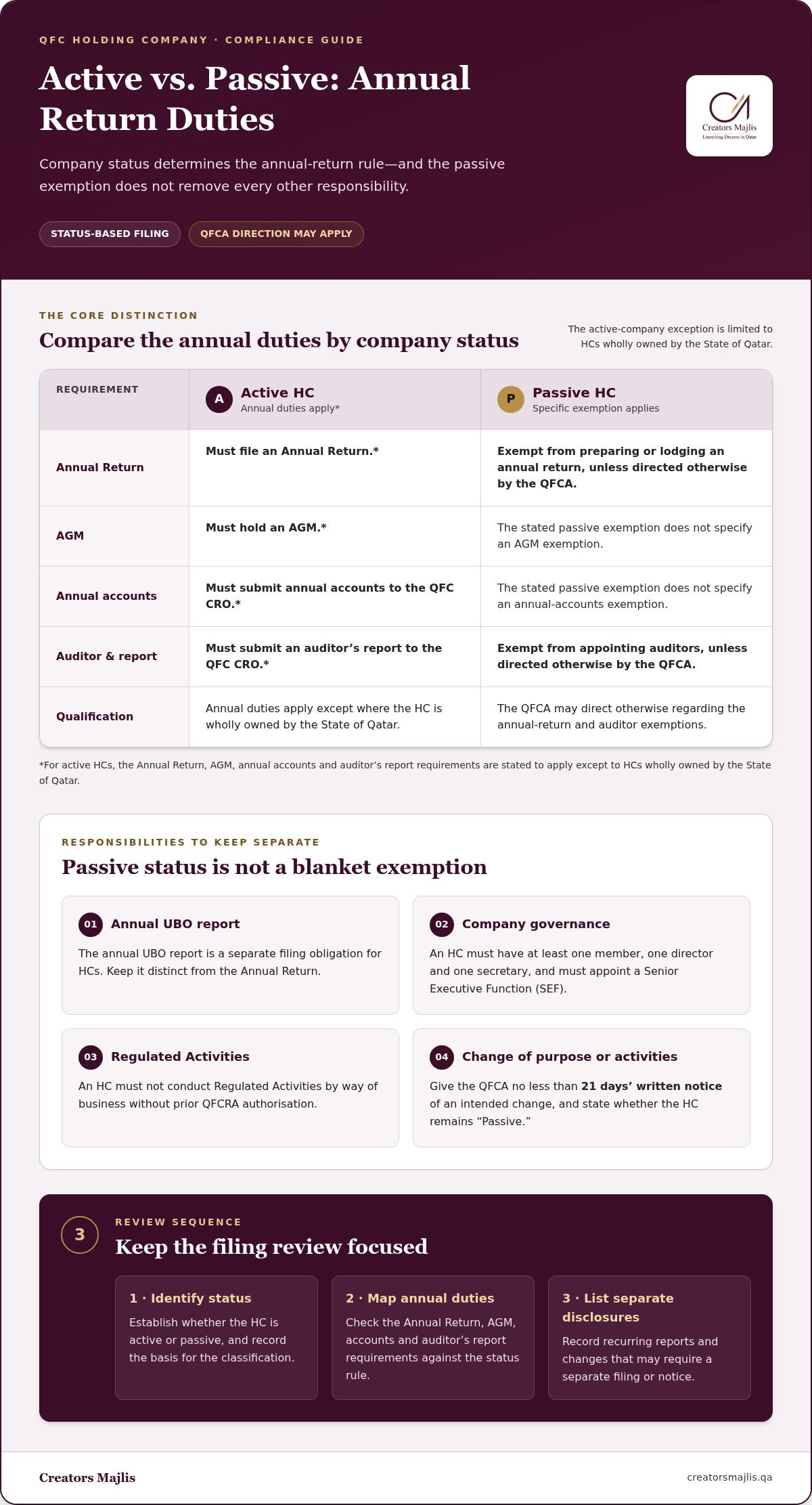
The key difference is the company’s classification and the scope of the relevant exemption. Active HCs, except those wholly owned by the State of Qatar, must file Annual Returns. They must also hold an AGM and submit annual accounts and an auditor’s report to the QFC CRO. A passive HC is exempt from preparing or lodging an annual return and appointing auditors unless the QFCA directs otherwise.
| HC status | Annual-return and related requirements |
|---|---|
| Active | Must file Annual Returns, hold an AGM, and submit annual accounts and an auditor’s report to the QFC CRO, except where the HC is wholly owned by the State of Qatar. |
| Passive | Is exempt from preparing or lodging an annual return and appointing auditors unless directed by the QFCA. |
In practical terms, active status carries the specified annual-return, AGM and accounts obligations. Passive status exempts the HC from preparing or lodging an annual return and appointing auditors unless the QFCA directs otherwise. Use this distinction when reviewing a qfc holding company annual return, and do not treat the passive exemption as a general waiver from other obligations.
What changes when a QFC holding company is passive?
The stated passive exemption covers preparing or lodging an annual return and appointing auditors. It does not, by itself, remove every disclosure responsibility. The annual UBO report is a separate filing for HCs, so keep it distinct from the annual-return question.
Other regulatory requirements also remain relevant. An HC must not conduct Regulated Activities by way of business without prior QFCRA authorisation. For an intended change in the HC’s purpose or activities, retain the required notice wording: “Notify the QFCA, with no less than 21 days’ written notice of any intended change in purpose or activities, and state whether the HC remains ‘Passive.’”
Creators Majlis’ Compliance & Regulatory Services can help organize corporate compliance documentation and filing records for a focused review.
How to Review QFC Holding Company Filing Obligations
Use these steps to review the qfc holding company annual return without mixing it up with disclosures triggered by a separate event.
- Identify the HC’s status. Establish whether the company is active or passive, and record the basis for that classification. This determines which annual-return rule to assess.
- Map the annual duties that apply. For an active HC, review the Annual Return, AGM, annual accounts and auditor’s report requirements. A passive HC is exempt from preparing or lodging an annual return and appointing auditors unless directed by the QFCA.
- List separate disclosures. Record recurring reports and changes that may require a separate filing or notice. Keep these distinct from the annual return and follow the applicable instructions for each.
Keep the governance record aligned with that review. The QFC holding company governance guide provides related context for checking company roles and governance arrangements.
Which obligations are separate from the annual return?
The annual UBO report is distinct from the Annual Return. Changes can also have their own notification requirements. Track each relevant change, its supporting records and the applicable notice instructions independently.
- Changes to the registered office or directors
- Changes to the SEF or secretary
- Changes to shareholders or SSP
For an intended change in the HC’s purpose or activities, retain the required wording: “Notify the QFCA, with no less than 21 days’ written notice of any intended change in purpose or activities, and state whether the HC remains ‘Passive.’” Follow the applicable instructions for each change rather than assuming it forms part of the annual return. An HC must also not conduct Regulated Activities by way of business without prior QFCRA authorisation.
Creators Majlis’ Compliance & Regulatory Services can help organize corporate compliance documentation for a focused review. Arrange a compliance discussion.
Prepare for QFC Holding Company Compliance with Clear Support
A focused review starts with well-organized records. Before assessing a qfc holding company annual return, gather the information that shows how the HC is classified, who holds its governance roles and which filings or notices relate to it. This makes it easier to distinguish annual duties from separate reporting responsibilities.
- Status: Record whether the HC is active or passive, and keep any relevant QFCA direction with the company’s compliance documents.
- Governance: Note the SEF, member, director and secretary, and keep current records of their roles.
- Filing records: Organize applicable annual-return records, annual accounts and auditor’s reports, UBO reporting documents, and notices concerning company changes.
If you’re establishing an HC or reviewing its structure, the QFC holding company setup guide offers formation context alongside this compliance review.
When can advisory support help clarify annual-return responsibilities?
Tailored advisory support can help you organize corporate compliance documentation and review how the stated obligations relate to your company’s status and records. Creators Majlis’ Company Formation and Compliance & Regulatory Services provide personalized support focused on Qatar. This support can help clarify requirements, while regulatory decisions and filing outcomes remain subject to the applicable requirements.
Keep the wider regulatory picture in view: an HC must not conduct Regulated Activities by way of business without prior QFCRA authorisation. For an intended change in the HC’s purpose or activities, preserve the required wording: “Notify the QFCA, with no less than 21 days’ written notice of any intended change in purpose or activities, and state whether the HC remains ‘Passive.’”
Prepare your company’s status, governance details and filing records, then discuss your requirements with Creators Majlis.
Turn compliance clarity into confident next steps
Use your QFC holding company annual return review as a foundation for sound compliance planning, not just a filing exercise. A current picture of the company’s status, governance responsibilities and relevant records can help you prepare for decisions and keep compliance planning aligned as the structure evolves.
Creators Majlis is a QFC-licensed corporate advisory firm providing personalized support through Company Formation and Compliance & Regulatory Services. Its multilingual team works in German, English and Arabic, helping you organize compliance documentation and understand the obligations relevant to your company.
Start a focused review of your Qatar company compliance needs and take the next step with a clearer plan.
Frequently Asked Questions
Does a passive QFC holding company have to file an annual return?
No. A passive QFC holding company is exempt from preparing or lodging an annual return unless the QFCA directs otherwise. The stated exemption also covers appointing auditors, but it does not remove every other compliance responsibility. For a qfc holding company annual return review, retain any QFCA direction with the company’s records and assess separate disclosures independently.
What must an active QFC holding company file each year?
An active HC, except one wholly owned by the State of Qatar, must file Annual Returns, hold an AGM, and submit annual accounts and an auditor’s report to the QFC CRO. The annual UBO report is a separate filing obligation for HCs. Keep records for each reporting requirement distinct so one submission is not mistaken for another.
Can QFCA require a passive holding company to file an annual return?
Yes. A passive HC’s exemption applies unless the QFCA directs otherwise, so a direction can require an annual-return filing. Retain the direction, identify what it asks the company to provide and follow the applicable instructions. Passive classification alone does not override a specific QFCA direction.
Are annual returns the only recurring compliance requirement for a QFC holding company?
No. The annual UBO report is separate from any annual return. Other notices may also be triggered by changes to company details, such as its directors or registered office. Track each requirement according to its own trigger and instructions; do not assume a disclosure is included in, or satisfied by, an annual-return filing.
What notice is required before changing a QFC holding company’s purpose or activities?
For an intended change in purpose or activities, “Notify the QFCA, with no less than 21 days’ written notice of any intended change in purpose or activities, and state whether the HC remains ‘Passive.’” Keep a copy with the company’s decision records. This advance notice is separate from annual-return status.