

Short answer
Trading license requirements in Qatar include a valid Commercial Registration, approved business premises and any required sector approvals, with licences issued by the Ministry of Commerce and Industry. Your planned activity determines the licence category, so also check foreign ownership eligibility for your sector: the 2019 Foreign Investment Law permits 100% foreign ownership in many sectors.
The activity you plan to carry out determines which trade licence you need in Qatar. Trading license requirements in Qatar include a valid Commercial Registration, approved business premises and any required sector approvals. The licence authorises specified activities at those premises. The Ministry of Commerce and Industry issues trade licences.
Free 2026 checklist: Set up a company and move to Qatar, six phases on six pages.
Company registration is not the final step: Commercial Registration and a trade licence serve different purposes. The licence category matters too. Commercial, industrial and professional licences cover different kinds of work, and activities may require separate licences or permits.
This guide explains how to apply, prepare for a premises inspection, understand foreign ownership eligibility and match your planned activities to the appropriate licence. You’ll also see how the process fits together, from company registration and premises approval to any sector clearances required. With the requirements laid out clearly, you can build a practical setup plan and move forward with greater confidence.
Key Takeaways
- Separate company registration from permission to operate: align your Commercial Registration, licensed activities and business premises before applying.
- Prepare your premises and supporting documents for the application, including any required location, signage and sector approvals.
- Assess foreign ownership eligibility against your intended business sector; Qatar’s 2019 Foreign Investment Law permits 100% foreign ownership in many sectors.
- Match your planned work to the right licence category, since trading, production and professional services fall under different activity types.
How to Get a Trade License in Qatar?
First match your business activity, company registration and premises. Then prepare the application and any required approvals. The trading license requirements Qatar businesses must meet depend on these details.
License Purpose and Commercial Registration
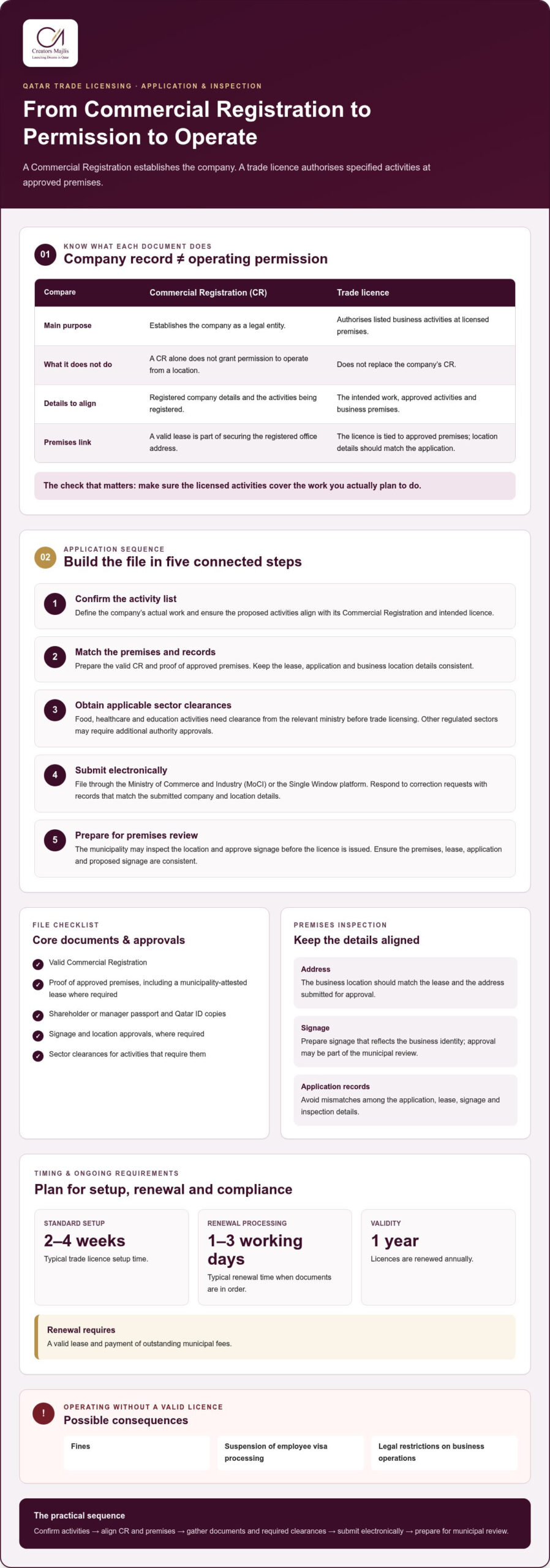
In Qatar, Commercial Registration (CR) establishes your company as a legal entity. A trade licence authorises specified business activities at approved premises. They are separate documents, so a CR alone does not grant permission to operate from a location.
Secure a valid lease for your registered office address as part of commercial registration. Then make sure the trade licence activities cover the work you intend to do. For example, a business selling goods needs licensed activities that cover that trading work.
Qatar Trade and Business License Terms
“Trade licence” generally means authorisation to conduct listed activities at licensed premises. “Business licence” is often used more broadly, but the approved activity and location are what matter. Neither term means the same thing as the CR.
Qatar’s Ministry of Commerce and Industry (MoCI) issues trade licences. Mainland companies and branch offices need a valid MOCI commercial permit, while free-zone companies are licensed by the QFZA and QFC firms by the QFC Authority. Trading license requirements Qatar companies face include matching their planned activities and premises to the licence.
Application Steps and Required Documents
Apply electronically through MoCI or the Single Window platform. The application requires a valid CR, approved premises and any required sector approvals. Prepare supporting records, including a municipality-attested lease, shareholder or manager passport and Qatar ID copies, and signage and location approvals where required.
Food, healthcare and education activities require clearance from the relevant ministry before trade licensing. Other regulated sectors may need additional authority approvals. Operating without a valid licence can lead to fines, suspension of employee visa processing and legal restrictions on business operations.
Trade Name Search and License Timing
Include a trade name search in your early registration planning, and prepare alternatives in case your preferred name cannot be used. Keep the selected name consistent across company documents and the activities you plan to register.
A standard trade licence setup typically takes 2 to 4 weeks. Renewal typically takes 1 to 3 working days when documents are in order. The CR and commercial permit can be renewed for one to five years; renewal requires a valid lease and payment of any outstanding fees.
Application and inspection steps
Build the application around the activity, company record and premises. Qatar’s electronic process runs through MoCI or the Single Window platform. Before filing, align the proposed activities with the company’s Commercial Registration and the premises intended for licensing. This keeps the application details consistent.
Prepare the core documents and approvals as one file:
- A valid Commercial Registration.
- Proof of approved premises, including a municipality-attested lease where required.
- Shareholder or manager passport and Qatar ID copies.
- Signage and location approvals, where required.
- Sector clearances for activities that require them.
Food, healthcare and education businesses need clearance from the relevant ministry before trade licensing. Other regulated sectors may also require additional authority approvals. Identify these requirements for your planned activities before submitting, because missing sector clearance can delay the licensing sequence.
Prepare the premises for a possible municipal inspection. The municipality may inspect the location and approve signage before issuing the licence. Keep the business location consistent with the lease and application, and ensure the proposed signage reflects the business identity. For example, the lease and premises documents for a trading company should match the address submitted for approval.
Use this filing order: confirm the activity list, assemble the CR and premises documents, obtain applicable sector clearances, then submit electronically. Track requests for corrections and respond with documents that match the company and location details submitted. These checks help prevent mismatches between the application, lease, signage and inspection.
If you’d like help organizing the filing and premises paperwork, discuss your Qatar setup requirements.
Foreign ownership eligibility
Mainland and Qatar Free Zone businesses both need valid trade licences. The licensing route follows the chosen jurisdiction, so decide where the company will operate before preparing the application.
Qatar’s 2019 Foreign Investment Law permits 100% foreign ownership in many sectors. That does not mean every activity has the same ownership eligibility. Treat ownership as a sector-specific decision, then match the proposed activity to the relevant licensing route and approvals.
Start by defining the company’s actual work. A business importing and selling goods has different activities from a consultancy or manufacturer. List each planned activity clearly, then assess whether the intended ownership structure fits that sector. A broad business label does not establish that every activity qualifies.
Use these planning steps:
- Choose mainland Qatar or a Qatar Free Zone as the intended jurisdiction.
- List the company’s specific activities, such as wholesale trading or consultancy.
- Assess foreign ownership eligibility against each activity and sector.
- Identify any additional authority approvals linked to those activities.
- Align the ownership plan and licence application with the selected jurisdiction.
Assess each line of work separately in a mixed-activity company. For example, a company combining goods trading with professional consultancy needs to identify both activities, rather than assume one approval covers the whole operation. Each activity may require its own licence or permit, and some sectors require additional approvals.
Keep three decisions distinct: who owns the company, which activities it conducts, and where it operates. A positive ownership assessment does not replace activity licensing or premises approval. Choosing a free zone does not establish eligibility for every sector. Build the application around the ownership structure, business activities and jurisdiction together.
Mainland Qatar and Qatar Free Zone businesses both need valid trade licences, but the licensing route depends on the chosen jurisdiction. The licence or permits required, and any additional approvals, may also depend on the company’s specific activities.
License types and the activities they cover
Choose a licence based on the work your company will perform, not its broadest business label. Qatar’s commercial, industrial and professional licences cover distinct activities. Match each planned activity to its relevant category before preparing the application. This matters especially when one company will trade goods and provide services.
Use these categories to map your operations:
- Commercial licence: buying and selling goods, import and export, general trading, retail or wholesale.
- Industrial licence: manufacturing or production, usually in designated industrial areas, with environmental approvals.
- Professional licence: services and consultancy, including IT, management consulting, engineering and marketing.
For example, a retailer selling goods needs commercial activity coverage. A manufacturer producing goods falls under industrial activity, while an engineering consultancy fits professional services. The nature of the work matters. A company that only advises clients should not assume its activity belongs under commercial trading simply because it operates as a business.
List each revenue-generating activity separately before selecting a licence. A company combining wholesale sales and management consultancy has two distinct lines of work. Each activity may require its own licence or permit. Sector-specific approvals may also apply, so include the full activity list when planning the licensing route.
Check the fit with three practical questions: Will the company buy or sell goods? Will it manufacture or produce them? Will it deliver a professional service or consultancy? The answers point toward commercial, industrial or professional licensing. Then check whether activities need separate permissions and whether industrial operations involve environmental approvals or designated-area requirements.
Choose the category that reflects actual operations, not future possibilities alone. If your activity mix spans categories, structure the list clearly before applying. Plan your Qatar business activity and licence structure with support for your setup.
Creators Majlis: Company Formation
Creators Majlis supports founders with company formation and business setup in Qatar. Turn to the team when shaping your activity list, choosing a setup route or coordinating the steps between incorporation and operational readiness.
Company Formation and Business Set Up in Qatar can help align your business structure with the activities you intend to carry out. PRO Services can support the administrative processes involved in establishing and maintaining the business. This is useful when your plans involve several activities, as each may affect licensing and approval requirements.
Bring your intended activities, ownership plan and preferred jurisdiction to the planning conversation. These details help focus the setup process on the business you’re building. Contact Creators Majlis to discuss your Qatar company formation plans.
Turn Your Qatar Business Plan Into Action
Your next step is to turn the proposed activities and ownership structure into a clear company setup plan. Treat trading license requirements in Qatar as part of that wider planning, so your intended operations and business structure work together from the outset.
Creators Majlis supports this next stage through Company Formation, PRO Services and Business Set Up in Qatar. These services help founders move from planning toward establishing their business, with attention to the administrative steps involved. Bring your proposed activities and business goals to the conversation to focus the support on your plans.
Start shaping the foundation for your business in Qatar. Contact Creators Majlis today to discuss your next steps, and move forward with a plan built around your ambitions.
Are a trade license and a commercial license the same in Qatar?
In practice, yes. “Trade licence”, “commercial licence” and “commercial permit” are used for the same MOCI document: the permission to carry out your registered activities at approved premises. What is not the same is the Commercial Registration (CR), which creates the company, and the municipal approvals that sit behind the licence.
| Document | What it does | Issued or approved by |
|---|---|---|
| Commercial Registration (CR) | Registers the company, its owners and its activities | MOCI |
| Trade / commercial licence | Permits the licensed activities at a specific address | MOCI |
| Municipal approvals | Premises, location and signage clearance | Ministry of Municipality |
| Sector licences | Additional permission for regulated activities such as food, health or education | The relevant ministry or authority |
The term “municipal licence” persists because the trade licence was historically issued through the municipality. Today the licence comes from MOCI, while the municipality remains involved through premises inspection and signage approval. QFC and free zone companies follow their own licensing authority instead of MOCI.
Do you need a trade license consultant in Qatar?
You can apply yourself through MOCI and the Single Window platform. Most foreign founders still use a consultant, because the delays rarely come from the form itself; they come from the sequence around it.
A good trade licence consultant typically:
- maps your activities to the correct MOCI activity codes before the CR is filed;
- checks whether each activity allows full foreign ownership or needs approvals;
- aligns the lease, municipal approvals and signage with the licence address;
- handles attestation, Arabic translation and follow-up with the authorities;
- tracks renewals so the CR, licence and lease do not fall out of sync.
Before you engage one, ask which steps they file themselves, which depend on the authority, and whether they also cover visas and bank accounts. Our mainland company formation service and PRO services cover this full sequence.
Frequently Asked Questions
What types of trading licenses are available in Qatar?
Qatar has commercial, industrial and professional licence categories. Commercial licences cover goods trading, including retail, wholesale, and import or export. Industrial licences cover manufacturing and production, while professional licences cover services such as IT or consultancy. If your company combines activities, map each separately. For example, selling products alongside management consulting may involve distinct activity permissions.
What are the eligibility and ownership requirements for a trading company in Qatar?
Eligibility depends on the company’s activities, ownership structure and chosen jurisdiction. Define the work precisely, then assess whether the ownership plan fits that sector and which approvals the activities require. A business planning both wholesale trading and consultancy should evaluate both, rather than rely on one general company description. The licence and permits must cover the work the company will actually conduct.
How do you apply for a trading license in Qatar, step by step?
First, specify each intended activity and select the relevant licensing route. Complete company registration, arrange premises and obtain any applicable sector clearances. Then submit the trade licence application electronically through the Ministry of Commerce and Industry or Single Window platform. Keep activity descriptions consistent across filings, and prepare the location and signage for a possible municipal inspection before the licence is issued.
Does a Qatar trading license require a commercial registration, office lease, or municipality permit?
Yes. A valid Commercial Registration is required for the trade licence application, and a valid lease is required for commercial registration. The premises must be approved for licensing. A municipality-attested lease, location approval or signage approval may also be required, depending on the application. For example, the premises address in the lease should match the location submitted for licensing.
What are the rules for foreign investors and 100% foreign ownership of trading businesses in Qatar?
Qatar’s 2019 Foreign Investment Law permits 100% foreign ownership in many sectors, but this doesn’t automatically apply to every trading activity. Assess ownership eligibility against the specific sector and planned operations. A company importing goods, for instance, should consider the relevant trading activity and jurisdiction together. Ownership permission is separate from obtaining the trade licence and any activity-specific permits.
What are the trading license fees and renewal costs in Qatar?
Government fees for the Commercial Registration and the yearly commercial permit are set by MOCI and are typically modest for a single activity; confirm the current amounts on the MOCI portal before applying. The CR and commercial permit can be renewed for one to five years, provided a valid lease is in place; sector approval costs vary.
What is a trade license in Qatar?
A trade licence is the MOCI permit that allows a registered company to carry out its listed activities at an approved address. It is issued after the Commercial Registration and must be renewed with it. Without a valid licence, a company cannot legally trade, sponsor staff or, in most cases, open a bank account.
Can I get a trade license in Qatar without an office?
Usually not for a mainland company: the licence is tied to approved premises, and a lease is required for the CR. Executive or shared offices can meet this requirement for many service activities. See our guide to office space requirements for a trade licence.
Can I add a new activity to my existing trade license?
Yes. You amend the CR to add the activity, then update the licence and obtain any sector approval the new activity needs. Check foreign ownership for the new activity first. Our guide on adding a business activity to a Qatar trade licence walks through the steps.
Does a QFC company need a MOCI trade license?
No. A QFC firm is licensed by the QFC Authority for its permitted activities and does not need a MOCI trade licence for those. If it wants to trade goods on the mainland, a separate mainland entity is usually the cleaner route.
Planning your own setup? Our company formation in Qatar service covers the route choice, licensing and the bank account in one process.