

For a foreign-owned entity deriving income from Qatar sources, corporate tax registration in Qatar is a key compliance step: every entity with a Commercial Registration, including tax-exempt Qatari- or GCC-owned companies, must register with the GTA on Dhareeba and obtain a tax card. Qatar’s standard income tax rate is 10% of taxable income for the tax year. Registration is only the starting point: businesses also need to understand the filings, payments and records that follow.
Free 2026 checklist: Set up a company and move to Qatar, six phases on six pages.
It’s natural to want clarity about what information to prepare and which rules apply to your business structure. This guide explains who may need to register, what the process involves and how to approach ongoing tax responsibilities. Use it to build tax compliance into your company’s operations from the outset.
Key Takeaways
- Assess your company’s ownership, Qatar-source income and any applicable exemption to understand its tax position.
- Prepare clear, consistent business and ownership details before starting the registration process.
- In-scope multinational groups can use Dhareeba for Pillar Two registration, which establishes a unique identifier and point of contact.
- Build filing, payment and record-keeping into your ongoing compliance plan, and consider company formation support when setting up in Qatar.
Ongoing filing, payment and record-keeping obligations
Registration begins the compliance process, but filing income tax returns, paying tax and keeping records continue afterward. In Qatar, a company’s obligations depend on its taxable income and activities.
Filing and Payment Duties
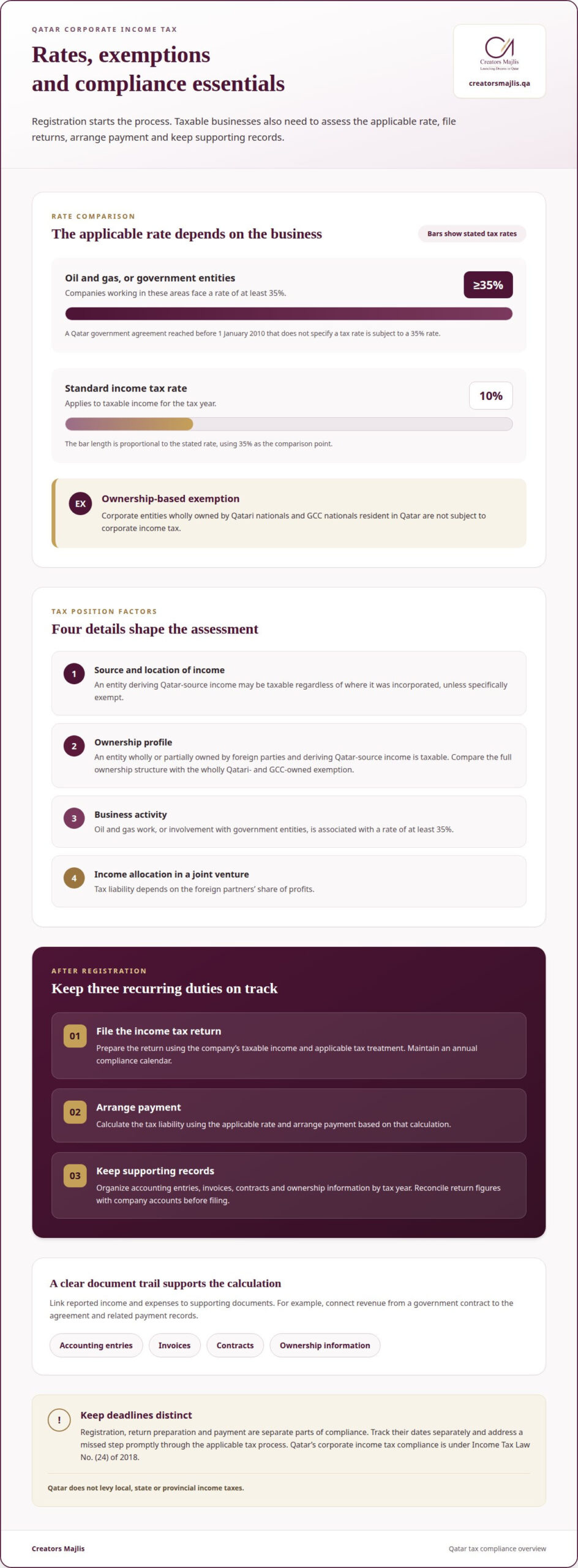
Filing and payment duties are the recurring steps a taxable business takes to report income and settle its tax liability. Keep an annual compliance calendar, prepare the company’s tax return, and arrange payment based on the resulting calculation. Qatar’s standard income tax rate is 10% of taxable income for the tax year. Income from petroleum operations and the petrochemicals industry is taxed at not less than 35%. For a Qatar government agreement reached before 1 January 2010 that does not specify a tax rate, the applicable rate is 35%.
Tax Rate and Exemptions
The applicable corporate income tax rate is used to calculate tax on taxable income. Corporate entities wholly owned by Qatari nationals and GCC nationals resident in Qatar are not subject to corporate income tax. Qatar does not levy local, state or provincial income taxes. For a joint venture, tax liability depends on the foreign partners’ share of profits. Ownership, business activity and income allocation are therefore important when preparing a tax calculation.
Record-Keeping
Record-keeping means maintaining documents that support reported income, expenses and tax calculations. Organize accounting entries, invoices, contracts and ownership information by tax year. For example, link revenue from a government contract to the agreement and related payment records. Before filing, reconcile the figures in the tax return with the company’s accounts. A consistent document trail helps explain how taxable income was calculated and supports accurate filings and payments.
Late or Missing Registration Penalties
Penalty exposure concerns the consequences attached to a specific compliance breach. For late or missing registration, the relevant factors include the breach involved and whether filing or payment duties were also missed. Keep registration, return preparation and payment dates on separate calendar reminders, then address any missed step promptly through the applicable tax process. Don’t treat registration as a substitute for filing or paying: each is a distinct part of corporate income tax compliance under Income Tax Law No. (24) of 2018.
Information required for tax registration
A registration profile contains the details used to identify a business and its tax position. Prepare the entity’s legal name, structure, ownership, activities in Qatar and contact details. Keep these consistent with the company’s official business records.
The registration deadline depends on the entity’s category and the applicable rules. Before setting a compliance calendar, identify whether the business is a standard taxpayer or falls under a separate framework, such as the global minimum tax.
Processing times and any registration fees depend on the applicable process and the information submitted. Complete, consistent details give the reviewing authority a clear basis for assessing an application and can help prevent avoidable follow-up.
A foreign-owned company or branch should present its legal identity, ownership structure and operations in Qatar clearly. An entity that derives Qatar-source income may be taxable regardless of where it was incorporated, unless specifically exempt. Use consistent legal names and ownership details across registration records and supporting company documents.
Dhareeba is Qatar’s online portal for tax registration and filing by all taxpayers. It also includes a registration route for in-scope multinational enterprise groups under the Global Minimum Tax framework. These groups register through Dhareeba with the General Tax Authority. Registration assigns a unique identifier, establishes a single point of contact and supports subsequent compliance obligations. Keep the submitted group and entity details together for future filings.
Before starting, organize the business information into a consistent file: legal identity, ownership, activity description and contact details. For a group, map the Qatar entity to its parent structure and identify the relevant contact. This preparation creates a clear record and makes it easier to respond to questions about the application.
If you’re preparing a Qatar launch, discuss your registration planning alongside the company’s setup details.
Foreign persons seeking direct application of Qatar tax treaty benefits must submit requests and supporting information to a Trusted Entity in Qatar. Keep the request and supporting documents together, and ensure they relate to the application. Organizing the material before submission helps the Trusted Entity in Qatar review the request alongside the relevant information.
Which businesses must register for corporate income tax in Qatar?
Taxable status is a business’s position under Qatar’s income tax rules, based on its income, ownership and any applicable exemption. An entity generating Qatar-source income may be taxable regardless of where it was incorporated, unless specifically exempt. The source and location of income are therefore central to assessing a company’s position.
Foreign ownership is a key factor in that assessment. An entity wholly or partially owned by foreign parties and deriving income from Qatar sources is taxable in Qatar. For example, a foreign-owned company earning income from activities in Qatar should assess its tax obligations based on those local-source earnings, not solely on where it was incorporated.
Some ownership structures are treated differently. Corporate entities wholly owned by Qatari nationals and GCC nationals resident in Qatar are not subject to corporate income tax. Compare the company’s full ownership profile with this exemption: a business with any foreign ownership does not meet the condition of being wholly Qatari- or GCC-owned.
A subsidiary of a listed entity also needs an ownership-based review. Fully owned subsidiaries of listed entities in Qatar are taxable to the extent of non-exempt ownership, including foreign ownership or non-exempt Qatari or GCC ownership. Map each ownership share to the owner’s status, then identify the portion that is not exempt. The parent’s listing does not automatically exempt its subsidiary.
Use a practical screening sequence: identify where the entity earns income, trace direct and indirect ownership, then apply any relevant exemption. A Qatar-incorporated business and a foreign-incorporated business can both fall within scope if they generate Qatar-source income. The stated exemption, by contrast, depends on complete ownership by qualifying Qatari nationals or Qatar-resident GCC nationals. This review helps determine whether the company should proceed with tax registration and which ownership details support that decision.
QFC permits 100% foreign ownership of businesses, but ownership alone does not establish the applicable tax rate. Its framework offers a 0% concessionary tax rate to qualifying investment managers, reinsurers, captive insurers, or businesses that are at least 90% Qatari-owned. A QFC business may qualify for group loss relief when it shares at least 75% common ownership with another QFC-licensed firm.
How do companies register for corporate tax in Qatar?
Tax registration records a business with the tax authority under the framework that applies to its activities. To complete corporate tax registration in Qatar, first identify the company’s legal structure and tax category. A standard corporate taxpayer and an in-scope multinational group may follow different processes, so classify the entity before beginning.
Dhareeba is Qatar’s online portal for registration and filing by all taxpayers. It also offers registration for in-scope multinational enterprise groups under the Global Minimum Tax, or Pillar Two, framework. For this route, prepare the group and Qatar entity details, identify a suitable point of contact, and submit the registration through Dhareeba to the General Tax Authority. Registration assigns a unique identifier, establishes a single point of contact and supports subsequent compliance obligations.
For a group registration, follow this sequence:
- Determine whether the group and Qatar entity fall within the Pillar Two scope.
- Organize the relevant group and entity information before entering it in Dhareeba.
- Submit the registration to the General Tax Authority and retain the assigned identifier with the company’s tax records.
A QFC-licensed firm follows a distinct timing point: QFC tax registration takes place after the firm receives its QFC licence. Keep the licence and entity details aligned when preparing the registration. This sequence applies to companies using the QFC framework, while multinational groups should focus on the Pillar Two route available through Dhareeba.
For other corporate tax registration in Qatar, identify the correct tax category and prepare consistent company information before proceeding through the relevant tax process. Keep a record of the route taken, details submitted and identifiers received. These records can support the company’s next compliance steps.
Planning a Qatar company launch alongside its tax pathway? Discuss your company registration plan and the setup steps that support it.
Creators Majlis: Company Formation
Creators Majlis supports founders with Company Formation and Business Set Up in Qatar, helping establish the company structure before tax obligations begin. This is a practical next step when planning a new venture, entering the market or organizing the setup details needed for tax registration.
Company Formation and PRO Services can support the administrative side of launching a business. Keep ownership, activity and company records aligned for registration, then follow the tax route relevant to your entity and maintain those details for ongoing compliance.
To discuss setting up your company in Qatar, contact Creators Majlis or visit creatorsmajlis.qa.
Build compliance into your next business step
Make tax readiness part of your company’s operating plan, rather than leaving it until the first filing approaches. Clear ownership records, consistent business information and a defined process for maintaining documents help ground future decisions in the company’s actual structure. Treat corporate tax registration in Qatar as one part of preparing a business to operate and grow.
Creators Majlis supports this foundation through Company Formation, PRO Services and Business Set Up in Qatar. If you’re moving from planning to launch or refining how your business is established, connect your setup decisions with the administrative steps that follow.
Contact Creators Majlis to discuss your next step, and move forward with a clearer plan for establishing your business in Qatar.
Frequently Asked Questions
What documents and information are required for Qatar tax registration?
Prepare the company’s legal identity, structure, ownership details, activities in Qatar and contact information. Organize supporting company and ownership records so they can be matched accurately during registration. For example, keep an ownership chart with the company’s formation records and use consistent legal names across documents. The information required depends on the registration route, including whether the entity is an in-scope multinational group.
What tax filings and compliance obligations follow registration in Qatar?
After registration, establish a process for preparing tax returns, calculating tax on taxable income, arranging payment and keeping supporting accounting records. Also assess whether global minimum tax rules apply: Qatar’s Domestic Minimum Top-Up Tax and Income Inclusion Rule apply for fiscal years beginning on or after 1 January 2025. The Domestic Minimum Top-Up Tax covers in-scope Qatar Constituent Entities, while the Income Inclusion Rule applies to relevant Qatar-based parent entities.
Planning your own setup? Our company formation in Qatar service covers the route choice, licensing and the bank account in one process.