

A Qatar ID (QID) is an important residency milestone, but it is not a standalone work permit. If you’re arriving in Qatar or coordinating an employee’s paperwork, don’t assume the card confirms that every immigration and employment step is complete. The ID and permission to work are distinct matters, and the right process depends on the applicant’s circumstances.
That distinction matters when you’re preparing documents, checking status, or planning a renewal. Requirements can vary by sponsorship and application type, so relying on an old checklist or another person’s experience may cause avoidable confusion. Confirm the correct route before you begin.
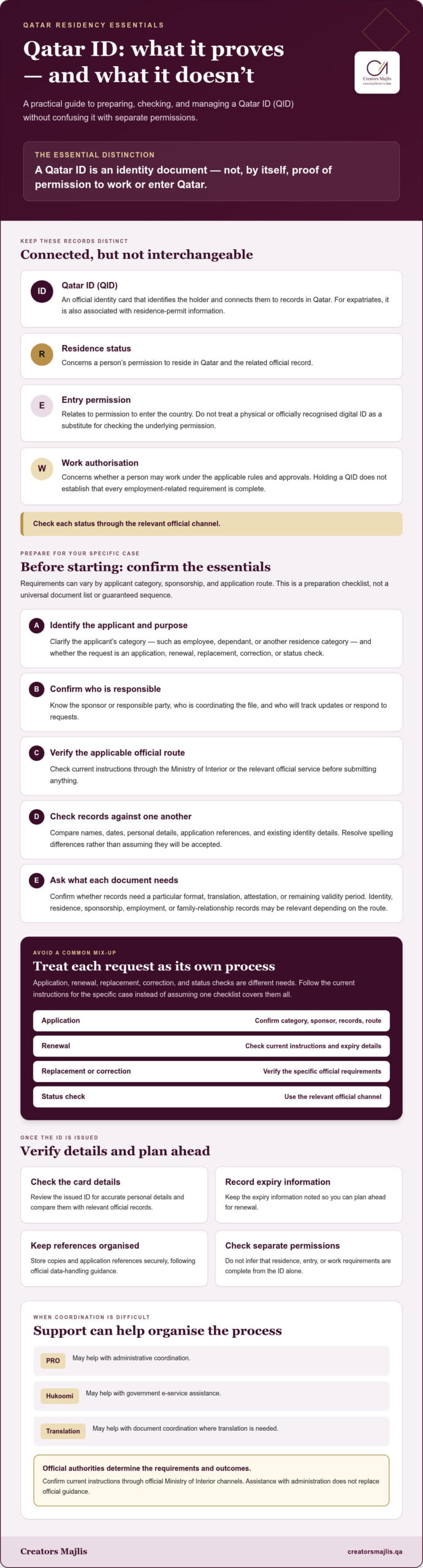
This practical 2026 checklist explains what the Qatar ID is for, what it does and doesn’t establish, and what to confirm for applications, renewals, replacements, and status checks. Use it to organise your questions and records, then verify current instructions through official Ministry of Interior channels. Where coordination is difficult, PRO support, Hukoomi assistance, or translation may help with administration, but official authorities determine requirements and outcomes.
Key Takeaways
- Understand what a Qatar ID confirms, and why it should not be treated as proof of work authorisation.
- Identify the applicant category and responsible party before gathering records, since requirements can vary by situation.
- Keep application, renewal, replacement, and correction steps separate, then follow the current official instructions for your case.
- Check the details on your issued ID and record its expiry information so you can plan ahead.
- Consider document coordination, translation, or government e-service assistance if you need help organising the process.
What is a Qatar ID, and what does it actually prove?
For residents, a Qatar ID (QID) is an official identity card used to identify the holder and connect them to their records in Qatar. For expatriates, it is also associated with residence permit information. In plain English: a Qatar ID is an identity document that reflects key personal and residency records, but it is not, by itself, permission to enter or work in Qatar. Check current terminology and procedures through the Ministry of Interior, since rules and application routes may vary by category.
National identity cards serve different functions around the world. For broader context, you can compare Qatar’s approach with other countries’ national identity document policies. For decisions about your own status, rely on current official Qatar guidance rather than general comparisons.
Qatar ID, residence status, and work permission: how are they different?
These concepts are connected, but they are not interchangeable. The QID is the identity document. Residence status concerns a person’s permission to reside in Qatar and the associated official record. Entry permission relates to entering the country, while work authorisation concerns whether a person may work under the applicable rules and approvals. A physical card, or a digital version where officially recognised, should not be treated as a substitute for checking those underlying permissions.
For example, a business owner arranging an employee’s move may need to coordinate employment-related approvals, residence procedures, and identity documentation. These steps can be linked, but receiving or holding an ID card does not by itself establish that every separate requirement has been met. Check each status through the relevant official channel.
Who may need a Qatar ID?
Residents can include employees, dependants, and people in other residence categories. Eligibility, sponsor or responsible party, documents, and application route may differ. Don’t assume a colleague’s checklist applies to your case. First identify the applicant’s category and the purpose of the request, then confirm the current instructions with the Ministry of Interior or the relevant official service.
A useful starting point is to identify the document you need and verify the status or permission it is meant to reflect. This helps residents and employers avoid treating one administrative milestone as confirmation that every other step is complete.
Qatar ID preparation checklist: what to confirm before starting
Prepare for your specific case. This checklist helps you organise questions and records, but it is not a guaranteed application sequence or a universal document list. The correct route may depend on the applicant’s category and circumstances, so confirm official instructions before submitting anything.
Information and documents to verify for your situation
Start by identifying the applicant category, the person or organisation coordinating the process, and the official channel that applies. Then check which identity and supporting records are required for that case. Depending on the route, records may relate to identity, residence, sponsorship, employment, or family relationships. Treat these as categories to verify, not a promise that every item will be requested.
Before submission, check each record for the following:
- Compare names, dates, and other personal details across documents. Resolve spelling differences rather than assuming they’ll be accepted.
- Confirm whether records need a particular format, translation, attestation, or remaining validity period. Requirements may differ by document and applicant category.
- Check that application references or existing identity details are accurate and match the relevant official records.
If the process involves an employer establishing or organising a business in Qatar, review the wider setup context in this Qatar company formation guide. Business setup planning does not replace the current instructions for an individual’s application.
A simple readiness check for applicants and employers
Before moving forward, make sure everyone involved knows who is coordinating the file, which official route applies, and how updates or requests will be tracked. Keep copies and reference details organised in a secure location, following official data-handling guidance. If an employer and applicant are sharing tasks, agree who will check each item and respond to requests so that nothing is overlooked.
- Ready: The applicant category and responsible party are clear, and records appear consistent and current.
- Pause and verify: A record is missing, expired, difficult to read, or inconsistent with another document.
- Confirm through official channels: You’re unsure about a requirement, submission format, or next step.
For an official document inquiry, use the Ministry of Interior’s service to check your QID status. Keep the result with your records, but verify application-specific instructions separately. If coordinating documents or government e-services becomes difficult, ask about PRO support in Qatar. Administrative support can help organise the process, while the relevant authorities determine requirements and outcomes.
Qatar ID application and renewal: understand the stages without assumptions
Think of the process as a series of checks, not one fixed checklist for every resident. First confirm the applicant’s category and the relevant official route. Then prepare the records requested for that case, follow the authority’s instructions, and check the result through the appropriate official channel. The steps, responsible parties, and submission method may differ for a first application and a later service request.
Hukoomi and the Ministry of Interior provide government information and services, but a page describing one service may not cover every applicant group. Review official Qatar ID services and check whether the information applies to your circumstances. Use relevant Ministry of Interior guidance to verify the route before acting.
What to expect during a first-time process
For a first-time application, the broad stages are to confirm the applicable route, identify who is responsible for coordination, prepare the records specified by the authority, and follow any instructions for submission or appointments. Additional requirements may apply in some cases. Don’t assume every applicant uses the same portal, attends the same appointment, or provides identical evidence. The applicant, employer, or sponsor may have different roles depending on the case.
Once submitted, retain the official reference and follow the stated method for checking progress or responding to a request. Keep a record of what was sent and when, so applicants and employers can coordinate without treating an estimated timeline or an intermediary’s update as an official decision.
Renewals, replacements, and correcting details
Renewal is a separate task from a first-time application. Check the current renewal window, required actions, and responsible party through official instructions rather than relying on a previous cycle or another person’s experience. If details on an issued card are incorrect, or the card is lost or damaged, verify the relevant correction or replacement procedure. These situations may require different steps from renewal.
- Renewal: Confirm the applicable dates, route, and instructions for the resident’s category.
- Replacement: Check the official process for a lost or damaged card before submitting a request.
- Correction: Identify which record needs correcting and follow the authority’s instructions for updating it.
Keep references and status updates together, and use official channels to confirm what action is required next. Manage each request according to its purpose, and let current instructions, not assumptions, guide the next step.
Qatar ID checklist after issuance: verify details and plan ahead
Receiving your Qatar ID is a useful milestone, but check it before filing it away. Compare the details shown on the card with your official records, including the spelling of your name and other identifying information. If something doesn’t match, follow the relevant authority’s correction instructions rather than assuming the card can be used as issued without further action.
Good recordkeeping also supports coordination between business owners and employees. Store the card and related records securely, limit access to people who need the information, and note the confirmed expiry date. Set a reminder based on current renewal guidance so you have time to check requirements and arrange the next steps.
Check your Qatar ID details and keep records organised
Match the issued details against the source records used in the process. If you spot an error, check official instructions for reporting or correcting it and retain any reference linked to your enquiry. Keep copies in a secure location, and don’t share sensitive information unless it’s needed for a legitimate administrative purpose. Digital access or display options may be available, but confirm their acceptance and use through official sources.
Plan for expiry, changes, or a lost card
Record the expiry date and set a reminder that leaves time to review current renewal instructions. If relevant personal information changes, check whether official records or the card need updating. For loss or damage, follow verified reporting and replacement guidance. Don’t rely on an old process or assume that a digital copy replaces any required action.
- Expiry: Keep the date visible to the applicant and whoever coordinates the renewal.
- Changed details: Confirm whether an update is needed and which official route applies.
- Lost or damaged card: Check the current reporting and replacement instructions, then save the official reference.
For employers coordinating employee records, a consistent tracking process can help keep expiry dates, references, and follow-up tasks together. The Qatar PRO services guide offers relevant administrative context. If you need help coordinating QID-related administration or government e-services, contact Creators Majlis about PRO support. Administrative support can help organise the process, while official authorities determine requirements and outcomes.
When Qatar ID support can help you move forward
The key steps are to identify the applicant category, check current official instructions, organise relevant records, and track the outcome and any follow-up. The right process depends on the individual case. Qatar’s authorities set the applicable requirements and make decisions, so treat third-party guidance as administrative support, not a substitute for official confirmation.
Support may be useful when an employer is coordinating records across several people, an applicant needs help organising documents, or instructions for a government e-service are unclear. Translation can also help make documents easier to review, but confirm with the relevant authority whether a translation, format, or other condition is required for your case.
What a PRO support partner can and cannot do
Creators Majlis provides PRO services, QID processing assistance, Hukoomi government e-services, residency assistance, and professional translation. This support can help with administrative coordination and understanding the steps involved. It does not make the firm a government authority, allow it to issue a Qatar ID, or guarantee approval. Before engaging a provider, agree on the scope of support, who is responsible for each action, and which documents may be needed. Verify changing requirements directly through official channels.
Clear responsibilities matter. For example, an employer and applicant can agree who will organise records, monitor official updates, and respond to requests. This helps avoid confusion without suggesting that an intermediary controls the application or its outcome.
Choose your next step with clarity
Before asking for administrative help, prepare a short case summary. Include the applicant’s category, current status, type of request, relevant reference details, and the questions you need answered. Don’t send sensitive records until you understand why they’re needed and how they’ll be handled.
If a requirement or personal circumstance is unclear, verify the correct route with the relevant official authority first. Then decide whether support with document coordination, translation, or Hukoomi services would make the process easier to manage. The goal is an organised next step, not a promise of a particular outcome.
If you’d like to discuss your circumstances and possible administrative support, contact Creators Majlis to discuss your next steps.
Keep your Qatar ID process clear and organised
A Qatar ID is an important identity document, but it shouldn’t be confused with residence status, entry permission, or work authorisation. Start by confirming the applicant’s category and current official route, then prepare the records that apply to that case. After issuance, check the details and keep expiry information organised so you can plan ahead.
Requirements and outcomes are determined by the relevant authorities, and procedures may differ for applications, renewals, replacements, and corrections. Verify instructions through official channels whenever your circumstances or the next step are unclear.
For employers and residents who would value administrative coordination, Creators Majlis provides PRO support that includes QID processing and Hukoomi government e-services. Residency assistance and professional translation are also available. This support can help organise the process, but it doesn’t replace official guidance or guarantee an outcome.
Discuss your Qatar ID support needs with Creators Majlis and share your circumstances to explore a practical next step. With clear records and the right guidance, you can move forward with greater confidence.
Frequently Asked Questions
What is a Qatar ID?
A Qatar ID, often called a QID, is an identity document associated with a person’s residence in Qatar. It helps identify the holder and is linked to official personal records. It isn’t interchangeable with a visa, residence status, or permission to work, which describe different parts of a person’s administrative situation. Check current Ministry of Interior guidance to understand how the ID applies to your category and circumstances.
Is a Qatar ID the same as a work permit?
No. A Qatar ID is an identity document, while work authorisation and residence arrangements are separate matters, even when their processes involve the same person or employer. Holding an ID alone shouldn’t be treated as proof of permission to work. Requirements depend on the individual’s circumstances and current rules, so confirm the applicable route with official sources and the responsible employer or sponsor where relevant.
Who needs a Qatar ID?
People living in Qatar may need a Qatar ID, but eligibility and procedures depend on their status and circumstances. Employees, dependants, and other resident categories may follow different routes and have different requirements. This general overview can’t determine an individual’s eligibility. Check current official guidance for the applicant’s category, and ask the responsible employer or sponsor to clarify their role if one applies to the case.
What documents are needed to apply for a Qatar ID?
There isn’t one document list that safely applies to every applicant and process. First confirm the official route for the person’s category, then check which identity records and supporting documents are requested. Instructions may also specify document validity, format, translation, or attestation. Compare names and personal details across records before submission, and share sensitive information only through verified channels or as directed by the relevant authority.
How do I check or renew my Qatar ID?
Start by identifying the task: checking a current record, renewing an ID, replacing a lost or damaged card, or correcting details. Each may have a distinct official procedure. Use current Ministry of Interior or relevant government guidance to confirm the correct channel, timing, and records for your case. Don’t rely on an old checklist or unverified third-party timeline, as instructions can vary by applicant category and situation.
How long does it take to get a Qatar ID?
There’s no single timeframe that should be treated as a guarantee for every Qatar ID application. Timing can depend on the applicant’s circumstances, route, completeness of records, and current government procedures. Confirm any estimate through the responsible official channel or the authorised coordinator handling the case. If a deadline matters, ask which steps remain and whether any requested documents or actions are outstanding.
What should I do if my Qatar ID details are incorrect or the card is lost?
Follow current official instructions to correct inaccurate details or report and replace a lost card. The steps may differ depending on the issue and the applicant’s situation. Keep relevant application references available, protect personal information, and use verified government channels. If an employer or sponsor is coordinating the process, clarify their role while ensuring any official reporting or correction instructions are followed promptly.