

What if your next executive hire’s arrival wasn’t a source of administrative dread, but a seamless milestone in your company’s expansion? In the wake of Law No. 9 of 2026, the stakes for employee visa processing Qatar have never been higher. You likely feel the pressure to stay ahead of reinforced Ministry of Labour regulations while avoiding the operational blocks and public registries that come with non-compliance. It’s a complex landscape where a single digital contract error or a missed health insurance deadline can halt your momentum.
We understand that building a world-class team requires more than just finding talent; it requires a steady, knowledgeable hand to navigate the bureaucracy. This guide provides the strategic clarity you need to master the residency system, ensuring your international talent is onboarded with speed and total legal security. We’ll walk through the entire roadmap from digital contract authentication to the final issuance of the Qatar ID, giving you the confidence to focus on your business goals while we handle the administrative foundation. We will explore the critical transition from job offer to compliance, ensuring you have the tools to build your team with absolute certainty.
Key Takeaways
- Distinguish between work permits and residency permits to ensure your international talent remains compliant from their first day in the country.
- Master the end-to-end lifecycle of employee visa processing Qatar to transition smoothly from a digital contract to a secured Qatar ID.
- Evaluate the strategic benefits of direct sponsorship against third-party models to choose the most efficient path for your company’s growth.
- Pre-emptively manage medical and biometric requirements to avoid common administrative hurdles that can delay your team’s onboarding.
- Leverage Hukoomi government e-services and professional PRO support to maintain a clear, real-time view of your entire visa pipeline.
Navigating the 2026 Qatar Residency and Work Permit Landscape
As Qatar advances through its Third National Development Strategy, the role of international talent has evolved from a simple labor resource to a strategic pillar of national growth. By 2026, the government aims for over 46% of the total workforce to be classified as highly skilled. This shift means that employee visa processing Qatar is now a sophisticated strategic operation rather than a back-office task. Understanding the Visa policy of Qatar is your first step in building a compliant, resilient team that can scale alongside the nation’s ambitions.
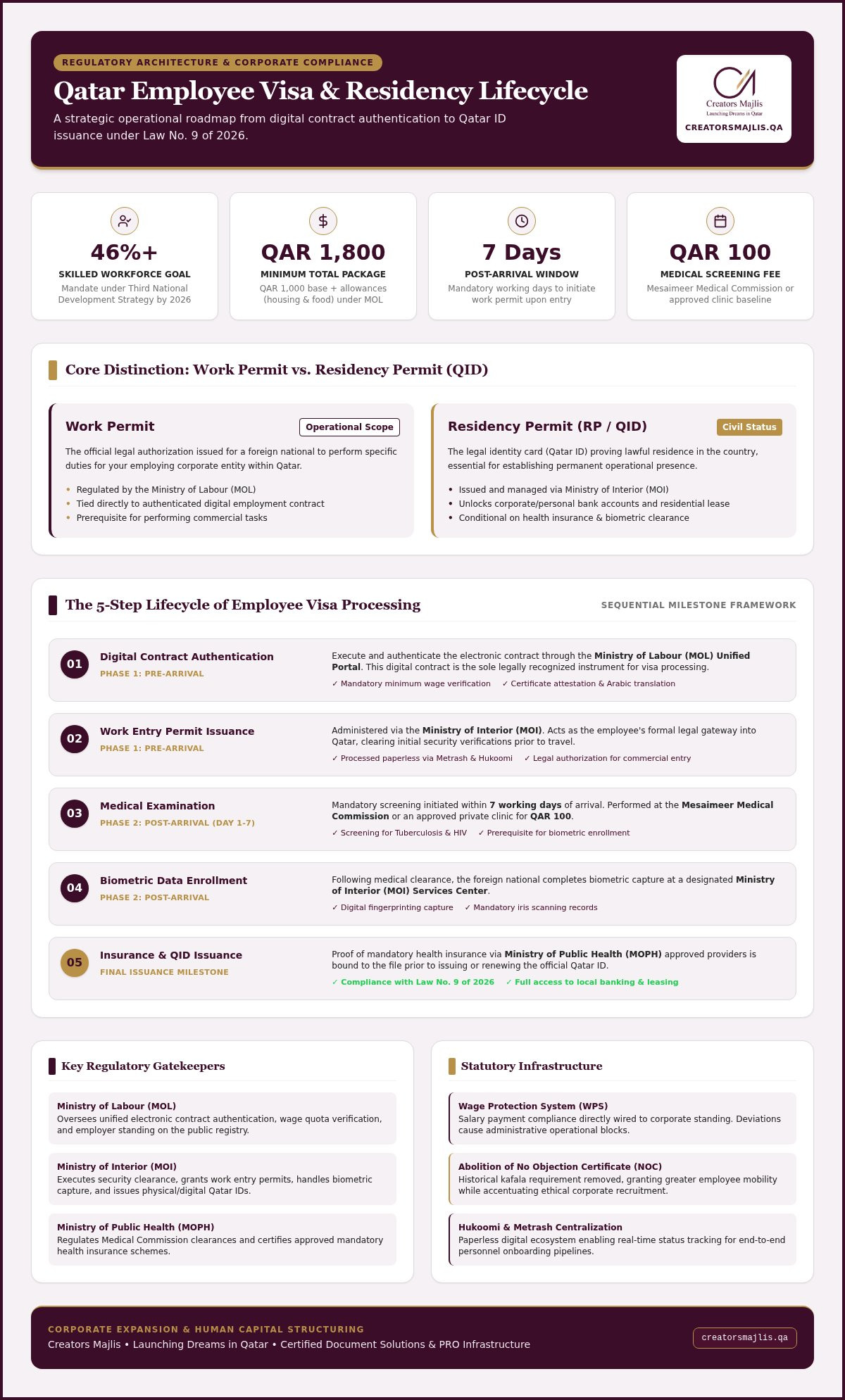
You’ll need to distinguish clearly between the Work Permit and the Residency Permit (RP). The work permit is the legal authorization for a foreign national to perform specific duties for your entity. The RP, often called the Qatar ID (QID), is the actual proof of residency that unlocks everything from local bank accounts to housing. Compliance starts early. The Wage Protection System (WPS) requirements are baked into the employee visa processing Qatar workflow. If your salary structures don’t align with Ministry of Labour standards from the outset, you risk immediate administrative blocks that can paralyze your operations.
Key Regulatory Bodies in the Visa Lifecycle
The Ministry of Labour (MOL) serves as the primary gatekeeper for digital employment contracts. They ensure every agreement meets the mandatory minimum wage of QAR 1,000, along with housing and food allowances totaling at least QAR 1,800. Once the MOL approves the digital contract, the Ministry of Interior (MOI) handles security clearances and biometric enrollment. This entire process is now paperless. Through Hukoomi and the Metrash application, government interactions are centralized. This digital shift allows for real-time tracking of every application, ensuring you aren’t left guessing about your team’s onboarding status.
Sponsorship Obligations for Qatari Entities
The landscape of sponsorship has changed, but your responsibilities remain vital. Under Law No. 9 of 2026, you’re legally bound to provide mandatory health insurance through Ministry of Public Health approved providers before a QID can be issued or renewed. While the requirement for a No Objection Certificate (NOC) has been abolished, allowing employees more mobility, your role involves ensuring ethical recruitment and maintaining a clean record on the MOL’s public registry. Compliance is about protecting your corporate reputation. By acting as a reliable local navigator, you provide the stabilizing force your employees need to focus on their work.
The Step-by-Step Lifecycle of Employee Visa Processing in Qatar
Transitioning from the historical sponsorship and kafala framework to the current digital-first era has transformed how companies scale. Employee visa processing Qatar is no longer a paper-heavy hurdle but a methodical sequence of five critical milestones. It begins with the issuance of a work entry permit by the Ministry of Interior, which serves as the employee’s legal gateway into the country. This initial step is the catalyst for everything that follows, setting the stage for a compliant onboarding experience.
Phase 1: Pre-Arrival and Contract Approval
Success starts long before the employee boards their flight. You must execute and authenticate a digital employment contract through the Ministry of Labour’s unified portal. This electronic version is the only legally recognized instrument for visa issuance and dispute resolution. You’ll also need to manage the attestation of educational certificates and marriage licenses. Since every official filing requires high-precision Arabic versions, leveraging certified translation services is essential to maintain compliance and avoid administrative delays that could stall your operations.
Phase 2: Post-Arrival Formalities
The moment your hire arrives, the pace accelerates. You’re required to initiate work permit processing within 7 working days of their entry. The first priority is the mandatory medical examination at the Mesaimeer Medical Commission or an approved private clinic. This screening, which typically costs QAR 100, checks for infectious diseases like Tuberculosis and HIV. It’s a non-negotiable prerequisite for residency. Once cleared, the employee moves to biometric enrollment for fingerprinting and iris scanning at a designated MOI service center.
The final milestone is the issuance of the Residency Permit and the physical Qatar ID (QID). This card is the employee’s lifeblood in the country, enabling them to access essential services and confirm their legal status. The entire process requires precision and a deep understanding of local timelines. If you feel the need for a local navigator to guide you through these specific requirements, it’s often helpful to connect with a professional PRO partner who can handle the background complexities while you focus on the foreground of your business.
Direct Sponsorship vs. Employer of Record (EOR): Choosing Your Path
Deciding how to structure your team’s legal presence is a pivotal strategic choice. While many providers push the Employer of Record (EOR) model as the only fast-track solution, savvy entrepreneurs recognize that true operational autonomy comes from direct ownership. Employee visa processing Qatar becomes a long-term asset when you hold your own visa quotas rather than “renting” them from a third party. Ownership gives you the security of a steady, knowledgeable hand over your most valuable resource: your people.
The financial math often favors the direct route for committed businesses. While EOR models offer lower initial hurdles, they carry recurring monthly service premiums that can erode your margins as your team scales. In contrast, direct sponsorship involves upfront setup fees but results in a significantly higher ROI over time. By following the Qatar work residence permit requirements directly, you eliminate middleman markups and retain full control over your Wage Protection System (WPS) filings. This independence is often anchored in proper LLC company formation in Qatar, which serves as the legal foundation for your establishment card and subsequent labor quotas.
When to Choose Direct Sponsorship
Direct sponsorship is the gold standard for companies with a long-term vision. It allows you to build genuine brand equity and foster direct employer-employee relationships without external interference. You can implement internal HR policies, performance bonuses, and career progression paths exactly as you see fit. This model also simplifies your administrative pipeline, as your internal or outsourced PRO manages your employee visa processing Qatar directly through your own Hukoomi portal, ensuring that your corporate data remains secure and under your exclusive purview.
When EOR Might Be a Temporary Alternative
EOR models can serve as a useful bridge if you’re testing a specific project or need to deploy a small team within weeks while your own entity is still being finalized. It acts as a stabilizing force during the initial market entry phase. However, you must be wary of prolonged reliance on third-party sponsorship. Under Law No. 9 of 2026, the Ministry of Labour has intensified its scrutiny of employment structures. Transitioning to your own sponsorship as soon as your entity is ready isn’t just a cost-saving move; it’s a vital compliance strategy that protects your business from the risks of administrative blocks targeting third-party sponsors.
Compliance Mastery: Avoiding Delays in Medical and Biometric Stages
Mastering the final hurdles of employee visa processing Qatar requires more than a checklist; it demands a proactive strategy to manage the medical and biometric stages. These phases are the most common points of friction where operational timelines can suddenly stall. You’ll need to ensure your talent is physically and administratively ready for the scrutiny of the Medical Commission and the Criminal Evidence and Information Department (CEID). Compliance isn’t just about paperwork. It’s about ensuring your team meets the stringent health and security standards that protect the nation’s workforce.
One of the most critical risks involves medical failure protocols. Qatar strictly enforces immigration health regulations targeting infectious diseases, specifically Tuberculosis, HIV, and Hepatitis B and C. A chest X-ray that reveals even old scar tissue can trigger a rejection. We recommend pre-screening talent in their home countries before they travel to mitigate the risk of medical deportation. Additionally, you must account for any previous GCC travel history. The integrated biometric systems across the region mean that identity matching is instantaneous, and any historical discrepancies can lead to lengthy security delays during the employee visa processing Qatar workflow.
The Medical Commission Workflow
Booking appointments through the Hukoomi portal or the Metrash app is the first step once your employee enters the country. The standard government fee for the medical fitness examination is QAR 100. During the appointment, the Commission conducts blood assays and chest X-rays. While results typically populate the Ministry of Interior database within 24 to 72 hours, certain job categories, such as food handlers or healthcare workers, may face additional screenings. If an employee requires a re-test, it’s vital to act immediately to stay within the statutory 30-day window for residency completion.
Biometrics and Fingerprinting Best Practices
Once the medical clearance is digitally logged, the employee must proceed to biometric enrollment. This involves iris scanning and fingerprinting at a designated MOI service center, which also carries a fee of approximately QAR 100. You’ll need to ensure the employee has their original passport and the printed medical clearance. Timing is everything here. Coordinating transport to avoid peak hours at the CEID centers can save hours of operational downtime. You can track the real-time status of the Qatar ID issuance through the Metrash application, which serves as your digital window into the final stages of the process.
If you want to ensure your team moves through these sensitive stages without a single administrative hiccup, consult with our strategic PRO experts to secure your onboarding timeline.
Optimizing Your Human Capital with Strategic PRO Support
High-growth firms in 2026 recognize that talent is their most volatile asset if not managed with absolute precision. Employee visa processing Qatar isn’t merely a series of government interactions; it’s the bridge between a job offer and a fully functioning contributor. By leveraging Hukoomi government e-services, you gain a real-time dashboard for your human capital. This digital visibility allows you to track visa statuses, labor quotas, and establishment card renewals from a single point of authority, ensuring that no administrative oversight halts your momentum.
Strategic success requires a foundation of compliance. When you integrate your administrative workflows with professional oversight, you eliminate the friction that typically slows down international scaling. This end-to-end support ensures that your corporate file remains pristine, allowing you to focus on the high-level goals of your expansion while the background complexities are handled by experts who know the terrain intimately.
The Value of a Dedicated PRO Partner
A strategic PRO partner acts as your local navigator, handling the complexities that often overwhelm internal HR teams. Beyond the initial employee visa processing Qatar, they manage the entire lifecycle of your corporate compliance. This includes proactive alerts for residency renewals and the management of sensitive cases, such as family sponsorship for your executive team. They also ensure that every filing is backed by certified translation, preventing the costly rejections that often stem from linguistic inaccuracies in official Ministry of Labour documents. It’s about providing the security of a steady, knowledgeable hand.
Next Steps for Your Qatari Team
Integrating residency management into your broader growth strategy is the final step toward market mastery. Once the QID is issued, your employees unlock the full spectrum of life in Qatar, from securing housing to establishing local banking relationships. This stability directly impacts your team’s retention and performance. If you’re ready to move from administrative confusion to strategic clarity, we invite you to secure a tailored PRO and residency assistance plan. Let us handle the background complexities so you can focus on the foreground of your business success.
Building a Resilient Workforce for Qatar’s Future
Mastering the residency lifecycle is more than a regulatory box to check; it’s a strategic investment in your firm’s long-term stability. By prioritizing direct sponsorship and rigorous medical pre-screening, you protect your operations from the administrative blocks and public registries mandated by the 2026 labor laws. Efficient employee visa processing Qatar ensures your international talent transitions from a job offer to a functional, productive role with speed and total legal security. This foundation allows you to focus on your core business objectives while the background complexities remain under control.
Creators Majlis acts as your visionary guide, providing the steady, knowledgeable hand required to navigate this evolving landscape. We offer expert Hukoomi e-service management, certified translation for all legal documents, and boutique support for both mainland and free zone entities. Our commitment is to bridge the gap between your expansion goals and a compliant, functioning reality. Secure Your Team’s Future with Creators Majlis PRO Services today. Your ambition to build a world-class team in Qatar deserves a partner who is personally invested in your success.
Frequently Asked Questions
How long does the employee visa processing take in Qatar in 2026?
Processing times typically range from two to four weeks depending on the candidate’s nationality and document readiness. You must initiate the work permit process within seven working days of the employee’s arrival. Once the medical and biometric results populate the Ministry of Interior database, which takes 24 to 72 hours, the final Qatar ID is issued. Pre-attesting documents and using digital portals ensures you stay within the statutory 30-day residency window.
Can an employee start working before their Qatar ID is issued?
Yes, an employee can begin their duties once they enter the country on a valid work entry permit and the digital employment contract is authenticated. However, they aren’t fully compliant until the Qatar ID is issued. You must complete the residency process within 30 days of entry to avoid fines. Holding a valid QID is also a prerequisite for accessing essential services like local bank accounts for salary disbursement via the Wage Protection System.
What documents need to be attested for a Qatar work visa?
You must provide attested educational certificates for all professional and technical roles. If the employee is sponsoring family members, marriage licenses and birth certificates also require attestation. This involves a multi-stage process starting in the home country’s Ministry of Foreign Affairs and ending with the Ministry of Foreign Affairs in Qatar. Using certified translation services ensures these documents are accepted by the Ministry of Labour during the digital contract authentication stage.
Is there a limit on the number of visas a new company can apply for?
Yes, your visa capacity is determined by a labor quota, also known as a block visa, approved by the Ministry of Labour. This quota specifies the approved nationalities, genders, and job titles for your entity. The Ministry evaluates your physical office space and commercial activity before granting these slots. Strategic PRO support can help you navigate these quota applications to ensure your hiring capacity aligns with your growth projections for the year.
What is the difference between a work permit and a residency permit?
A work permit is the legal authorization for a foreign national to perform specific professional duties for your company. In contrast, the residency permit, or Qatar ID, is the document that grants the individual the right to live in the country. Both are essential for employee visa processing Qatar. The work permit is often the first step, while the residency permit is the final milestone that confirms the employee’s legal status within the state.
How much does it cost to process an employee visa in Qatar?
Statutory government fees for the first year include the initial work permit at QAR 100 and the residency conversion at QAR 500. The mandatory medical and biometric screenings each cost approximately QAR 100. Additionally, the first-year residency issuance is QAR 1,000. You must also budget for mandatory employer-funded health insurance, which usually ranges from QAR 1,200 to QAR 1,500 per adult annually. These fixed government and insurance costs do not include professional service or translation fees.
Can I change an employee’s job title after the visa is processed?
Yes, you can change a job title, but it requires a formal application through the Ministry of Labour and the Ministry of Interior. You’ll need to update the digital employment contract and ensure the new title aligns with the employee’s attested educational qualifications. Once the Ministry of Labour approves the change, the Ministry of Interior updates the residency records and issues a new Qatar ID card. This ensures your corporate file remains accurate and compliant with current regulations.
What happens if an employee fails the mandatory medical test?
If an employee fails the medical screening for infectious diseases like Tuberculosis or HIV, the visa application is immediately rejected. Qatar enforces strict immigration health regulations, and a failure at the Medical Commission results in deportation without a right to appeal. To protect your operations and the candidate, we strongly recommend conducting thorough pre-departure medical screenings. This proactive step prevents the operational delays and financial losses associated with a failed in-country medical test.
Related services: PRO Services in Qatar · Residency in Qatar · Company Formation in Qatar