

What if the perceived wall of Qatari bureaucracy was actually a gateway to one of the world’s most stable and thriving economies? You’ve likely recognized the immense potential within this market, yet the technicalities of the Qatar company registration process often feel like a maze of government portals and complex translation requirements. It’s frustrating to face the ambiguity of 100% foreign ownership criteria or the meticulous demands of local document attestation when you’re ready to build. We understand that your ambition deserves a clear path, not a series of administrative hurdles.
This 2026 strategic guide is your definitive roadmap to navigating these complexities with absolute confidence. We’ve distilled the registration, licensing, and operational launch into a practical sequence that transforms bureaucratic tasks into exciting milestones. You’ll gain a clear timeline of every essential step, professional clarity on choosing the right legal structure, and a thorough understanding of post-registration compliance. By the end of this article, you’ll have the insights needed to move from a visionary concept to a fully functioning reality in the Qatari market.
Key Takeaways
- Learn how to select the ideal jurisdiction by comparing the unique advantages of Mainland, QFC, and Free Zone setups for your 2026 expansion.
- Master the end-to-end Qatar company registration process through a clear, phased roadmap that eliminates the guesswork from name reservation to final licensing.
- Identify the most effective legal structures for your goals, including how to maximize the benefits of 100% foreign ownership criteria.
- Discover how professional PRO services and Hukoomi support act as the stabilizing force for your ongoing corporate compliance and government relations.
- Unlock the value of starting with a feasibility study to ensure your business foundation is built on data-driven market insights rather than assumptions.
Navigating the Qatar Business Landscape in 2026
In 2026, Qatar stands as a premier destination for international capital. The nation has successfully transitioned into a diversified, knowledge-based economy, offering a stable and lucrative environment for global entrepreneurs. However, success here isn’t just about having a great idea. It requires a sophisticated understanding of the Qatar company registration process. You need to align your business goals with the right regulatory framework from the very start. This isn’t merely a bureaucratic exercise; it’s the first step in your strategic market entry.
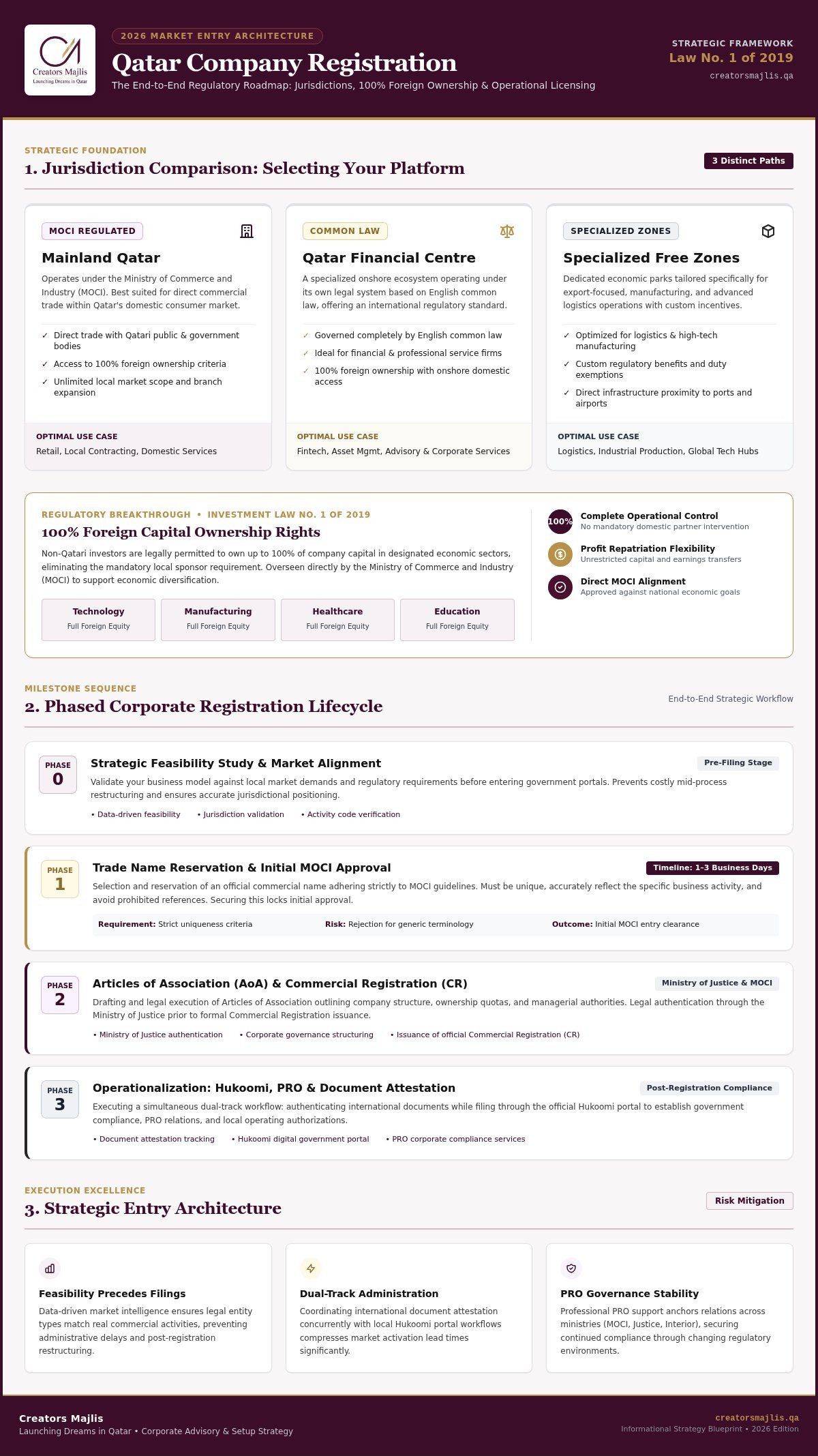
Establishing a presence requires choosing between three primary paths: Mainland, the Qatar Financial Centre (QFC), or specialized Free Zones. Each jurisdiction offers distinct advantages depending on your target audience and operational needs. Making this choice early is vital because it dictates your licensing requirements, tax obligations, and your ability to trade within the local market. A well-planned registration strategy ensures your foundation is built for long-term growth. If your organization is also mapping out cross-border expansion in neighbouring Gulf markets, EBMS Business Services LLC provides specialized support for UAE mainland, free zone, and offshore business setup.
The Rise of 100% Foreign Ownership
Investment Law No. 1 of 2019 revolutionized the market by permitting non-Qatari investors to own up to 100% of the capital in most economic sectors. This landmark legislation removed the traditional requirement for a local partner in industries such as technology, manufacturing, healthcare, and education. The Ministry of Commerce and Industry (MOCI) oversees these approvals, ensuring that your ownership structure aligns with national economic targets. Choosing this path provides you with full operational control and greater flexibility in profit repatriation. It’s a powerful incentive that has made the Qatar company registration process more attractive to international firms than ever before. To understand exactly which sectors qualify and how to structure your equity for maximum autonomy, see our comprehensive guide on 100% foreign ownership in Qatar for international investors in 2026.
Mainland vs. Specialized Economic Zones
Your specific business activity dictates your jurisdiction. Mainland companies fall under MOCI regulations and are ideal for those wishing to trade directly with the public or government entities. Conversely, the Qatar Financial Centre platform offers a unique onshore environment governed by English common law; it’s perfect for financial and professional services firms. There are also specialized Free Zones designed for logistics and high-tech industries. Selecting the wrong zone can lead to operational restrictions or missed tax benefits. To make an informed choice, consult our Business Setup in Qatar 2026: The Strategic Guide to Market Entry for a deeper jurisdiction analysis.
Launching a venture requires a blend of legal and operational strategy. You must manage timelines for document attestation while simultaneously preparing for Hukoomi portal filings. This dual-track approach prevents common delays that stall many new entrants. By treating registration as a milestone-driven project, you secure your market position faster and with greater confidence.
The Step-by-Step Qatar Company Registration Process
Success in the Qatari market begins long before you log into a government portal. We call this “Step 0,” the essential feasibility phase where you align your business model with local market demands and regulatory requirements. Skipping this foundational step often leads to costly pivots later. Once your strategy is set, the Qatar company registration process moves through a structured sequence of approvals involving key stakeholders like the Ministry of Commerce and Industry (MOCI) and the Ministry of Justice. Understanding this roadmap allows you to manage expectations and resources effectively as you transition from an idea to a legal entity.
Phase 1: Trade Name Reservation and Initial Approval
Your first milestone is securing a trade name that complies with MOCI guidelines. In 2026, the criteria remain strict; names must be unique, avoid prohibited religious or political references, and accurately reflect your business activity. Once you’ve selected a name, you’ll apply for initial approval from MOCI. This phase typically takes 1 to 3 business days. A common pitfall is choosing a name that is too generic or already trademarked, which can lead to immediate rejection. If you’re unsure which phase to prioritize first, our team can provide a personalized walkthrough of the current reservation standards.
Phase 2: Articles of Association and Commercial Registration
With initial approval in hand, you must draft your Articles of Association (AoA). This document defines your company’s internal regulations, ownership percentages, and management structure. The Ministry of Justice must authenticate the Articles of Association before any further steps can be taken. As highlighted in the International Trade Administration’s guide to establishing an office in Qatar, securing your Commercial Registration (CR) is a pivotal moment in establishing a legal presence. The CR acts as your company’s birth certificate, enabling you to open corporate bank accounts and sign contracts. This phase generally requires 3 to 7 business days to complete.
Phase 3: Trade License and Signage Approvals
The final phase transforms your legal entity into an operational business. While the CR gives you a legal name, the Trade License gives you the right to conduct specific activities from a physical location. You must secure a commercial lease and obtain signage approvals from the municipality to ensure your storefront or office meets national safety and aesthetic standards. For a broader view of the ecosystem, see our guide on How to Start a Business in Qatar: The Definitive 2026 Investor Roadmap. Expect this final stage to take 1 to 2 weeks, depending on the speed of physical inspections and document processing.
Legal Structures: Choosing the Right Entity for Your Goals
Selecting your legal entity is the most significant decision in the Qatar company registration process. It’s not just about compliance; it’s about defining your operational boundaries and tax efficiency. Whether you’re a global tech giant or a boutique consultancy, your choice between a Mainland LLC or a specialized platform like the QFC will determine how you interact with the local economy and manage your capital. This decision creates the framework within which your business will grow, so it’s vital to align it with your 2026 strategic objectives.
Strategic LLC Formation in Qatar
The Limited Liability Company (LLC) remains the most versatile and popular vehicle for international investors. It grants you the freedom to trade directly with government entities and the local private sector across the nation. While the 2019 Investment Law allows for 100% ownership in many sectors, the specific commercial registration requirements in Qatar must still be met through the Ministry of Commerce and Industry. For a deep dive into capital requirements and shareholder protections, explore our guide on LLC Company Formation Qatar: The Definitive 2026 Strategic Guide. In 2026, the minimum capital is generally defined by the company’s activity, and the structure requires at least one shareholder, offering a robust foundation for market entry.
The QFC Alternative for Professional Services
For firms in fintech, consulting, or financial services, the Qatar Financial Centre (QFC) offers an attractive onshore alternative. Unlike Mainland entities, the QFC operates under its own legal and regulatory framework based on English Common Law. This provides a familiar environment for international firms accustomed to global business standards. Key advantages include 100% foreign ownership in Qatar across all activities and the ability to repatriate 100% of profits without restriction. The QFC also maintains a competitive corporate tax rate of 10% on locally sourced profits, making it a strategic choice for high-growth service providers looking for a sophisticated regulatory home.
If your goal is simply to explore the market without commercial trading, a Representative Office might suffice. However, if you intend to execute contracts and generate revenue, a Branch Office, which remains a legal extension of your parent company, is often the preferred route for foreign contractors. Each structure carries unique implications for your tax liability and liability exposure. Aligning these technicalities with your long-term vision ensures that the Qatar company registration process serves as a springboard for success rather than a restrictive hurdle.
Operationalizing Your Business: PRO Services and Compliance
Securing your Commercial Registration marks a significant milestone, but the legal birth of your entity is only the beginning. To truly operationalize, you must transition from paperwork to people and physical presence. This phase of the Qatar company registration process demands continuous interaction with various government bodies. Public Relations Officer (PRO) services serve as your strategic bridge, handling the intricate administrative tasks that keep your business compliant and moving forward. They act as the stabilizing force in the background, allowing you to focus on your core growth objectives.
Managing the Hukoomi government e-services portal is a daily reality for 2026 ventures. While the platform is designed for efficiency, the technical requirements for corporate filings and license management are meticulous. A single error in a digital submission can stall your operations for weeks. Professional PRO support ensures your annual renewals and license updates are handled proactively, preventing any disruption to your market momentum. This proactive stance is what separates successful market entries from those that struggle with administrative friction.
Visa Processing and Qatar ID (QID) Management
Bringing your team into the country requires navigating a multi-layered system of investor visas and employee work permits. The Qatar ID (QID) serves as the essential document for all administrative life in Qatar. Beyond the initial application, your business must coordinate medical checks and fingerprinting for every team member. These are not just bureaucratic hurdles; they are necessary steps to establish a secure and authorized workforce. Managing these timelines effectively ensures your team is on the ground and productive as quickly as possible.
Certified Translation and Document Attestation
Precision in documentation is non-negotiable. All foreign documents, from board resolutions to educational certificates, must be translated into Arabic by certified professionals to be recognized for official use. The Ministry of Foreign Affairs (MOFA) plays a critical role in this cycle through document attestation, verifying the authenticity of your international paperwork. This process is vital for ensuring that your foreign legal documents carry weight within the Qatari regulatory system.
Creators Majlis streamlines this entire PRO and translation workflow, acting as your local navigator through the Ministry of Foreign Affairs and other regulatory bodies. We ensure your documents are attested correctly and translated with the highest accuracy. If you are ready to move past the paperwork and start growing your team, reach out to our expert consultants today to secure your operational foundation.
Launching with Creators Majlis: Your Strategic Partner in Qatar
In 2026, the Qatari market presents a landscape of unparalleled opportunity, but it also demands a high level of administrative precision. You don’t just need a service provider; you need a strategic partner who understands the deep nuances of the local regulatory environment. Unlike large, high-volume consultancies where your vision can get lost in a sea of files, Creators Majlis offers a sophisticated, personalized experience. We act as your dedicated navigator through the Qatar company registration process, ensuring that every milestone is met with clarity and foresight. This boutique approach gives you direct access to senior expertise, turning complex government requirements into a structured path for growth.
Our commitment goes beyond simply filing paperwork. We see ourselves as a bridge between your ambition and the practical reality of the Qatari business world. By handling the background complexities of PRO services and certified translation, we provide you with the security of a steady, knowledgeable hand. We don’t just react to bureaucratic changes; we anticipate them, ensuring your compliance is always ahead of the curve. This allows you to maintain your momentum and focus on the strategic foreground of your business. In a market where local knowledge is the ultimate currency, having a reliable guide is the difference between a stalled entry and a successful launch.
Feasibility and Market Entry Research
A successful launch is built on a foundation of data, not assumptions. Our feasibility studies and market research services validate your business model against real-time 2026 Qatari market data. We help you identify specific competitive advantages and potential local partners that align with your industry goals. This data-driven strategic advisory mitigates risk by identifying potential hurdles before they impact your timeline. We ensure your market entry strategy is grounded in practicality, giving you the confidence to move forward with your investment because you understand the landscape before you even begin the registration journey.
A Seamless Path to Market Entry
We provide a “white-glove” approach to company formation that covers the entire lifecycle of your setup. Our end-to-end support ranges from securing your first trade license to managing residency permits and protecting your intellectual property through trademark registration. We understand that your brand’s security is paramount, which is why we integrate IP protection into the initial registration journey. By managing the intricate details of Hukoomi filings and document attestation, we ensure your transition into the Qatari market is seamless and professional. Ready to launch? Partner with Creators Majlis for expert Qatar company registration today.
Building Your Qatari Legacy in 2026
You’ve explored the strategic roadmap for entering one of the world’s most dynamic economies. Success here depends on more than just completing paperwork; it requires choosing the ideal jurisdiction and grounding your venture in data-driven market research. From navigating 100% foreign ownership criteria to mastering the technicalities of the Qatar company registration process, every milestone you achieve builds a stronger foundation for your future growth.
As specialists in QFC and Mainland formation, Creators Majlis provides the comprehensive PRO and Hukoomi support you need to handle administrative hurdles with ease. We manage the intricacies of certified translation and document attestation so you can stay focused on your visionary goals. Our expertise in feasibility studies ensures your market entry is backed by practical, local insights. Your ambition deserves a strategic partner who is personally invested in your journey from the first license to operational launch. Secure your strategic market entry with Creators Majlis today and transform your business vision into a functioning reality. The path to your achievement is clear, and we’re ready to lead the way.
Frequently Asked Questions
How long does the Qatar company registration process take in 2026?
The full Qatar company registration process typically takes between four to six weeks to reach complete operational status. While initial phases like trade name reservation are completed within one to three business days; the issuance of a Commercial Registration usually requires three to seven days. Finalizing the Trade License and municipal approvals adds another one to two weeks. Timelines vary based on the complexity of your specific business activity and the efficiency of document attestation.
Can a foreigner own 100% of a company in Qatar?
Yes; international investors can achieve 100% ownership in most economic sectors under Investment Law No. 1 of 2019. This legislation covers industries such as information technology, manufacturing, and healthcare. While the Ministry of Commerce and Industry oversees these approvals; specialized zones like the Qatar Financial Centre also offer full ownership by default. It’s essential to verify if your specific activity falls within the eligible sectors before initiating the setup process.
What is the minimum capital required to start an LLC in Qatar?
Minimum capital requirements are generally defined by your specific business activity and chosen legal structure. For a standard Limited Liability Company; the Ministry of Commerce and Industry evaluates the capital based on the scale of the proposed operations. While traditional benchmarks exist; the 2026 regulatory environment focuses on ensuring the entity has sufficient funds to support its stated objectives. Consulting with a strategic advisor helps determine the exact capital commitment required for your registration.
What is the difference between a Commercial Registration (CR) and a Trade License?
A Commercial Registration (CR) acts as your company’s legal identity or birth certificate; allowing you to open bank accounts and sign contracts. Conversely; a Trade License is the permit that grants you the legal right to conduct specific business activities from a physical location. You must secure a CR before you can apply for a Trade License. Both documents are mandatory for any entity looking to operate legally within the national market.
Do I need a physical office space to register a company in Qatar?
Yes; securing a physical office space is a mandatory requirement for the issuance of a Trade License in 2026. The municipality must inspect and approve the premises to ensure they meet safety and aesthetic standards. While some specialized zones offer flexible desk options; mainland companies must typically provide a valid commercial lease agreement. This physical presence serves as the registered address for all official government communications and inspections throughout the company’s lifecycle.
What are PRO services and why does my company need them?
Public Relations Officer (PRO) services manage the essential bridge between your business and government departments during and after the Qatar company registration process. Your company needs them to handle complex tasks like visa processing; Qatar ID (QID) management; and document attestation at the Ministry of Foreign Affairs. These specialists ensure your entity remains compliant with annual renewals and labor laws. By outsourcing these administrative burdens; you can focus on strategic growth while your PRO handles the meticulous Hukoomi portal filings.
Can I register a company in the QFC if I am not a financial firm?
Yes; the Qatar Financial Centre (QFC) is not limited to financial firms and welcomes a wide range of professional services. Businesses in fintech; consulting; media; and information technology frequently choose the QFC for its English Common Law framework. The platform provides a sophisticated onshore environment with 100% foreign ownership and competitive tax rates. It’s a strategic alternative for service-based ventures that don’t require a mainland presence to trade directly with the local public.
What documents are required for initial approval from MOCI?
Initial approval from the Ministry of Commerce and Industry (MOCI) requires a set of foundational documents. You must provide a valid trade name reservation; copies of the shareholders’ identification or passports; and a draft of the Articles of Association. If a foreign entity is a shareholder; attested board resolutions and certificates of incorporation from the home country are also necessary. Ensuring these documents are translated into Arabic by certified professionals prevents delays during the early registration phase.