

What if your biggest obstacle to market entry isn’t the regulatory framework, but the outdated map you’re using to navigate it? You’ve likely realized that business setup in qatar in 2026 requires more than just a filing agent; it demands a strategic partner who understands a landscape where the non-hydrocarbon sector now powers over 65% of the economy. It’s natural to feel overwhelmed by the complexities of the Hukoomi portal or the high-stakes choice between QFC and Mainland structures. You want the security of 100% ownership without the stress of hidden setup costs or the frustration of PRO delays.
We’re here to bridge the gap between your ambition and a fully operational reality. This guide offers an expert roadmap to navigate Qatar’s latest regulations, including the e-commerce framework established in March 2026 and recent excise tax updates. You’ll gain a clear path to securing your legal entity, protecting your brand through trademarking, and mobilizing a team with valid QIDs. We will explore the essential steps of company formation, from initial feasibility to long-term operational growth in a rapidly diversifying market.
Key Takeaways
- Identify the high-growth sectors within Qatar’s 2030 Vision to align your market entry with national economic diversification goals.
- Navigate the critical choice between 100% foreign-owned Mainland structures and the world-class legal framework of the QFC for your business setup in qatar.
- Follow a precise five-step registration roadmap to secure your commercial license and navigate the complexities of drafting Articles of Association.
- Understand how integrated PRO services and Hukoomi management maintain operational continuity through seamless QID and permit processing.
- Leverage feasibility studies and strategic market research to transform a basic license into a sustainable, competitive presence in the Qatari market.
The 2026 Qatar Business Landscape: Opportunities for Growth
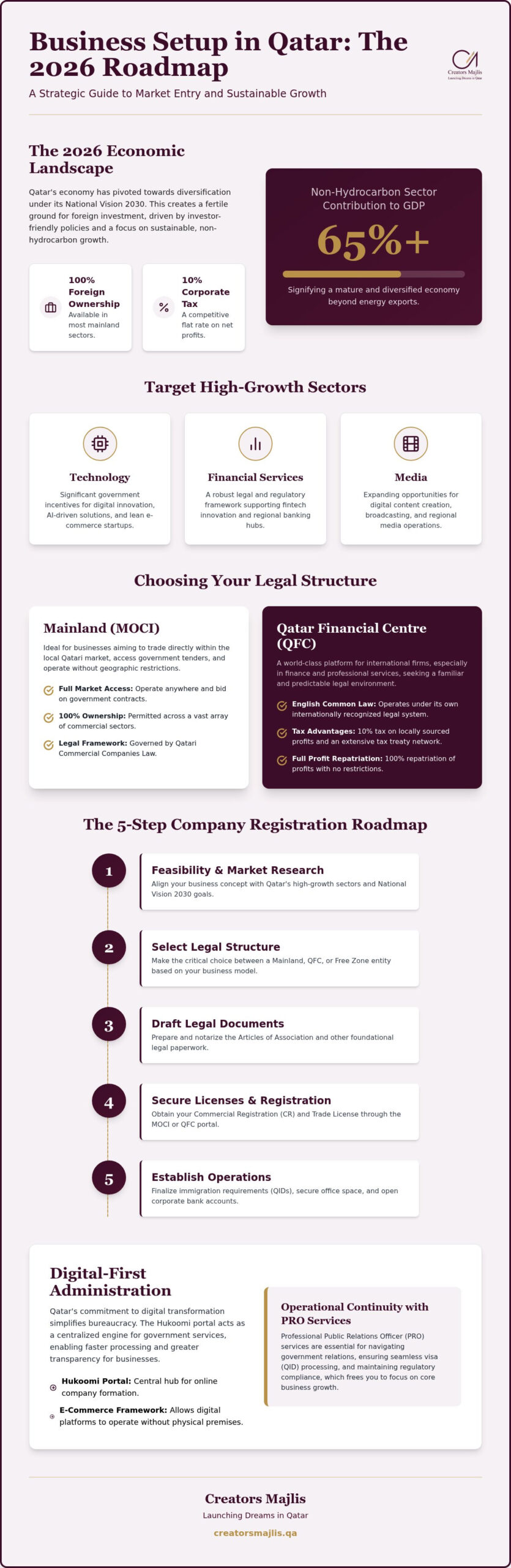
Qatar’s economic trajectory in 2026 isn’t just about energy; it’s a story of calculated diversification. As the nation enters the final chapters of the Qatar National Vision 2030, the Economy of Qatar has transformed into a resilient hub where the non-hydrocarbon sector now accounts for over 65% of total GDP. This shift creates a fertile ground for entrepreneurs. If you’re considering a business setup in qatar, 2026 offers a unique window where infrastructure is mature and regulatory frameworks are increasingly investor-friendly. The focus has moved from building the foundation to accelerating operational excellence across all sectors.
Economic Diversification and Investor Incentives
The Third National Development Strategy (NDS3) has sharpened the focus on SMEs, providing a protective yet ambitious environment for growth. Foreign investors now enjoy 100% ownership rights in most mainland sectors, supported by a competitive 10% flat corporate tax on net profits. You should also stay mindful of the latest amendments to the Excise Tax Law (Law No. 2 of 2026), which took effect in July 2026, reflecting the government’s commitment to a sophisticated and transparent tax base. Key sectors driving this momentum include:
- Technology: Significant incentives for digital innovation and AI-driven solutions.
- Financial Services: A robust framework for fintech and regional banking hubs.
- Media: Expanding opportunities for content creation and digital broadcasting.
By positioning your venture within this ecosystem, you gain access to a market that prioritizes stability and full capital repatriation rights. The Qatar Financial Centre (QFC) continues to act as a bridge for international firms, offering a world-class legal and tax environment that attracts global talent and simplifies cross-border operations.
Digital Transformation in Business Administration
The administrative burden that once defined regional market entry is fading. The Hukoomi portal has evolved into a centralized engine for digital-first government services, significantly shortening the timeline for company formation. With the enforcement of Ministerial Decision No. 25 of 2026, the new e-commerce licensing framework allows digital platforms to operate without physical premises in specific categories. This change drastically lowers the barrier to entry for lean startups and digital service providers.
Digital compliance is no longer optional; it’s the foundation of modern operations. Moving toward a paperless environment isn’t just a government goal; it’s a practical reality that streamlines everything from municipal licensing to Chamber of Commerce registrations. You can now manage corporate documentation with a level of transparency and speed that was previously impossible. Successfully navigating this paperless transition requires a firm grasp of the latest e-services, but the reward is a significantly reduced operational overhead and faster time-to-market.
Choosing Your Legal Structure: Mainland vs. QFC vs. Free Zones
Selecting the right legal vehicle for your business setup in qatar is the most consequential decision in your market entry journey. Your choice dictates your tax obligations, ownership rights, and your ability to trade within the local market. The landscape is sophisticated; resources like Invest Qatar provide a high-level view of why this market is so attractive for global capital, but the practical execution requires a deep dive into specific licensing platforms and regulatory requirements.
Mainland Company Formation (MOCI)
The Limited Liability Company (LLC) remains the bedrock of mainland operations. Historically, foreign investors required a local partner holding 51% of shares, but the implementation of Law No. 1 of 2019 has fundamentally changed the game. Today, you can achieve 100% foreign ownership across a vast array of sectors, including consultancy, technology, and manufacturing. Securing your Commercial Registration (CR) and Trade License through the Ministry of Commerce and Industry (MOCI) allows you to bid for government tenders and operate anywhere within the country without geographic restrictions. This flexibility makes the mainland an excellent choice for a comprehensive business setup in qatar.
The Qatar Financial Centre (QFC) Advantage
If your business model requires a familiar legal environment, the Qatar Financial Centre (QFC) offers a world-class alternative. It operates under its own legal system based on English Common Law, providing a level of predictability that appeals to international firms. QFC entities benefit from a competitive 10% corporate tax rate on locally sourced profits and enjoy 100% capital repatriation. Beyond the legal framework, the QFC simplifies administrative hurdles, offering streamlined residency and work permit processing for your global team. This makes it an ideal hub for financial services, professional consultancy, and technology firms looking for a prestigious base with global standards.
For those focused on heavy logistics or large-scale manufacturing, the Qatar Free Zones provide specialized infrastructure and customs exemptions. Matching your business activity to the right platform is about balancing market access with operational flexibility. If you’re unsure which path aligns with your long-term growth plan, a strategic partner like Creators Majlis can provide a tailored feasibility study to clarify your options and ensure your foundation is secure from day one.
The 5-Step Qatar Company Registration Process
Establishing a legal presence in Qatar is a methodical journey that rewards precision. While government portals offer a streamlined interface, the technical sequence of your business setup in qatar determines how quickly you can move from a concept to a functioning office. Data from the World Bank’s Doing Business report for Qatar highlights the importance of understanding local procedural nuances to avoid administrative delays. Success isn’t just about filing papers; it’s about building a compliant foundation through these five critical milestones.
- Step 1: Trade Name Reservation and Activity Selection. Your journey begins at the Ministry of Commerce and Industry (MOCI). You’ll need to choose a unique trade name that adheres to local naming conventions and select specific commercial activities that accurately reflect your business model.
- Step 2: Articles of Association (AOA) Drafting and Attestation. This document is your company’s legal DNA. It outlines ownership percentages, management structures, and profit distribution. Once drafted, it must be signed by all shareholders and attested by the Ministry of Justice.
- Step 3: Commercial Registration (CR) and Tax Card Issuance. With your AOA attested, you’ll receive your CR. This is your company’s “birth certificate,” officially recognizing it as a legal entity. Simultaneously, you’ll be issued a tax card, which is vital for all future financial dealings.
- Step 4: Trade License and Establishment Card Procurement. A CR allows you to exist, but a Trade License allows you to trade. This step requires a physical office lease or a digital platform license for e-commerce. Following this, you’ll secure an Establishment Card, which is the gateway to hiring staff and managing visas.
- Step 5: Final Operational Approvals and Bank Account Opening. The final phase involves securing approvals from specific ministries depending on your sector, such as the Ministry of Health or Civil Defense, and finalizing your corporate bank account.
Document Preparation and Certified Translation
The most frequent cause of delay in a business setup in qatar is improper document attestation. If you’re bringing in documents from abroad, they must be attested by the Ministry of Foreign Affairs (MOFA) in the country of origin and then by MOFA in Qatar. Every document filed with government bodies must be in Arabic. This makes high-quality, certified translation a non-negotiable requirement. A minor error in the translation of your AOA can lead to legal complications or rejection at the notarization stage, so it’s essential to ensure your paperwork is handled by experts who understand the legal terminology.
Post-Registration: Establishment and Tax Cards
Once you hold your CR and Trade License, the focus shifts to operational readiness. Your Establishment Card is a prerequisite for all labor and immigration services; without it, you can’t issue work permits or process Qatar IDs (QIDs) for your team. Compliance also demands immediate registration with the Dhareeba tax portal. This centralized system manages your tax obligations and ensures you remain in good standing with the General Tax Authority. Finally, opening a corporate bank account in Qatar typically requires a minimum of two to four weeks and involves a rigorous KYC process. Having all your corporate documents, including the CR and tax card, organized and ready is the only way to accelerate this final hurdle. For a comprehensive overview of the full process, our definitive guide on how to start a business in Qatar provides a step-by-step framework aligned with the latest 2026 regulations.
If you want to go even deeper into the procedural details, the Qatar company registration process strategic guide for 2026 breaks down every milestone from trade name reservation through post-registration compliance into a clear, actionable sequence.
Operational Excellence: PRO Services and Government Relations
Securing your commercial license is a significant milestone, but it’s only the start of your journey. The real challenge of business setup in qatar lies in the “operational bridge”-the ongoing interaction with government bodies that keeps your company compliant and your team functional. PRO (Public Relations Officer) services represent more than just administrative support; they’re the strategic link that ensures your business continuity isn’t disrupted by missed deadlines or regulatory shifts.
Managing your workforce requires a firm grasp of Qatar’s labor laws and the Wage Protection System (WPS). This mandatory electronic salary transfer system ensures that all employees are paid through local banks in accordance with their contracts. Failure to comply can lead to immediate halts in your immigration services. Simultaneously, you must track your Commercial Registration (CR) and Trade License expiry dates with vigilance. Letting these lapse can result in frozen corporate bank accounts and a total suspension of operations.
Hukoomi and E-Government Management
Your presence on the Hukoomi portal is the digital heartbeat of your company. It’s where you’ll manage visa quotas, handle residency renewals, and process Qatar IDs (QID) for your global team. Delays in QID processing don’t just affect your staff’s ability to access essential services; they directly impact your operational efficiency. By optimizing your e-government presence, you ensure that residency renewals and work permits are handled without friction. Many successful founders choose to outsource these functions to experts who navigate these portals daily, allowing the leadership team to focus on market expansion.
Compliance and Intellectual Property
Operational excellence also means safeguarding your brand’s future. Trademark registration is a critical step to ensure your intellectual property is protected within the national market. Without this, your brand identity remains vulnerable to local competitors. Beyond IP, you’ll need to maintain rigorous corporate governance, including the attestation of international contracts and regular regulatory reporting to the relevant ministries. Navigating a business setup in qatar requires a proactive approach to government relations that anticipates requirements before they become hurdles.
If you’re ready to streamline your operations and ensure total compliance from day one, explore our specialized PRO services and Hukoomi management to keep your business moving forward.
Strategic Market Entry: Beyond the License
Possessing a commercial license is simply your entry ticket to the Qatari market. True success is defined by how you leverage that license to build a sustainable, competitive presence. In a landscape where the non-hydrocarbon sector is rapidly expanding, the difference between a thriving enterprise and a stagnant one often comes down to the quality of pre-launch preparation. A successful business setup in qatar requires a shift in perspective from purely administrative compliance to long-term strategic growth across the nation.
Feasibility Studies and Data-Driven Decisions
A feasibility study isn’t just a document; it’s your most critical pre-launch asset. It allows you to analyze market demand and develop realistic financial projections for 2026 based on current economic trends. By identifying potential risks and regulatory barriers early, you can pivot your business model before committing significant capital. If you plan to secure financing from local banks or attract high-level Qatari partners, a robust, data-driven feasibility study provides the professional credibility you need. It ensures that your business setup in qatar is built on a foundation of reality rather than assumptions, accounting for the country’s unique demographics and high-spending consumer segments.
The Creators Majlis Partnership
Choosing the right partner is the final piece of the puzzle. While high-volume registration agents might handle basic filing, a boutique consultancy offers the personalized, strategic advisory necessary for complex market entry. We don’t just file your papers; we act as a local navigator through the entire lifecycle of your business. Our support extends from the initial feasibility study and market research to the final steps of trademark registration and operational PRO management. We bridge the gap between your global vision and the local execution required to succeed in the national competitive environment.
We believe every entrepreneur deserves a steady, knowledgeable hand to guide them through the complexities of the landscape. Our commitment is to ensure your transition from an idea to a functioning reality is seamless, secure, and optimized for growth. If you’re ready to move beyond the paperwork and build a legacy in one of the world’s most dynamic economies, you can launch your Qatar venture with Creators Majlis today. Let’s turn your market entry into a strategic milestone.
Transforming Your Vision into a Qatari Reality
Success in the national economy requires more than just administrative compliance; it demands a fusion of regulatory precision and strategic foresight. You’ve seen how selecting the optimal legal structure and mastering the five-step registration process creates a stable foundation. However, the journey doesn’t end with a license. Maintaining momentum requires expert Hukoomi management and a proactive approach to labor law compliance to ensure your team remains operational and your brand stays protected.
Navigating a business setup in qatar is a complex undertaking, but you don’t have to walk this path alone. As specialists in 100% foreign ownership and end-to-end market entry, we provide the expert PRO and Hukoomi support needed to turn administrative hurdles into milestones. We’re ready to act as your steady, knowledgeable partner, handling the technical background so you can focus on the foreground of your growth. Take the first step toward a secure and prosperous presence in the region today.
Book Your Strategic Consultation with Creators Majlis and let’s unlock your company’s potential together. Your future in Qatar starts with a single, decisive action.
Frequently Asked Questions
Can a foreigner own 100% of a company in Qatar in 2026?
Yes, international investors can achieve 100% ownership in most sectors. This was enabled by Law No. 1 of 2019 and continues to expand in 2026. It applies to mainland companies in sectors like technology, manufacturing, and consultancy. This shift eliminates the previous requirement for a 51% local partner. It’s a cornerstone of the national strategy to attract global capital and foster economic diversification across the country.
What is the difference between QFC and Mainland business setup?
Mainland companies operate under the Ministry of Commerce and Industry and can trade anywhere in the country. The Qatar Financial Centre (QFC) is a specialized platform with its own legal system based on English Common Law. While mainland firms follow local civil law, QFC firms benefit from a dedicated tax environment and simplified residency rules. Choosing between them depends on whether you need broad local market access or a familiar international legal framework.
How much does it cost to get a business license in Qatar?
Government fees for a mainland business setup in qatar typically range between $4,100 and $6,600. This includes trade name reservation, commercial registration, and the initial trade license issuance. Costs vary based on your specific business activities and the share capital required for your sector. You should also budget for office lease costs and document attestation fees. These figures represent government charges and don’t include professional consultancy or PRO service fees.
What are PRO services and why does my company need them?
PRO services handle the essential government relations work that keeps your company compliant. You need them to process work permits, manage Qatar ID (QID) applications, and renew commercial licenses. Without expert PRO support, your team could face residency delays or your corporate bank accounts could be frozen due to expired registrations. They act as the operational bridge between your business goals and the administrative requirements of various ministries.
How long does the company registration process take in Qatar?
You can typically secure a Commercial Registration (CR) within 5 to 10 working days if your documents are correctly attested. However, the full business setup in qatar, including the trade license and establishment card, usually takes 4 to 6 weeks. Opening a corporate bank account is often the final hurdle and can add another 2 to 4 weeks to the timeline. Proper preparation of attested documents is the most effective way to prevent delays.
Is a local physical office address mandatory for a Qatar business license?
A physical office lease is generally mandatory for mainland and QFC companies to obtain a trade license. However, Ministerial Decision No. 25 of 2026 introduced a new framework for e-commerce businesses. This allows certain digital platforms to operate without a physical commercial premise for specific activities. For most traditional sectors, you’ll still need a verified lease agreement registered with the municipality to maintain a valid license and process staff visas.
What documents are required for an investor visa in Qatar?
To apply for an investor visa, you’ll need your company’s Commercial Registration (CR) and the attested Articles of Association. Additional requirements include a valid passport, a certificate of good conduct from your home country, and a local medical examination. All foreign documents must be attested by the Ministry of Foreign Affairs in both the originating country and Qatar. Having these documents translated into Arabic by a certified professional is a mandatory step for filing.
Do I need a local Qatari partner for my LLC in 2026?
You don’t necessarily need a local Qatari partner for a Limited Liability Company (LLC) in 2026. While the 51/49% ownership model still exists for certain restricted sectors, most commercial activities now allow 100% foreign ownership. This provides international founders with full operational control and total right to profits. It’s important to verify your specific business activity against the latest investment lists to confirm your eligibility for full ownership before starting the Qatar company registration process.
Related services: Company Formation in Qatar · PRO Services in Qatar · Business Consultancy in Qatar