

Is the traditional local sponsor in Qatar a relic of the past or your most strategic asset for 2026? For many international investors, the prospect of entering this market feels like a balancing act between ambitious growth and the fear of losing operational control. You want the security of a stable foundation, yet the evolving landscape of foreign ownership laws can feel like a moving target. It’s understandable to feel a sense of caution when your capital and your vision are on the line.
This guide promises to demystify the complexities of sponsorship, providing you with a clear roadmap to secure a reliable partner for your journey. We’ll explore the critical differences between full ownership and the strategic advantages of a local partnership, ensuring your investment remains protected under a robust legal framework. You’ll discover how the right alignment transforms government relations from a hurdle into a competitive edge. From feasibility studies to full-scale operations, we’re preparing you to lead with confidence in a market that rewards the well-informed.
Key Takeaways
- Understand how recent regulatory shifts define whether your specific business activity still requires a local partner in 2026.
- Evaluate the strategic differences between individual and corporate sponsorship to find the most secure fit for your company structure.
- Identify the sectors on the “Negative List” where a local sponsor in Qatar remains a legal necessity for market entry.
- Master the use of side agreements and Power of Attorney to safeguard your operational control and 100% beneficial ownership.
- Learn how professional feasibility studies can streamline your setup process and mitigate risks before you commit capital.
The Evolution of Local Sponsorship in Qatar: 2026 Context
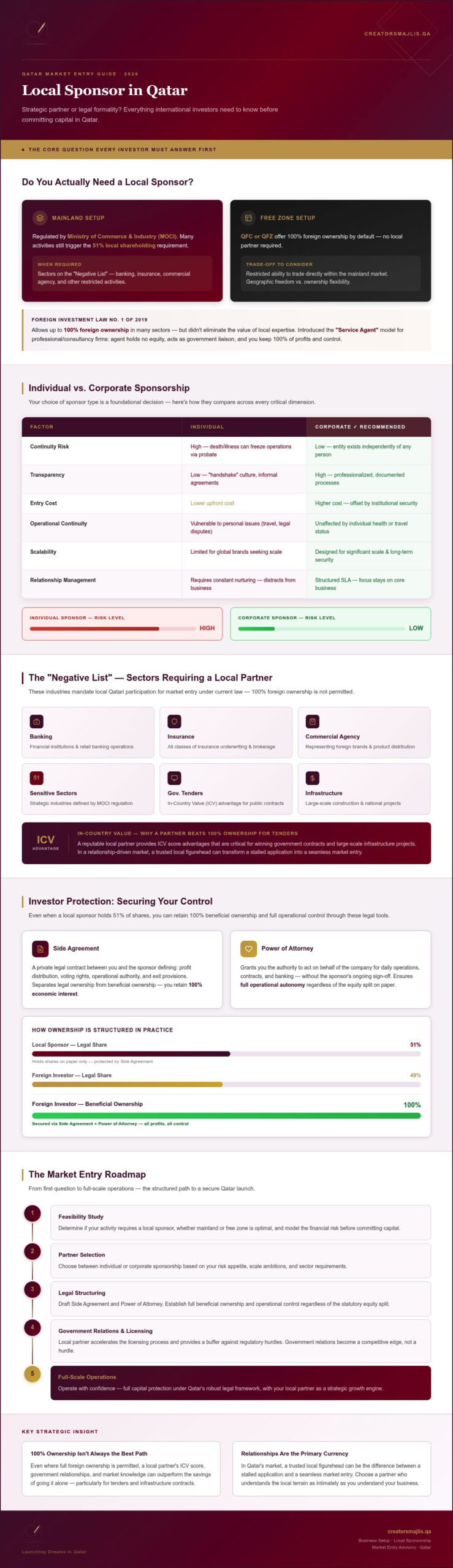
A decade ago, the role of a local sponsor in Qatar was often viewed as a purely administrative necessity, a gatekeeper required by law to hold 51% of a mainland company’s shares. This traditional model focused on compliance rather than collaboration. Today, that perception is shifting rapidly. In 2026, the concept of a Qatari partner has matured into a high-level strategic alliance. While the legal framework still requires local participation for many mainland activities, the focus has moved toward how this partnership can actively fuel your business growth and provide a secure foundation for long-term success.
The pivotal shift began with Foreign Investment Law No. 1 of 2019. This legislation fundamentally changed the landscape by allowing up to 100% foreign ownership in many sectors, yet it didn’t eliminate the need for local expertise. It created a more nuanced environment where investors must choose between full ownership and the institutional advantages of a local sponsor in Qatar. For professional entities, such as consultancy firms, the law allows for a “Service Agent” model. In this setup, the agent doesn’t hold equity but acts as your liaison for government relations and administrative processes, leaving 100% of the profits and control in your hands.
Mainland vs. Free Zone Requirements
Your choice of location dictates your ownership options. Mainland setups fall under the jurisdiction of the Ministry of Commerce and Industry (MOCI), where specific activities still trigger the 51% local shareholding requirement. Conversely, zones like the Qatar Financial Centre (QFC) or the Qatar Free Zones (QFZ) offer 100% ownership by default. However, these zones often restrict your ability to trade directly within the mainland market. Before committing to a structure, conducting thorough Feasibility Studies is essential to determine if the geographic freedom of the mainland outweighs the ownership flexibility of a free zone.
Why 100% Ownership Isn’t Always the Answer
While 100% ownership sounds ideal on paper, it isn’t always the most profitable path. Partnering with a local sponsor in Qatar often provides an “In-Country Value” (ICV) advantage, which is crucial for winning government tenders and large-scale infrastructure contracts. Beyond procurement, a reputable local partner accelerates the licensing process and provides a buffer against regulatory hurdles in sensitive sectors like banking, insurance, or commercial agency. In a market where relationships are the primary currency, having a trusted local figurehead can be the difference between a stalled application and a seamless market entry. Choosing a partner isn’t just about meeting a legal quota; it’s about securing a visionary guide who understands the local terrain as intimately as you understand your business.
Individual vs. Corporate Local Sponsorship: A Strategic Comparison
Every investor reaches a crossroads when selecting a local sponsor in Qatar. The choice isn’t merely about meeting a legal requirement; it’s about building a foundation that can withstand the test of time. In the Qatari market, you generally choose between a natural person (individual) or a legal entity (corporate) to fulfill this role. While an individual might offer a lower entry cost, a corporate structure provides the institutional strength that many global brands require to maintain long-term security.
Your decision should be based on a rigorous risk assessment. An individual sponsorship is often built on personal trust and a “handshake” culture, which can be flexible but lacks formal structure. Conversely, corporate sponsorship is a professionalized service designed to provide transparency and operational continuity. For businesses aiming for significant scale, the institutional model often outweighs the perceived savings of a personal arrangement.
The Risks of Individual Sponsorship
Partnering with an individual relies heavily on a single point of failure. This introduces variables that are often outside your control. If an individual sponsor passes away, their shares enter a complex probate process involving multiple heirs. This can freeze company operations, complicate bank account access, or lead to disputes over management rights. Additionally, an individual’s personal legal or financial troubles could inadvertently impact your company’s standing with the Ministry. Managing these personal dynamics requires constant attention; it’s a relationship that must be nurtured, which often distracts from your core business objectives.
The Stability of Corporate Sponsorship
Corporate sponsorship removes the “human element” risk by replacing an individual with a licensed, Qatari-owned entity. Because the sponsor is a company, it exists independently of any single person’s health or travel status. This ensures total continuity for your business license and labor department filings. This model is built for investors who prioritize transparency and wish to avoid the nuances of personal negotiation.
- Institutional Continuity: Your partnership remains valid and active regardless of leadership changes within the sponsoring firm.
- Professionalized PRO Services: Corporate sponsors typically provide dedicated teams to handle Hukoomi services and government relations.
- Structured Governance: Clear legal protocols replace informal agreements, providing a transparent audit trail for your beneficial ownership.
Choosing a corporate local sponsor in Qatar provides a layer of institutional support that simplifies complex administrative hurdles. If you are unsure which path aligns with your five-year growth plan, speaking with a strategic consultant can help clarify the legal and operational implications of each choice.
Sectors Requiring a Local Partner in Qatar
While the regulatory environment has opened significantly, certain sectors remain reserved for strategic domestic collaboration. Understanding these boundaries is the first step in a successful market entry. The “Negative List” isn’t a barrier; it’s a map of industries deemed vital to national sovereignty and economic stability. For activities within these categories, securing a local sponsor in Qatar is a legal mandate that ensures your business operates within the national interest while benefiting from local institutional support.
Strategic industries such as defense, private security, and specific specialized consultancies fall under this umbrella. These sectors require a Qatari partner to maintain oversight of critical infrastructure and national safety. Similarly, the Commercial Agency Law heavily influences the retail and distribution landscape. If your business model involves importing and distributing goods, a Qatari agent or partner is often required to act as the official representative. For unique projects that offer exceptional value to the nation, it’s possible to seek “Special Permission” from the Council of Ministers to bypass standard ownership caps, though this is reserved for high-impact investments.
Regulated Industries and Licensing
Banking, insurance, and financial services operate under the strict oversight of the Qatar Central Bank and the Ministry of Commerce and Industry. These sectors are heavily regulated to protect the financial ecosystem, making a local partnership the standard pathway for entry. Telecommunications and energy also follow specific licensing nuances where local equity is often a prerequisite. These requirements aren’t meant to hinder your progress. Instead, they provide a framework where your global expertise can merge with local capital and influence, creating a more resilient enterprise. Before you choose a structure, conducting thorough Market Research and Feasibility Studies will reveal the exact licensing requirements for your specific activity.
Navigating the 51/49 Profit Sharing Nuance
One of the most common misconceptions among international investors is that a 51% shareholding strictly dictates a 51% profit split. This is a myth that often causes unnecessary anxiety. Qatari law allows for significant flexibility in how earnings are distributed. You can legally structure your company to reflect your actual operational contribution and financial risk. By utilizing management fees and specific dividend split arrangements, international investors can retain a much higher percentage of the actual profits than their minority shareholding might suggest.
A Profit Sharing Agreement is a standard legal tool in Qatar that allows partners to deviate from the shareholding ratio when distributing dividends. This mechanism ensures that your hard work and capital investment translate directly into your bottom line. It provides the security you need to grow while keeping your partnership compliant with mainland regulations. When you align with a professional local sponsor in Qatar, these financial arrangements are documented clearly, protecting your interests and fostering a transparent, growth-oriented relationship.
Investor Protection: Securing Your Rights and Control
Investor protection is the cornerstone of any successful international venture. While the law might require a local sponsor in Qatar for certain activities, it doesn’t require you to relinquish your vision or your profits. You can protect your beneficial ownership and operational autonomy through a series of robust legal instruments that bridge the gap between compliance and control. The most critical of these is the “Side Agreement” or Memorandum of Understanding (MOU). This document explicitly states that while the Qatari partner holds the shares on paper, the foreign investor retains all economic rights, including 100% beneficial ownership and asset rights.
Operational control is further secured through a comprehensive Power of Attorney (POA). This grants the foreign manager the authority to sign contracts, open bank accounts, and manage the Commercial Registration (CR) without the sponsor’s daily involvement. Vetting a partner is equally vital. Your due diligence checklist should include verifying their financial standing, checking for a history of legal disputes, and assessing their reputation in government relations. A reliable partner acts as a silent supporter, not an active manager.
Essential Legal Safeguards
A well-drafted Shareholders’ Agreement (SHA) is your primary defense. It outlines specific roles, responsibilities, and dispute resolution mechanisms. To maintain a clear boundary, always ensure your Trademark Registration is filed in the name of the foreign parent company rather than the local entity. Additionally, utilizing professional PRO Services ensures that you maintain primary access to government portals like Hukoomi. This keeps your administrative data secure and under your direct supervision, preventing any unauthorized interference with your trade license or labor files.
Exit Strategies and Partner Changes
Ambition requires a clear exit path. Your partnership agreement must include a “Right to Transfer” clause. This allows you to move your business to a different local sponsor in Qatar or transition to a 100% foreign-owned structure if the regulatory environment evolves. If a relationship breaks down, the law provides mechanisms to replace a partner, provided your initial documentation is airtight. Because all official filings are in Arabic, the importance of professional Translation Services cannot be overstated. You must understand every word of the documents you sign to ensure your rights are never lost in translation. If you’re ready to build a secure legal framework for your expansion, contact our strategic advisors to begin your setup today.
How Creators Majlis Facilitates Secure Market Entry
Creators Majlis acts as your local navigator, transforming complex regulatory requirements into a clear path for growth. We don’t just fill out forms; we build the legal and strategic infrastructure your business needs to thrive. Our process begins with a comprehensive Feasibility Study. We analyze your specific business activity to determine if a local sponsor in Qatar is a legal necessity or if your sector allows for 100% foreign ownership. This initial clarity is vital to prevent costly structural mistakes before you commit capital.
Once your optimal path is identified, we provide end-to-end management of the LLC company formation Qatar process. We facilitate connections with reliable, vetted corporate sponsorship options that prioritize institutional continuity and transparency. Our team handles the heavy lifting of Hukoomi services and ongoing PRO management, ensuring your government relations remain seamless while you focus on scaling your operations.
Your Strategic Partner in Qatar
We believe market entry is only the first milestone in your journey. True success requires a partner who looks beyond the initial trade license toward long-term operational health. Our advisory services bridge the gap between your international ambitions and the local regulatory reality. We streamline the mobilization of your team by managing residency, QID, and work permit processing with methodical precision. You aren’t just getting a service provider; you’re gaining a strategic ally who understands that your success is the ultimate measure of our expertise.
Ready to Launch in Qatar?
Choosing a boutique consultancy offers a level of security and personalization that mass-market firms often fail to provide. We treat your investment with the same care we would our own, ensuring every side agreement and power of attorney is airtight and legally defensible. The Qatari market in 2026 is full of potential for investors who arrive prepared and protected. Unlock your business potential with Creators Majlis and take the first step toward a secure, high-growth future in one of the world’s most dynamic economies.
Your Vision, Our Expertise: The Future of Your Qatari Venture
The landscape of 2026 offers unparalleled opportunities for those who approach market entry with clarity and precision. You now understand that a local sponsor in Qatar is a strategic gateway rather than a bureaucratic hurdle. By prioritizing corporate continuity and securing your beneficial ownership through airtight legal frameworks, you’re building a foundation designed for longevity. Whether you’re navigating the nuances of the mainland or exploring the flexibility of the QFC, the right partnership transforms regulatory complexity into a competitive advantage.
Creators Majlis provides the high-level strategic oversight and comprehensive Hukoomi support your brand deserves. Our boutique approach ensures that your setup is handled with the expertise required for both mainland and free zone success. Don’t leave your expansion to chance. Start your Qatar market entry with a strategic consultation at Creators Majlis and turn your international ambition into a local reality. Your journey toward a thriving Qatari presence begins with a single, confident step today.
Frequently Asked Questions
Do I legally need a local sponsor to start a business in Qatar in 2026?
The requirement for a local sponsor in Qatar depends on your specific business activity and chosen jurisdiction. Since the implementation of Law No. 1 of 2019, many sectors allow for 100% foreign ownership on the mainland. However, strategic industries and specific commercial activities still mandate a Qatari partner holding 51% of shares. If you opt for a free zone setup, a sponsor isn’t required. We recommend a feasibility study to confirm your specific legal status.
What is the difference between a local sponsor and a service agent?
The primary difference lies in equity ownership and company structure. A local sponsor typically holds a 51% shareholding in a mainland Limited Liability Company (LLC). In contrast, a service agent is appointed for professional branches or representative offices where the foreign investor retains 100% ownership. The service agent doesn’t hold shares or management rights; they primarily facilitate administrative tasks and government liaison services without claiming a portion of the company’s profits or capital.
Can a foreign investor own 100% of a company on the Qatar mainland?
Yes, foreign investors can achieve 100% ownership on the mainland for many business activities. This possibility was established by Law No. 1 of 2019, which opened sectors like education, health, and manufacturing to full foreign control. Each application is reviewed by the Ministry of Commerce and Industry on a case-by-case basis. While many sectors are open, others remain restricted, making it essential to verify your specific activity with the Ministry before beginning the registration process.
How much does a local sponsor in Qatar typically cost?
The cost of a local sponsor in Qatar varies significantly based on the partner’s profile and the level of administrative support provided. Most arrangements involve a fixed annual sponsorship fee rather than a percentage of company turnover. Corporate sponsors often command a higher fee due to the increased security and professional PRO services they offer. Since prices aren’t fixed by law, these fees are negotiated privately and should be clearly outlined in your initial partnership agreement.
Is my investment safe if a Qatari partner owns 51% of the shares?
Your investment is secure provided you implement the correct legal safeguards from the outset. While the Qatari partner holds 51% of shares on the Commercial Registration, a robust Side Agreement or Shareholders’ Agreement can protect your 100% beneficial ownership. This document, combined with a comprehensive Power of Attorney, ensures you maintain full operational and financial control. These instruments are standard practice in the market and are designed to provide international investors with total peace of mind.
What are the restricted sectors that still require a Qatari partner?
Certain strategic sectors are currently restricted from 100% foreign ownership and require a local partner. These typically include banking, insurance, and commercial agency activities. Additionally, industries related to defense, private security, and specific telecommunications services often mandate Qatari participation. These restrictions ensure national oversight in sensitive areas of the economy. Because the “Negative List” can be updated, we advise investors to conduct market research to confirm the latest regulatory requirements for their chosen field.
How do I change my local sponsor if I am unhappy with their service?
Changing a sponsor is a legal process that involves transferring shares from the current partner to a new one. This is most seamless if your initial Shareholders’ Agreement includes a “Right to Transfer” or exit clause. Both parties must sign the share transfer at the Ministry of Justice. If the relationship has broken down and the sponsor refuses to sign, legal intervention may be necessary. Having airtight, professionally translated documentation from the start makes this transition much easier.
What documents are required to finalize a sponsorship agreement?
Finalizing an agreement requires several key documents to ensure full legal compliance. You’ll need the company’s Articles of Association, a notarized Shareholders’ Agreement or Side Agreement, and a Power of Attorney granting you management control. Additionally, copies of the partners’ passports or Qatari IDs are essential. For corporate sponsors, you’ll also require their Commercial Registration and a board resolution authorizing the partnership. All foreign documents must be properly attested and accompanied by certified translations into Arabic for local filing.
Related services: Local Sponsorship in Qatar · Company Formation in Qatar · Business Consultancy in Qatar