

Business registration delays in Qatar often start before an application is submitted. Avoiding business registration delays in Qatar begins with preparing the core documents, such as the Articles of Association, shareholder identification, trade name reservation details, premises evidence and commercial registration application. Foreign documents may also require translation, notarisation or certification through the Ministry of Foreign Affairs.
It is understandable to focus first on paperwork, since missing or inconsistent documents can slow an application. But the setup route matters too: mainland, Qatar Financial Centre (QFC) and free-zone applications have different activity rules, premises requirements and approval processes. Choosing a route that fits your business from the outset can reduce avoidable rework.
This guide covers the documents to prepare, how to classify your planned activities and what to consider when choosing a setup route. It also explains how complete application files, external approvals and timely responses can affect processing, so you can plan for registration and reduce preventable hold-ups.
Key Takeaways
- Prepare a coordinated document file, including any translations and attestations required for foreign records.
- Align each activity description with the approvals and licensing requirements that apply to your intended operations.
- Allow for the full application pathway: processing time depends on a complete file, the chosen structure and any additional clearances.
- Compare mainland, QFC and free-zone routes against your activities, ownership plans and premises needs before selecting a setup path.
What documents will a professional need for Qatar business registration?
A professional prepares an application around your ownership structure, planned activities and chosen setup route. Avoiding business registration delays in Qatar starts with aligning these details before filing.
Registration fees depend on the route, activity, approvals and document requirements. Business formation pricing is provided after a quote request, with the scope based on these factors.
-
Provide Documents and Application Information
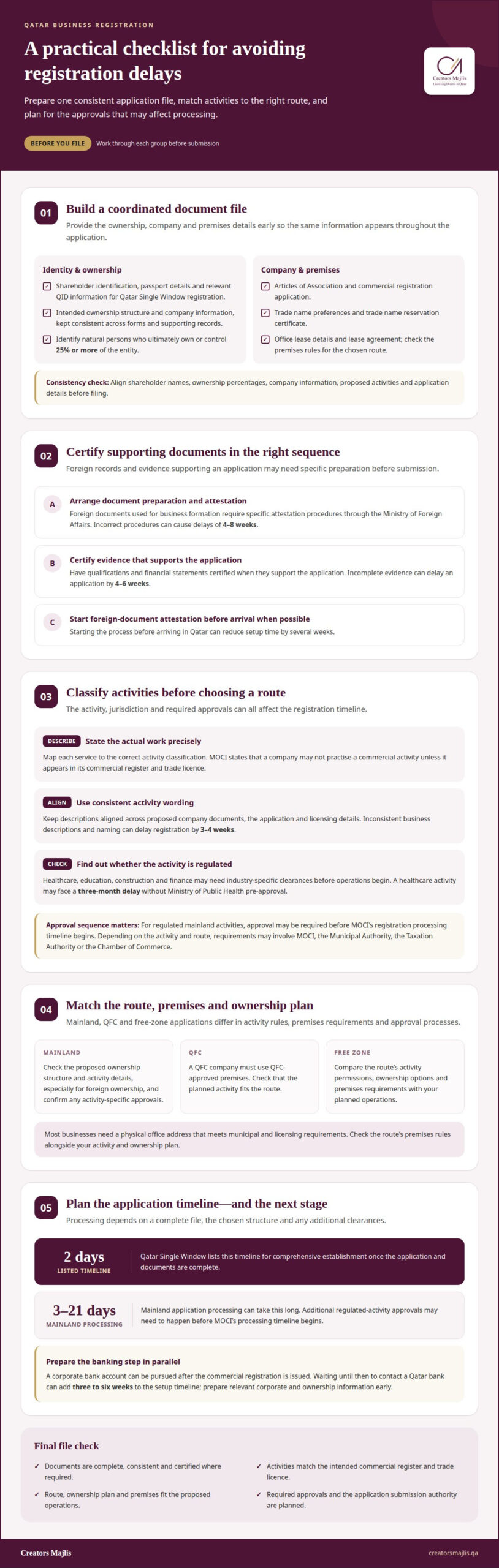
Provide shareholder identification, passport details and corporate information before the application is prepared. For Qatar Single Window registration, have the relevant QID, passport and company information ready. Include your intended ownership structure and business activities so details remain consistent across forms and supporting records.
Also provide trade name preferences and office lease details. The standard file includes the Articles of Association, trade name reservation certificate, office lease agreement and commercial registration application. For ownership declarations, identify natural persons who ultimately own or control 25% or more of the entity.
-
Have Supporting Documents Prepared and Certified
Arrange professional preparation of the Articles of Association and supporting documents before submission. Foreign documents used for business formation require specific attestation procedures through the Ministry of Foreign Affairs. The correct sequence matters: incorrect attestation procedures can cause delays of 4-8 weeks.
Have qualifications and financial statements certified when they support the application. Incomplete evidence, such as unattested qualifications or uncertified financial statements, can delay an application by 4-6 weeks. Starting attestation before arriving in Qatar can reduce setup time by several weeks.
- Resolve ownership details before submitting the file. Keep shareholder names, ownership percentages and company information consistent throughout. For a mainland application involving foreign ownership, the proposed structure and activity details help prepare documents for the right route. This alignment is a practical step in avoiding business registration delays in Qatar.
- Plan banking alongside registration. You can pursue a corporate bank account after the commercial registration is issued, but waiting until then to contact a Qatar bank can add three to six weeks to the setup timeline. Preparing relevant corporate and ownership information early helps connect this next stage with registration and coordinate the setup.
Professional classification of business activities and checks on permitted activities
Classify each planned activity before choosing a structure or preparing an application. In Qatar, the activity, jurisdiction and required approvals can all affect the registration timeline.
- Describe the actual work precisely, then map each service to the correct activity classification. MOCI states that a company may not practise a commercial activity unless it appears in its commercial register and trade licence. A consultancy, for example, should not use a description that suggests unrelated services. Inconsistent business descriptions and naming can delay registration by 3-4 weeks.
- Keep activity wording consistent across proposed company documents, the application and licensing details. A mismatch between a broad business description and a specific activity classification can prompt questions or require corrections. MOCI records approved activities in the commercial registration, so align descriptions before submission rather than after initial approval.
- Find out whether the activity is regulated and requires separate government approval. Healthcare, education, construction and finance may need industry-specific clearances before operations begin. A healthcare activity may face a three-month delay without Ministry of Public Health pre-approval. For regulated mainland activities, approval may be required before MOCI’s registration processing timeline begins.
- Match premises and legal structure to the activity and route. Most businesses need a physical office address that meets municipal and licensing requirements; a QFC company must use QFC-approved premises. Mainland, QFC and free-zone rules differ, including activity permissions and ownership options. A professional can assess those conditions together before filing.
- Plan the approval sequence with the relevant government bodies. MOCI issues the commercial registration, while activity-related requirements may involve the Municipal Authority, Taxation Authority or Chamber of Commerce. The authority involved depends on the activity and setup route. For support aligning classifications and approvals with your proposed structure, discuss your Qatar business setup.
Commercial registration application and processing times
A professional moves from activity and structure selection to initial approval, document preparation, premises, application submission and the commercial registration certificate. Qatar Single Window lists a two-day timeline for comprehensive establishment once the application and documents are complete; mainland application processing can take 3-21 days.
-
Have the Application Submitted Through the Single Window
Give the professional the information and authority needed to submit on the proposed business’s behalf. The person submitting must be authorised to act for the business, and an agent must have the required authorisation ready. The professional prepares the application file, enters the company details and submits through Qatar Single Window, keeping corporate information aligned with supporting records.
-
Have the Application Tracked and Requests Addressed
Arrange for the professional to monitor official application updates and coordinate responses with the relevant authority. Requests for clarification or corrections can affect the timeline if they remain unanswered. Respond to authority requests within 24-48 hours, and keep a communication log covering submission dates, requested documents and replies. This creates a clear record for follow-up.
-
Prevent Common Causes of Delays with Professional Support
Ask the professional to review the complete file before submission, including consistency across the application and corporate documents. Incomplete or inconsistent information can delay processing, while a rejected application that needs correction and resubmission can add 4-8 weeks. Regulated activities may also require approval before the MOCI registration timeline begins, so account for clearances first.
- Set expectations for the full process, not just the authority’s processing stage. MOCI’s registration timeline starts when the application file is complete, not when preparation begins. A professional can sequence approvals, submission and responses, then track progress toward the commercial registration. Do not begin business operations before commercial registration and trade licence approval.
Mainland, QFC, and free-zone setup routes
- Match the route to your business activity before starting company formation. Qatar’s mainland, Qatar Financial Centre (QFC) and free-zone pathways have different activity permissions, premises requirements and approval sequences. The right choice depends on what the company will do, where it will operate and its ownership plan. A route mismatch can result in rejection or the need to restructure.
- Assess mainland registration against your planned operations and ownership structure. Under Qatar’s Foreign Investment Law, Law No. 1 of 2019, non-Qatari investors may own up to 100% of a mainland company in most sectors, subject to restrictions. This is not a blanket permission for every business activity. Identify applicable restrictions and activity approvals before preparing licensing documents.
- Choose QFC when its permitted activities fit the company’s intended work. A QFC company must have a registered office on QFC-approved premises. Regulated and non-regulated activities have different requirements, so classification affects the application pathway and compliance obligations. Include premises and activity alignment in the formation plan rather than treating licensing as a later step.
- Consider a free-zone route when its permitted business activities and operating conditions suit your plans. Businesses operating within Qatar’s free zones may be formed with 100% foreign ownership. Compare that ownership option with the route’s activity scope and premises requirements. Each route has its own approvals, so selecting a jurisdiction solely on ownership can create extra work.
- Make the decision with the complete operating model in view. Compare the proposed activities, ownership, approved premises and licensing sequence across mainland, QFC and free-zone formation. The route that best fits those factors can help keep the application coherent and avoid rework. Discuss your Qatar company setup route before moving into registration.
Creators Majlis: Business Set Up in Qatar
Creators Majlis helps founders move from a proposed activity and structure to a prepared business registration in Qatar. Its Business Set Up in Qatar and Company Formation support can bring route selection, application preparation and registration requirements into one coordinated process. Turn to professional support when your activity classification, ownership structure or choice between mainland, QFC and free-zone setup needs careful alignment.
PRO Services can support administrative steps connected with the application and help organise submissions and authority communications. Start with a clear picture of your intended activities, ownership and preferred setup route. Share your priorities with Creators Majlis to discuss the next steps for your business.
Contact Creators Majlis to discuss your Qatar business setup.
Turn your registration plan into a confident next step
Your registration strategy should support more than an application. It should create a clear path from business planning to a company ready to move forward. A focused approach to avoiding business registration delays in Qatar keeps decisions connected, so your structure, activities and setup route work together from the outset.
Creators Majlis offers Business Set Up in Qatar, Company Formation and PRO Services to support founders preparing for this transition. Whether you’re refining your setup plan or ready to begin formation, professional guidance can help bring the process into focus.
Contact Creators Majlis to discuss your next step and move your Qatar business plans forward with clarity.
Frequently Asked Questions
Do I need a physical office address before applying for company registration?
Usually, yes: most Qatar business activities require a physical office address before registration can be completed. Premises requirements depend on the activity and licensing route. For example, a QFC company must use QFC-approved premises, while other applications may require an address that meets municipal requirements. Include premises selection in your formation plan so the proposed address suits the intended operations.
How long does the complete business formation process take in Qatar?
Registration timelines can vary depending on the structure and sector. This broader timeline includes preparation and any required clearances, not only the authority’s processing stage. A complete application through Qatar Single Window has a listed two-day comprehensive establishment timeline, but that does not represent the total preparation period for every business.
What documents should I provide for business registration in Qatar?
Prepare shareholder identification, passport and QID details where relevant, corporate information, Articles of Association, trade name reservation details, premises evidence and application information. Foreign records may need translation, notarisation or certification, including attestation through Qatar’s Ministry of Foreign Affairs. Documents should match the proposed ownership, structure and activities so the professional can assemble the filing set for your chosen route.
How long does company registration take in Qatar?
A mainland commercial registration application typically takes 3-21 days to process. That is the application stage, not the full formation journey, which can take 4-8 weeks end to end. Qatar Single Window lists a two-day comprehensive establishment timeline once the application and documents are complete. Activity clearances and document preparation affect which timeline applies to your case.
How can foreign investors have a company registered in Qatar, and what ownership rules apply?
Foreign investors can consider mainland, QFC or free-zone registration, with ownership permissions depending on activity and jurisdiction. Under Qatar’s Foreign Investment Law, Law No. 1 of 2019, non-Qatari investors may own up to 100% in most sectors, subject to restrictions. Free-zone businesses may also have 100% foreign ownership. Assess the activity and route together before settling the company structure.
What are common causes of delays in Qatar business registration?
Delays often arise when the applicant’s authority to submit is unclear, company details differ across forms or an activity clearance has not been secured. Premises that do not fit the selected route can also interrupt progress. Assign one person to coordinate decisions and official messages, and have the professional resolve inconsistencies before submission. This can help prevent corrections during review.