

A factory’s permitted activity, not just its company name, shapes the license it needs. An industrial license application in Qatar is submitted to the Ministry of Commerce and Industry with project details. The license defines the industrial activities a factory may carry out and permits the business to be established and operated in the country.
If you plan to manufacture, process or assemble products, clarify the applicable activity classification and requirements before committing to a site or production plan. Accurate project details help shape the application.
This guide explains what an industrial license covers, the kinds of activities it can apply to, and how safety, environmental and production compliance fit into the process. You’ll also learn what information and project documentation may be required, and why industrial applications can involve more review than a standard commercial setup. With that picture in place, you can plan your next steps with greater confidence.
Key Takeaways
- Identify whether your planned work is manufacturing, processing, or assembly, since the permitted activity shapes the industrial license scope.
- Understand how company structure, site suitability, and project documentation influence the application pathway.
- See how environmental approvals, safety reviews, and production requirements fit into industrial compliance in Qatar.
- Learn when Business Set Up in Qatar and PRO Services can support the setup process as your project moves toward operation.
What Is an Industrial License in Qatar?
An industrial licence authorises a business to establish and operate in Qatar for approved production activities. The Ministry of Commerce and Industry (MOCI) reviews the project details, activity classification and site requirements.
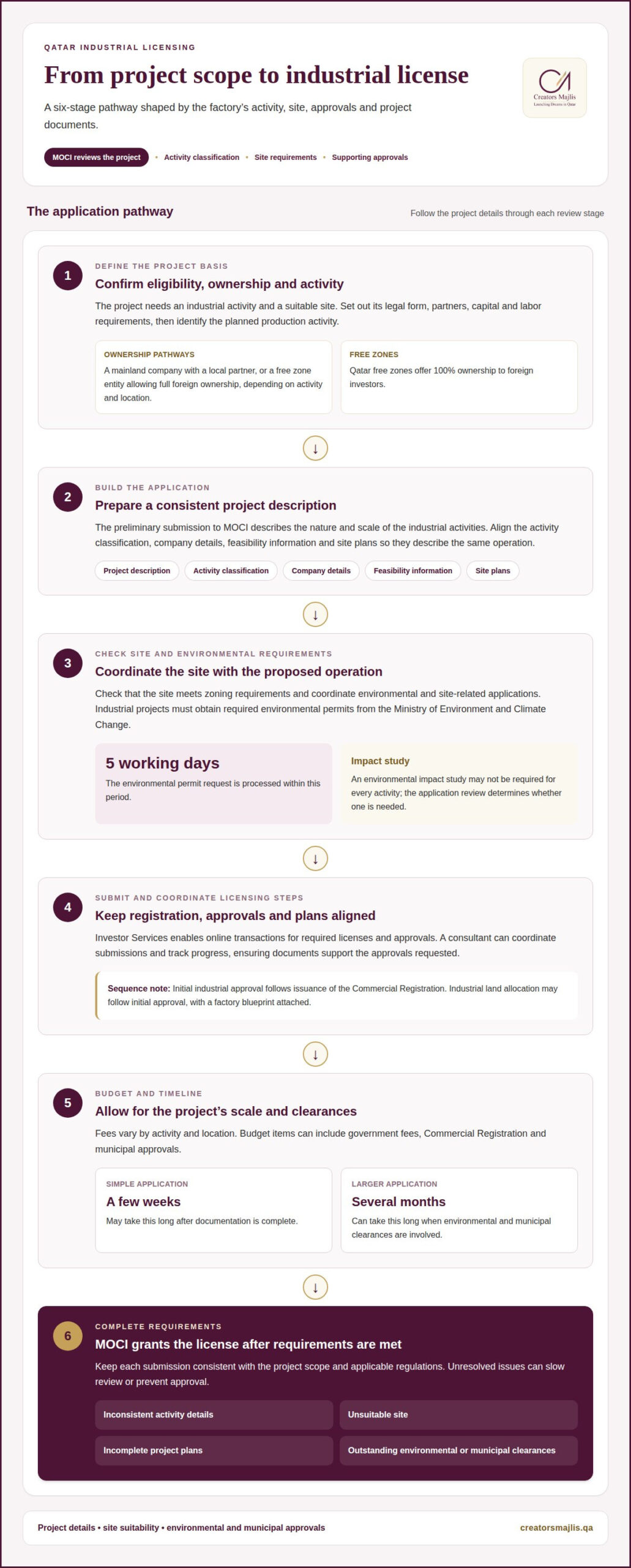
- Confirm eligibility and ownership. The project needs an industrial activity, a suitable site, and information about its legal form, partners, capital, and labor requirements. Foreign investors can establish through a mainland company with a local partner or a free zone entity allowing full foreign ownership, depending on activity and location. Qatar free zones offer 100% ownership to foreign investors.
- Prepare the preliminary application. A consultant organizes the project description and submits it to MOCI, including the nature and scale of the planned industrial activities. The consultant also aligns the proposed activity classification, company details, feasibility information, and site plans so they describe the same operation.
- Coordinate site and environmental approvals. The consultant checks that the proposed industrial site meets zoning requirements and helps coordinate environmental permit and site-related applications. Industrial projects must obtain required environmental permits from the Ministry of Environment and Climate Change. The environmental permit request is processed within five working days; an impact study may not be required for every activity.
- Manage online licensing steps. Investor Services enables online transactions for required licenses and approvals. A consultant can coordinate submissions and track application progress, while ensuring the project’s documents support the approvals being requested. Industrial land allocation may follow initial approval, with a factory blueprint attached.
- Plan for fees and processing time. Fees vary by activity and location, with government fees, Commercial Registration, and municipal approvals among the budget items. A simple industrial license application may take a few weeks after documentation is complete; larger applications involving environmental and municipal clearances can take several months.
- Reduce avoidable delays. Inconsistent activity details, an unsuitable site, incomplete project plans, or outstanding environmental and municipal clearances can slow review or prevent approval. MOCI grants the license after requirements are met, so the consultant coordinates each submission against the project scope and applicable regulations.
Industrial licenses for manufacturing, processing and assembly
An industrial licence defines the production activities a factory may conduct in Qatar. Align the activity, company registration, site and operating plans before submitting the application.
-
How a consultant identifies activities requiring an industrial license
Match each planned operation to the appropriate MOCI industrial activity classification. Manufacturing, processing and assembly are production activities, while buying, selling, trading and services fall under commercial licensing. For example, a factory that produces goods and operates a retail showroom may need both industrial and commercial licences. Describe the production activity clearly rather than listing trading alone.
-
How a consultant manages industrial and manufacturing licensing services
Coordinate the licensing sequence with the company’s commercial registration. Initial industrial approval follows issuance of the registration, and MOCI grants the industrial licence once requirements are met. Align the activity classification with project plans, machinery specifications, production processes and infrastructure needs so the registration and permit application remain consistent.
- Match the site and plans to the activity. Industrial activities are typically located in designated industrial zones, not commercial or retail districts. Manufacturing is not allowed in commercially designated zones. Ask the consultant to coordinate site suitability and factory layout review, supported by architectural drawings and machinery details. These plans help show how the proposed operation fits the site and its intended use.
- Plan manufacturing inputs and construction requirements. Include machinery, equipment, and production processes in the project details, then identify whether importing raw materials or equipment requires a separate import license. Keep factory layout and operational plans aligned as the project develops. For construction planning, coordinate the site and layout approvals relevant to the factory rather than assuming a commercial premises approval covers industrial use. Discuss your business setup planning as you prepare the licensing pathway.
Safety, environmental, and production compliance
Industrial projects in Qatar must obtain the required environmental permits from the Ministry of Environment and Climate Change. An environmental impact study may not be required for every activity; the application review determines whether one is needed.
- Coordinate environmental documents with the project scope. Describe production processes, machinery and potential environmental impacts consistently across submissions. This gives authorities a clear basis to assess the proposed operation. Include the environmental permit request in the approval sequence, and align its details with the project description submitted to MOCI.
- Map municipal permits and clearances. Coordinate municipal permits with environmental clearances, since industrial registration may involve both. Keep site information, factory layout and intended production activity aligned in each application. A mismatch between the described operation and the proposed site can complicate review or delay related approvals.
- Prepare for technical and environmental review. MOCI reviews technical and environmental compliance and may conduct site inspections. Ensure the project file explains how machinery, technology, production processes and infrastructure support the planned activity. Keep the submitted plans consistent with the factory’s intended operation so reviewers can assess the project as a whole.
- Build safety compliance into operating plans. Industrial projects must comply with applicable local and international health, safety, and environmental standards. Identify how the production layout and machinery fit those standards, and keep the relevant plans available for compliance inspections. Industrial licensing can involve safety and compliance inspections, so treat these requirements as part of project preparation, not as a separate afterthought.
Industrial license activities and examples
Define the factory’s actual production stages, not simply the products it hopes to sell. MOCI assesses the industrial activity and its scope against the proposed operation.
- Describe each production stage. Distinguish manufacturing, processing and assembly in the activity description. A project may transform materials into finished goods, process an input before production, or assemble supplied components. These examples clarify the work involved; the licence must match the activities submitted for approval. Avoid broad labels that leave the factory’s actual processes unclear.
- Distinguish production from trade. A commercial licence covers buying, selling, trading and services; an industrial licence covers production activities. If the business will manufacture goods and sell them through a showroom, account for both the industrial activity and the commercial sales activity. The two functions are distinct, even when they support the same business.
- Connect the activity to factory operations. Describe the machinery, technology, production processes and infrastructure required for each activity. MOCI evaluates these project elements, so the activity description should align with equipment specifications and operational plans. A mismatch, such as listing assembly while the plans describe a different production process, can complicate assessment.
- Align feasibility with the proposed scope. A feasibility study should explain the project’s technical, financial, market, risk and regulatory aspects. Use it to show how the selected activities fit the planned operation, site and production capacity, without claiming activities the project will not perform. This gives the ministry a consistent picture to assess.
- Keep every approval aligned. The industrial license defines the activities and scope permitted at the factory. Relevant authorities may require approvals based on the activity, and changes to business activities require approvals matching the license category. For an industrial license application in Qatar, get support planning your activity classification before submission.
Creators Majlis: Business Set Up in Qatar
Creators Majlis supports your next steps through Business Set Up in Qatar and Company Formation. Turn to the team when your industrial activity, company structure, and required approvals are taking shape and you’re ready to establish the business framework.
PRO Services support the administrative side of setting up, while Company Formation connects formation decisions with your plans to operate in Qatar. The right starting point depends on your intended activities, ownership structure and setup requirements. Bring those details together as you move from project planning toward company establishment.
For support with your next steps, contact Creators Majlis.
Turn your project plan into a clear next move
Your factory concept becomes actionable when its planned activities, company structure and setup decisions work together. Clarify who will own the business, what it will produce and how its operations fit the company’s wider plans. This gives your industrial licence application in Qatar a practical foundation and keeps business decisions connected as the project advances.
Creators Majlis can support that next stage through Company Formation, PRO Services, and Business Set Up in Qatar. These offerings help address the company setup and administrative work around establishing your business, so you can focus on developing the project itself.
Contact Creators Majlis to discuss the next step for your industrial business. A well-planned setup can turn a production ambition into a stronger path forward.
Frequently Asked Questions
Which authority issues industrial licenses in Qatar?
The Ministry of Commerce and Industry (MOCI) grants industrial licenses after the project meets the applicable requirements. Environmental permits are handled by the Ministry of Environment and Climate Change. For a project involving both factory establishment and environmental clearance, keep the submissions coordinated: each authority needs project details that match the proposed industrial activity, site, and production plans.
What documents are required to apply for an industrial license in Qatar?
Prepare company and project information, including the legal form, trade name, partners, capital, activities, location and required labour. The project file may also include a technical and financial feasibility study, factory drawings, machinery specifications and operational processes. Depending on the activity, an industrial site lease and environmental impact assessment may be needed. Keep descriptions consistent across application documents.
Can a consultant apply for a Qatar industrial license through the Single Window portal?
Qatar’s Single Window Services platform lets users establish and renew businesses digitally, while Investor Services supports online transactions for required licences and approvals. Company Formation support can help organise project details and guide the application process. Online services facilitate digital business transactions but do not replace project approvals.
What land, zoning, and building approvals are required for a factory in Qatar?
A factory needs a suitable site that meets regulatory requirements. Industrial activities typically operate in designated industrial zones rather than commercial districts. After initial approval, investors may obtain industrial land allocation through the Ministry of Commerce with a factory blueprint attached. Municipal permits, site suitability clearance and factory layout approval may form part of the process, depending on the project and location.
What inspections, renewals, and ongoing compliance obligations apply to Qatar industrial licenses?
MOCI may conduct site inspections while reviewing technical and environmental compliance. Industrial projects must meet applicable local and international health, safety and environmental standards, and required environmental permits must be maintained. Renew the industrial licence before it expires. If the business changes its activities, obtain the necessary approvals and ensure the new activities match the licence category before operating under the amended scope.