

The lowest tax figure isn’t automatically the best Qatar setup for a service firm. What the difference is between QFC and QFZA for a service company comes down first to activity fit: QFC licensing covers professional and financial services, while Qatar’s free zones are oriented toward trading, logistics and light manufacturing. QFC companies are subject to 10% corporate tax on locally sourced profits; Qatar free-zone companies have a stated 0% corporate income tax rate, and QFZA guarantees 100% foreign ownership, according to Qatar Free Zones Authority.
For the route itself, see how free zone company setup in Qatar works with us, from the first fit check to the licence.
Free 2026 checklist: Set up a company and move to Qatar, six phases on six pages.
It’s natural to compare tax treatment and ownership rules first. But your client base, licensed activities and plans to operate in mainland Qatar also matter. This guide compares QFC, QFZA and mainland setups, helping you assess which structure best fits your professional services and intended way of working.
Key Takeaways
- Match the permitted licence category to the services your firm will actually deliver; the right setup begins with activity fit.
- Account for eligibility rules within tax regimes: according to Qatar Financial Centre, a 0% concessionary tax rate is available to investment managers, reinsurers, captive insurers, and businesses that are at least 90% Qatari-owned.
- Compare each framework’s legal and governance model with the expectations of your clients, partners, and intended markets.
- Use the decision guide to weigh your operating needs together, rather than choosing on a single headline benefit.
Free Zone vs Mainland vs QFC in Qatar – Which Should You Choose?
Choose the structure around ownership, tax treatment, location and customer access. QFC permits 100% foreign ownership in permitted activities; mainland ownership depends on the activity and approvals.
QFZA Ownership and Tax Incentives
QFZA companies in Qatar have guaranteed 100% foreign ownership, according to Qatar Free Zones Authority. Free-zone entities may receive a renewable corporate tax holiday of up to 20 years, with a 0% rate for a defined period depending on zone and activity. Zero customs duties may apply to imported machinery and raw materials used in production, a benefit more relevant to logistics and production than a professional-services firm.
Mainland Ownership and Market Access
Under Law No. 1 of 2019, foreign investors can own 100% of a mainland company in many approved sectors. Some restricted activities may require a Qatari national to hold at least 51%. Mainland entities offer a direct local-market structure, while QFZA companies typically need a local distributor or separate mainland entity to sell directly into that market. Services can still be provided to mainland customers from a free-zone company.
Premises and Local Substance Requirements
A QFC company must have a physical office to incorporate and remain compliant, but it can operate from any approved office in Qatar rather than a designated free zone. QFZA operates two designated sites, Ras Bufontas and Umm Alhoul. This makes location a practical distinction: a consulting firm may value an approved office near clients, while a logistics operation may prioritize a free-zone site.
Customer Access, Staffing, and Compliance
QFC is an onshore jurisdiction, and QFC companies can serve Qatar-based business clients; retail and direct consumer sales are not permitted. QFZA companies may provide services to mainland clients, while physical goods entering the domestic market attract standard customs duties. QFC entities are exempt from registering staff under the mainland Wage Protection System. Treat visa sponsorship and hiring as separate setup decisions; plan compliance around licence conditions, renewals, records, audits and orderly closure.
| Structure | Foreign ownership | Tax and customs | Access and location |
|---|---|---|---|
| QFC | 100% in permitted activities | 10% on locally sourced profits; 100% profit repatriation | Approved Qatar office; onshore business services |
| QFZA | Guaranteed 100% | Tax incentives; possible production-input customs benefit | Two designated sites; mainland direct sales may need another structure |
| Mainland | 100% in many approved sectors | 10% corporate tax on profits | Direct mainland-market structure |
Consider QFC for a professional-services activity that fits its licensing framework and an onshore business setting. Weigh QFZA against its zone requirements and your intended sales channels, or consider mainland for direct local-market operations.
Corporate tax treatment
Compare where profits arise, which tax framework governs the entity, and whether an incentive applies. In Qatar, QFC companies pay 10% corporate tax on locally sourced profits, while income earned outside Qatar by QFC-licensed entities is taxed at 0%. That distinction makes revenue location central to a service firm’s tax assessment.
The Qatar Financial Centre also offers a 0% concessionary tax rate to investment managers, reinsurers, captive insurers, and businesses that are at least 90% Qatari-owned. This is a defined eligibility-based concession, not a blanket rate for every QFC entity. A consulting firm should distinguish its activity and ownership profile from those qualifying categories before projecting its tax position.
Qatar’s free zones have a stated 0% corporate income tax rate, with incentives depending on the zone and activity. A renewable corporate tax holiday of up to 20 years may apply to Qatar Free Zone companies. For a manufacturing operation, the incentive period and eligible activity matter; a professional-services firm should assess whether its proposed work fits the relevant zone’s framework.
Mainland Qatar is a separate jurisdiction, with a 10% corporate tax rate listed on mainland profits. Compare that treatment with QFC’s locally sourced-profit basis and any QFZA incentive applicable to your activity. Then map expected revenue by source, ownership structure, and licensed activity. This gives a clearer basis for comparing tax outcomes than selecting an entity from its headline rate alone.
Tax planning should sit alongside the operational setup: an eligible rate only helps if the structure and activity fit its conditions. For support aligning those decisions with your Qatar business setup, bring the proposed services, ownership profile, and expected revenue sources into the discussion.
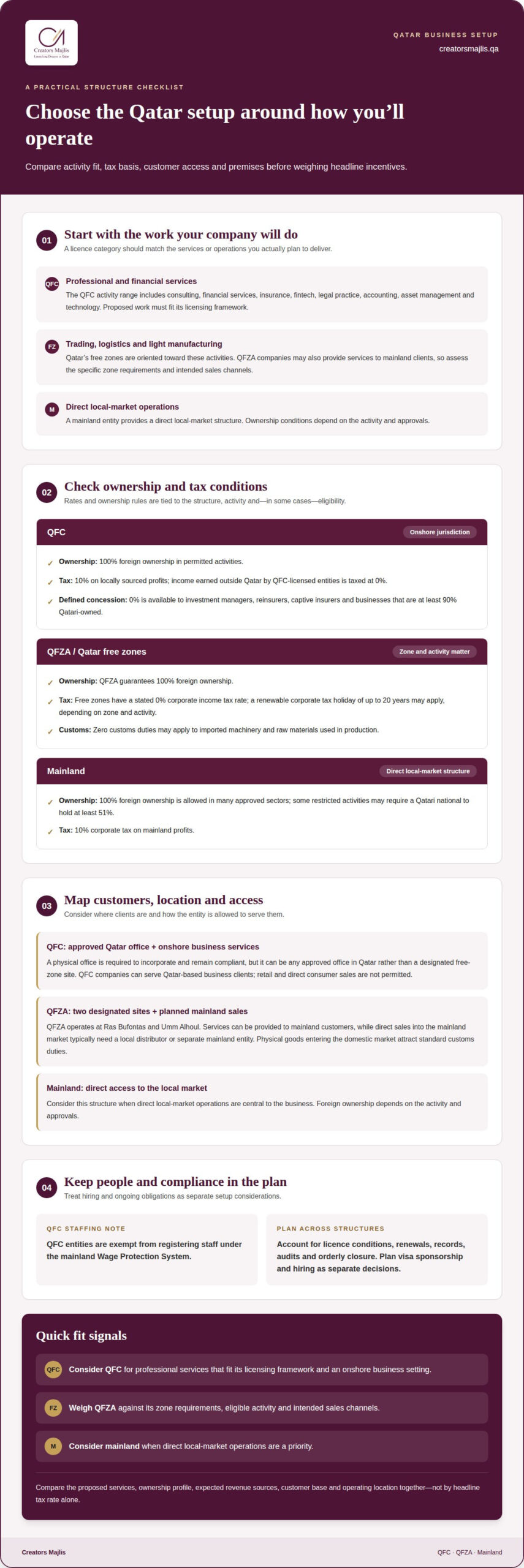
Business activity and licence categories
Choose a jurisdiction based on the work your company will perform, not its broad industry label. The Qatar Financial Centre (QFC) lists activities including consulting, financial services, insurance, fintech, legal practice, accounting, asset management and technology. A technology consultancy, for example, should describe its advisory work and technology services during registration. For a service company, the QFC and QFZA difference starts with whether the planned activities fit the relevant licensing framework.
QFC’s activity range makes it relevant to professional-services firms, but proposed work must fit its licensing framework. Financial services, insurance and legal practice differ from general consulting, so describe each service clearly when identifying the relevant route. Ownership and corporate tax also matter, but first match the company’s actual operations to permitted activities.
QFZA identifies trading, logistics and light manufacturing as suitable activities for its companies. This suggests a different operating profile from a consultancy or accounting practice. Before choosing a free-zone structure, map your service firm’s revenue-generating work to the zone’s activity scope. A logistics company coordinating goods and a firm providing business advice have different licensing needs.
If you’re comparing QFC and QFZA for a service company, prepare an activity description covering your core services, intended customers and delivery method. Compare it with QFC’s professional-service activities and QFZA’s stated focus. This helps reduce the risk of a mismatch between planned operations and the licence.
Setup, licensing and annual fees for QFC and QFZA depend on the jurisdiction, licence type, activity and premises. Compare applicable requirements and operating costs before choosing a structure.
Use this sequence to narrow the choice:
- List the services the company will deliver, such as consulting or accounting.
- Match each service to QFC’s listed professional activities or QFZA’s zone focus.
- Select a structure after assessing activity fit and the corresponding licence route.
Choosing between QFZA and QFC for professional services
For professional services, QFC’s activity scope and onshore business setting may be a closer fit. QFZA may suit service firms whose operations align with its zone activities and location.
QFZA Fit for Professional Services
QFZA identifies trading, logistics and light manufacturing as suitable activities, rather than focusing on professional services. A logistics consultancy linked to goods movement may align more naturally than a firm focused on legal practice or accounting. Free-zone companies can provide services to mainland customers, but direct sales into that market may require a local distributor or a separate mainland entity.
QFC Fit for Professional Services
The Qatar Financial Centre lists consulting, financial services, insurance, fintech, legal practice, accounting, asset management and technology. This makes QFC a direct activity match for many professional firms. Its framework uses English common law and is regulated by the QFC Regulatory Authority. QFC firms can serve Qatar-based business clients, though retail and direct consumer sales aren’t permitted.
Tax and cost should support the activity decision, not replace it. QFC applies 10% corporate tax to locally sourced profits, while Qatar free-zone entities have a stated 0% corporate income tax rate, subject to the applicable zone and activity framework. Setup and licensing costs depend on the selected jurisdiction, licence, activity and premises. Compare the required structure and operating needs alongside the tax treatment.
For a professional firm serving corporate clients in Qatar, QFC may be a closer fit when the licence covers its work. Consider QFZA when the planned service is tied to a zone-aligned operation, such as logistics, and its location and mainland sales route suit the business. Access to government contracts also matters: QFZA companies are generally excluded from bidding without additional mainland licensing.
Map your services, customers and operating location before choosing. Discuss your Qatar setup options to align the intended activity with a suitable structure.
Creators Majlis: Company Formation
Creators Majlis supports company formation in Qatar once you’ve narrowed your options to QFC, QFZA or mainland. The team can help align your proposed activities, ownership structure and target customers with a suitable setup route, turning your comparison into practical incorporation decisions.
Company Formation and Business Set Up in Qatar support the move from choosing a jurisdiction to establishing your business. PRO Services can help manage related administrative requirements as setup progresses. To get started, outline your services, intended market and preferred structure so the setup can reflect how your firm plans to operate.
Contact Creators Majlis to discuss your Qatar company setup.
Set Your Qatar Business in Motion
The difference between QFC and QFZA for a service company matters most when it shapes the business you want to build, not just the registration you complete. Treat the setup decision as an early strategic choice: it can influence how your firm presents itself, serves clients and grows into new opportunities. A clear plan for your services and target market gives that choice purpose.
Before moving ahead, bring your intended activities and business goals into one practical setup plan. Creators Majlis can help turn that direction into a defined next step. Talk with Creators Majlis about your Qatar setup and move forward with clarity and confidence.
Frequently Asked Questions
What Is QFZA (Qatar Free Zones Authority)?
QFZA is the Qatar Free Zones Authority, the body responsible for Qatar’s free-zone framework. It operates the Ras Bufontas and Umm Alhoul sites, offering a designated setting for companies whose activities fit the zone’s focus. For a founder, the practical distinction is that QFZA is the authority, while a company applies to establish and operate within its free-zone framework.
How long does business setup take, Free Zone versus QFC?
Qatar Free Zone and QFC setups typically take two to six weeks once documentation is complete. The timeline depends on the activity, the selected structure and whether application materials are ready for processing. A founder planning a launch should build in time to prepare company details and supporting documents, rather than treating the typical processing period as the entire planning window.
QFC vs QFZA: which is better for your startup?
For a startup focused on consulting, accounting, technology or another listed professional service, QFC may be the more direct activity fit. A startup built around logistics, trading or light manufacturing should assess QFZA. Also consider where the company will serve customers and how it will operate day to day. The suitable structure is the one that matches both the licensed work and commercial model.
What Is QFC (Qatar Financial Centre)?
QFC is the Qatar Financial Centre, an onshore business and financial centre with its own legal and regulatory framework. Established under Law No. 7 of 2005, it supports approved professional and financial activities. For a founder, this means the QFC is more than a registration label: its activity permissions and regulatory framework shape how the entity can conduct business.
What are QFC and QFZA in Qatar, and which authorities operate them?
QFC and QFZA are separate business frameworks in Qatar. The Qatar Financial Centre operates QFC, while the Qatar Free Zones Authority operates the free-zone framework. The QFC Regulatory Authority regulates QFC entities. Keep these roles distinct during setup: the framework determines the relevant licensing route, while the regulator oversees applicable requirements for entities under its remit.
Can a service company obtain a QFC or QFZA license, and which service activities are eligible?
Yes, a service firm can pursue a licence when its proposed activities fit the relevant framework. QFC lists consulting, financial services, insurance, fintech, legal practice, accounting, asset management and technology. QFZA’s stated focus includes trading, logistics and light manufacturing. Describe each planned service, then match those activities to the jurisdiction’s permitted categories.
Planning your own setup? Our company formation in Qatar service covers the route choice, licensing and the bank account in one process.