

The most attractive incentive may matter less than where your customers are. If you’re asking, “Qatar free zone vs mainland which is better for my business?”, start with your planned activity and the market you need to reach, not the headline benefits alone.
Choosing a registration route means comparing how your company will operate, who it will serve, and what it needs from its premises and ownership structure. MOCI mainland is Qatar’s primary commercial company registration route and applies to activities such as retail, physical-goods trade, on-site contracting, government procurement, and e-commerce to Qatar customers. The Qatar Free Zones Authority (QFZA) is a separate free-zone regime, with incentives relevant to inputs and re-export. The Qatar Financial Centre (QFC) is a third platform with its own framework. This guide compares the options so you can focus on the factors that matter to your business plan.
Key Takeaways
- To decide “Qatar free zone vs mainland which is better for my business,” begin with your intended activity and the customers you need to serve.
- Compare QFZA and MOCI mainland on activity, ownership, tax, customs, and operating needs, rather than incentives alone.
- If your model involves local retail, physical-goods trade, on-site contracting, government procurement, or e-commerce to Qatar customers, assess the mainland route closely.
- Before incorporation, define your activity and review the current requirements for the platform you are considering.
Qatar Free Zone vs Mainland: Start With What Each Route Is
Not sure which setup fits? Start by separating the platforms and matching each one to your company’s actual activities. MOCI mainland is Qatar’s primary commercial company registration route. QFZA is a distinct free-zone regime. QFC is a separate onshore centre for financial and professional services, not another name for QFZA.
What does MOCI mainland mean for a Qatar business?
A mainland company is registered through the Ministry of Commerce and Industry (MOCI). This route is especially relevant to businesses whose activities include retail, physical-goods trade, construction or contracting on-site, government procurement, or e-commerce serving customers in Qatar. For example, a retailer selling to local shoppers or a contractor carrying out work on-site should assess the mainland route against its planned activity. Map where transactions will take place and who will buy from you before comparing incentives.
How is QFZA different from QFC?
QFZA and QFC operate under different frameworks, so a benefit or requirement associated with one should not be assumed to apply to the other. QFZA is a free-zone regime, while QFC is an onshore financial and professional services centre with its own legal and regulatory framework. The Qatar Investment Authority forms part of the country’s broader investment context, but it does not determine which registration route suits your company.
Creators Majlis supports Company Formation across MOCI mainland, QFZA, and QFC. Its business advisory services include market research and feasibility studies to help founders assess their plans. Use this comparison as a planning guide, then review the current requirements that apply to your intended activity and platform.
Compare QFZA and Mainland Qatar on Market Access, Ownership, and Incentives
Compare the operating terms alongside the financial incentives. The key differences include the activities each platform covers, ownership rules, corporate tax treatment, customs, and premises.
- Activity and market: MOCI mainland is the primary commercial company registration route and applies to retail, physical-goods trade, on-site contracting, government procurement, and e-commerce to Qatar customers. Assess QFZA against the activities and operating model your company plans to pursue.
- Foreign ownership: Mainland companies may have up to 100% foreign ownership in most sectors. Banking, insurance, and commercial agencies are capped at 49% foreign ownership unless a special Cabinet dispensation is granted. QFZA allows 100% foreign ownership.
- Tax: Mainland corporate tax is 10% on the foreign-owned share of profit. Profits attributable to Qatari and GCC nationals are exempt. QFZA offers a renewable 20-year corporate-tax holiday at 0% tax.
- Customs: QFZA provides zero customs duty on inputs and re-export. Consider whether this treatment fits the way your business sources and moves goods.
- Land and units: QFZA land and units are lease-only. Include this in your premises planning and assess whether a lease-based model fits your operating needs.
Ownership rules need to be assessed against the specific activity. Although mainland foreign ownership can reach 100% in most sectors, banking, insurance, and commercial agencies have a 49% cap unless a special Cabinet dispensation is granted. Do not assume that the general ownership position applies to every sector.
Market access can be more important than an incentive. A retailer, physical-goods trader, on-site contractor, procurement-focused business, or e-commerce company targeting customers in Qatar should give the mainland route particular attention. A business importing inputs or re-exporting goods should compare its operating model with QFZA’s customs framework. The Qatar Free Zones Authority provides official zone information. If you are assessing a mainland structure, review the considerations for LLC company formation in Qatar as part of your comparison.
So, “Qatar free zone vs mainland which is better for my business?” depends on your activity, customer market, ownership needs, and operating model. Creators Majlis can help you compare these priorities through a Qatar company formation discussion.
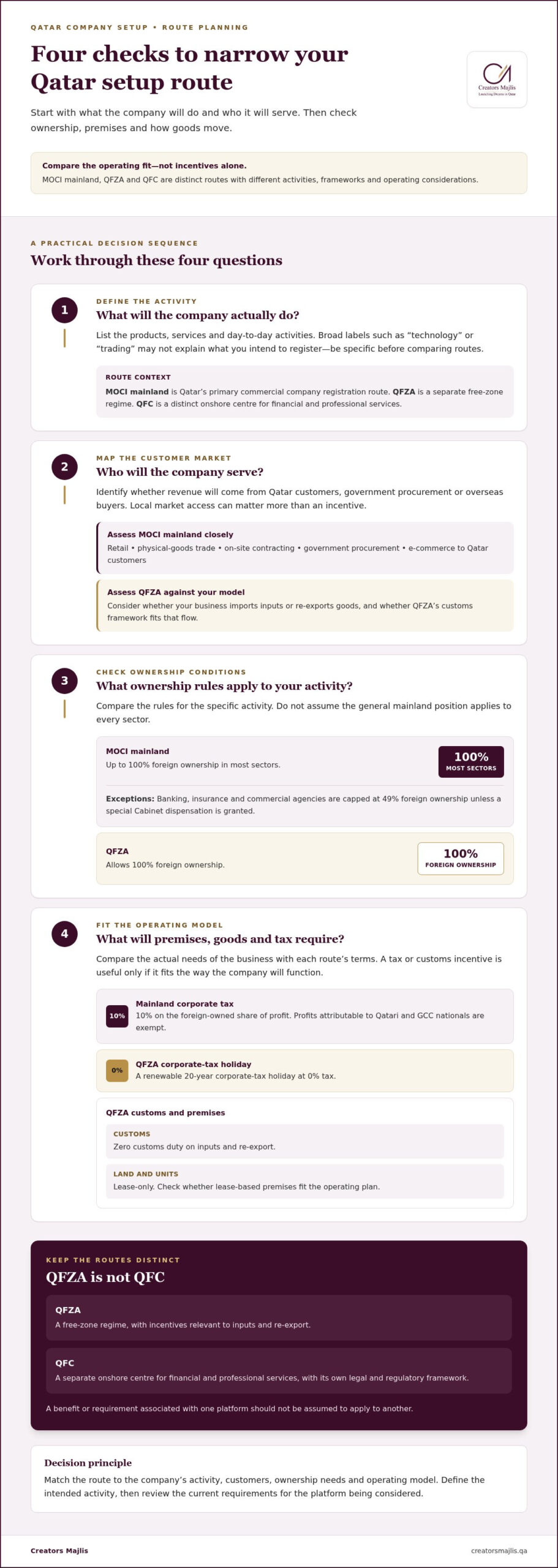
Which Qatar Setup Route Fits Your Business Model?
Work through the decision in a practical order. Start with the work your company will perform, then map its customers, ownership needs, and operating requirements. A tax or customs incentive is valuable only if it fits the way the business will function.
Use four questions to narrow the choice
- What will the company actually do? List its products, services, and day-to-day activities. A broad label such as “technology” or “trading” may not explain the activities you intend to register. Be specific before comparing routes.
- Who will it serve? Identify whether revenue will come from Qatar customers, government procurement, or overseas buyers. Local retail, physical-goods trade, on-site contracting, procurement, and e-commerce to Qatar customers are reasons to assess mainland registration closely.
- What ownership conditions apply? Compare the ownership rules for your intended activity. In mainland Qatar, foreign ownership may reach 100% in most sectors, while banking, insurance, and commercial agencies are capped at 49% unless a special Cabinet dispensation is granted. QFZA allows 100% foreign ownership.
- What does operating the business require? Consider premises, how goods move, and whether the model depends on QFZA’s lease-only land and units or on activities covered by MOCI mainland registration. Compare these needs with your actual operating plan.
When should you compare QFC as a separate route?
If your company provides financial or professional services, include QFC as a distinct onshore platform in your assessment. Keep its framework separate from QFZA: QFC information does not establish QFZA eligibility, incentives, or operating terms. This QFC Qatar business setup route guide can help you understand when to compare it alongside the other options.
Use your answers to create a short decision brief: intended activities, customer markets, ownership requirements, and operating model. Creators Majlis can help you consider these priorities through its Company Formation and business advisory services. Discuss your Qatar company formation options to shape the route around your business plans.
Plan Your Qatar Company Formation With a Clear Route
There is no universally better platform. The answer to “Qatar free zone vs mainland which is better for my business?” becomes clearer when you start with the company’s activities and target market, then assess ownership and day-to-day operating needs. Review the requirements for the relevant platform before incorporation. Treat this comparison as a planning guide, not a substitute for current regulatory advice.
What to prepare before discussing your setup
Prepare a concise outline of how the business will operate. Include:
- Proposed activities: Describe the products or services the company will provide, rather than relying only on a broad industry label.
- Customers and markets: Identify whether you plan to serve Qatar customers, pursue government procurement, or focus on exports and re-exports.
- Ownership objectives: Note the intended ownership structure and any sector-specific considerations that may affect it.
- Operating requirements: Set out practical needs such as premises, land or unit use, and how goods or services will reach customers.
This preparation helps you compare the available routes against the business you are actually building. It also makes it easier to distinguish an attractive headline incentive from a feature that fits your operating model.
Move from comparison to a tailored formation plan
Creators Majlis provides Company Formation support across Qatar Financial Centre (QFC), Qatar Free Zones Authority (QFZA), and Mainland Qatar. Its business advisory services include market research and feasibility studies, helping founders and investors assess their plans and priorities. Personal attention and multilingual support in German, English, and Arabic help keep the formation discussion clear and focused on your objectives.
Once you have outlined your activities, market, ownership, and operating needs, take the next step toward a formation plan tailored to your objectives. Discuss your Qatar company formation options with Creators Majlis.
Turn Your Platform Decision Into a Strong Launch Plan
Your registration route shapes how your business will operate and grow in Qatar. Before moving from comparison to incorporation, turn your preferred option into a practical plan: clarify the activities you intend to carry out, the customers you aim to reach, and the operating requirements that matter from launch. Then review the requirements that apply to your chosen platform. This connects your strategic choice to the decisions that follow, rather than treating registration as a box to tick.
If you are still weighing “Qatar free zone vs mainland which is better for my business”, a focused formation discussion can help bring your priorities into view. Creators Majlis is a QFC-licensed corporate advisory firm, with Company Formation support across QFC, QFZA, and Mainland Qatar. Discuss the right Qatar setup route for your business and take your next step with a clearer plan.
Frequently Asked Questions
Can a foreign investor own 100% of a mainland company in Qatar?
Foreign ownership may reach 100% in most mainland sectors. Banking, insurance, and commercial agencies are capped at 49% foreign ownership unless a special Cabinet dispensation is granted. Treat full ownership as a possibility to assess for your intended activity, not an automatic entitlement. Identify the activity you plan to register and consider the applicable ownership limit before settling your structure.
Is QFZA the same as the Qatar Financial Centre?
No. QFZA and QFC are separate platforms with distinct remits. QFZA is a free-zone regime, while QFC is an onshore centre for financial and professional services. Name the intended platform explicitly in your formation planning, and do not assume that a requirement or benefit associated with QFC also applies to a QFZA company.
Does a QFZA tax holiday automatically apply to every company?
QFZA offers a renewable 20-year corporate-tax holiday at 0% tax. When comparing “Qatar free zone vs mainland which is better for my business,” assess the tax treatment alongside your activities, customers, and operating model. Review the applicable QFZA requirements before relying on the incentive in your business planning.
Can a QFZA company sell directly to customers in Qatar?
Do not assume that QFZA registration automatically provides the same market access as MOCI mainland registration. MOCI mainland is the primary commercial company registration route and applies to e-commerce to Qatar customers, as well as retail and physical-goods trade. If your business plans to sell to local customers, include that activity in your platform assessment and review the relevant requirements before choosing a route.
What does lease-only land or unit access mean for a QFZA business?
QFZA land and units are lease-only. This matters if your operating plan depends on particular premises, long-term site control, or a specific facility configuration. Include your space requirements and intended use in the platform assessment, then review the applicable lease terms before committing to the model.