

Yes, you can sell a business in Qatar through a share transfer, but signing a sale agreement alone doesn’t complete the change of ownership. The process for transferring company ownership in Qatar depends on the company’s legal framework, its existing documents and the approvals required for the transaction. Getting the paperwork and liabilities in order is central to a smooth handover.
A company sale can seem straightforward until company records, shareholder approvals and government procedures need to be coordinated. This guide explains the checks and documents to consider, how a share sale agreement can allocate known and potential liabilities, and what is involved in formally updating ownership. The process of transferring company ownership in Qatar varies by registration framework, so the steps depend on whether the company is registered on the mainland, with the Qatar Financial Centre or in a free zone.
Key Takeaways
- Identify whether the company is mainland, QFC or free zone before planning the ownership transfer, as the governing process differs.
- Review the Commercial Registration and Articles of Association to identify transfer restrictions, approval requirements and any earlier ownership changes that still need formal registration.
- Prepare the company and shareholder documents required for the transaction, including valid identification and relevant corporate records.
- Use the share sale agreement to allocate known and potential liabilities clearly, while recognizing that contractual terms don’t automatically remove statutory or third-party claims.
What Documents Are Required to Transfer Commercial Registration?
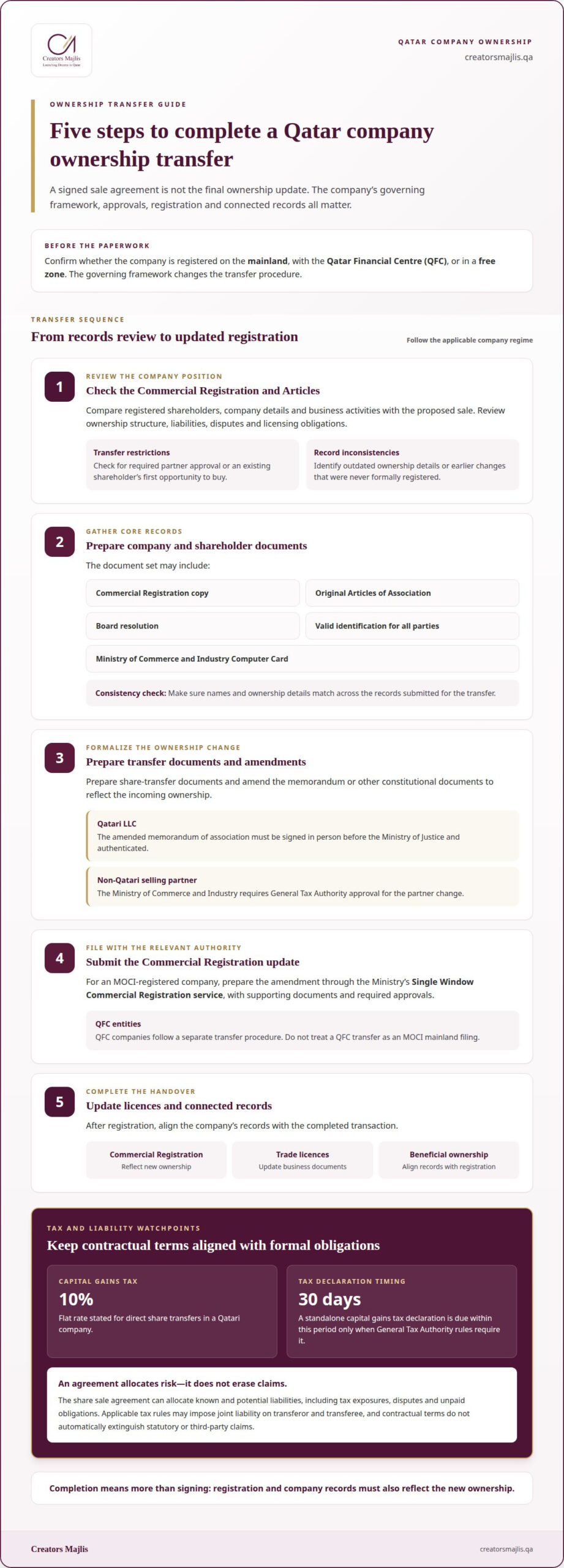
The process of transferring company ownership in Qatar begins with reviewing the company’s records and identifying the approvals required. Before signing, buyers and sellers should examine the ownership structure, liabilities, disputes, transfer restrictions and licensing obligations. This review may reveal an earlier ownership change that was not registered or another issue to address before proceeding.
- Review the Commercial Registration and Articles of Association. Compare registered shareholders, company details, and business activities with the proposed sale. Check whether the Articles of Association restrict transfers, require existing partner approval, or give shareholders the first opportunity to buy. Resolving inconsistencies early helps prevent the transfer application from reflecting an outdated ownership position.
- Prepare company and shareholder documents. The document set may include a Commercial Registration copy, original Articles of Association, board resolution, valid identification for all parties, and the Ministry of Commerce and Industry Computer Card. Confirm that names and ownership details match across the records submitted for the transfer.
- Amend the memorandum and constitutional documents. Prepare share-transfer documents and amendments reflecting the incoming ownership. For a Qatari LLC, the amended memorandum of association must be signed in person before the Ministry of Justice and authenticated. If the selling partner is non-Qatari, the Ministry of Commerce and Industry requires General Tax Authority approval for the partner change.
- Submit the Commercial Registration update. For an MOCI-registered company, prepare the amendment through the Ministry’s Single Window Commercial Registration service, with supporting documents and required approvals. QFC companies follow a separate transfer procedure, so identify the company’s legal framework before filing.
- Update licences and connected records. After registration, update the Commercial Registration, trade licences, and other business documents to reflect the new ownership. Align ultimate beneficial owner records with the registered position. The process for transferring company ownership in Qatar is not complete through a sale agreement alone; registration and company records must also be updated.
Share sale agreements and liability allocation
Set the transaction scope before drafting: decide whether the buyer acquires some shares or the entire holding. Direct share transfers in a Qatari company are subject to capital gains tax at a flat rate of 10%; applicable tax rules can also impose joint liability on transferor and transferee.
-
Set the Transfer Scope and Liability Terms with Professional Guidance
Define the shares being transferred and the ownership structure after completion. A partial transfer leaves some shareholders in place; a complete transfer changes the entire shareholding. The agreement should allocate known and potential risks, including responsibility for identified tax exposures, disputes and unpaid obligations. This helps clarify the parties’ contractual responsibilities, but does not automatically extinguish statutory or third-party claims.
-
Prepare Share Transfer Documentation with Professional Support
Prepare the share sale agreement and supporting documents to reflect the agreed transaction. If an owner is leaving a partnership, record whether the arrangement is being cancelled or the shares are being transferred to another party. For a transfer between existing shareholders, specify which shares are changing hands and set out the resulting ownership structure. Review the company’s constitutional documents for transfer restrictions, approval requirements or an existing owner’s right of first refusal.
- Address tax filings and formal completion. A standalone capital gains tax declaration is due within 30 days only when General Tax Authority rules require that filing. The agreement’s liability clauses don’t replace applicable tax obligations. Coordinate the signed transfer documents and required approvals with the registration process, then align the company’s records with the completed transaction. For coordinated assistance with the transaction, discuss your ownership transfer.
Documents required for an ownership transfer
An LLC registered with the Ministry of Commerce and Industry follows the applicable mainland process; QFC and free-zone companies use separate regimes. Foreign ownership may reach 100% in most economic sectors, but banking, insurance, and commercial agency activities generally require relevant approvals.
- Identify the company’s governing framework. Confirm whether the company is an MOCI-registered LLC, a QFC entity, or a free-zone company. Each framework has its own transfer procedure, so the document package must match the company’s registration authority. A QFC transfer should not be treated as an MOCI mainland filing.
- Assemble the core company and identity records. A Qatar share transfer may require a copy of the Commercial Registration, the original Articles of Association, a board resolution, valid identification documents for all parties, and the Ministry of Commerce and Industry Computer Card. These records establish the company’s current details, decision-making authority, and transfer parties.
- Prepare transaction-specific documents. Include the share transfer agreement and partner records, then draft amendments to the memorandum or Articles of Association where ownership details appear. For a Qatari LLC, the amended memorandum must be signed in person before the Ministry of Justice and authenticated. The amendment should reflect the intended ownership after transfer.
- Address foreign ownership and required approvals. Under Qatar’s Foreign Investment Law, non-Qatari investors may own up to 100% of an MOCI-incorporated LLC in most economic sectors. Banking, insurance, and commercial agency activities are generally excluded unless required approvals are obtained. Where a selling partner is non-Qatari, General Tax Authority approval is required for the partner change.
- Complete supporting records and registration updates. Legalise overseas documents for use in Qatar, as this can take longer than preparing corporate paperwork. Submit the required documents and approvals to the relevant authority, then update the Commercial Registration and applicable licences. Align ultimate beneficial owner records with the company’s registered ownership after the change is recorded.
Which Qatar government authorities handle company ownership transfers?
The company’s registration framework determines which authority handles the ownership change. For mainland companies, the Ministry of Commerce and Industry (MOCI) oversees company requirements, while Qatar Financial Centre (QFC) and free zone companies follow their respective procedures.
- Identify the company’s regulator first. Confirm whether the company is registered with MOCI, the Qatar Financial Centre (QFC), or a Qatar free zone. Each follows its own transfer regime, so route the application through the authority responsible for that registration. A regulated activity may also need approval from its relevant sector authority before ownership registration.
- Coordinate the mainland filing with MOCI. For an MOCI-registered company, submit the ownership amendment and supporting documents through the relevant government process. If the acquisition will result in foreign ownership exceeding 49%, a separate application under the Foreign Investment Law must be filed and approved by MOCI. Review the company’s activity and resulting ownership structure as part of that submission.
- Obtain applicable General Tax Authority approval. A change of partners involving a non-Qatari selling partner requires General Tax Authority approval under the stated MOCI process. The General Tax Authority must also be notified of a Qatari company’s shareholder change within 30 days after the amended Commercial Registration is issued. Plan both steps around the registration date.
- Complete authentication through the Ministry of Justice. For a Qatari LLC, the amended memorandum of association must be signed in person before the Ministry of Justice and authenticated. This formalizes the revised ownership document; it does not replace MOCI registration or any required approvals.
- Assess competition and post-registration requirements. Under Qatar’s Competition Law, parties should assess early whether the transaction may require prior notification to and approval from the Competition Protection and Anti-Monopoly Committee (CPAMC) before completion. After registration, align company records with the approved ownership. For support coordinating Qatar business setup and government procedures, discuss your transfer requirements.
Creators Majlis: Business Set Up in Qatar
Creators Majlis supports founders and investors with Business Set Up in Qatar, Company Formation and PRO Services. If a share transfer also involves restructuring the company or preparing for a new business direction, these services can help coordinate the related setup and administrative requirements. Each mandate is handled by one adviser from the initial assessment through the annual return, with multilingual advice and a written recommendation provided before filing. Start with a Free initial assessment to discuss your company’s needs.
Share the company’s current structure and intended changes to clarify which business setup steps may be relevant. For assistance with your next stage in Qatar, contact Creators Majlis.
Shape the Next Chapter of Your Business
A change in ownership is also a chance to clarify the company’s direction. Use the transition to align decision-making, priorities and the incoming owner’s role with the business’s plans. This gives the handover a clear purpose beyond completing the paperwork.
As you work through the process of transferring company ownership in Qatar, consider which decisions need continuity, where the new owner intends to lead and how responsibilities will be communicated across the company. These choices can help make the change a considered business transition, rather than treating registration as the finish line.
Creators Majlis can support you when an ownership transition also involves broader business setup or administration. Set priorities for the company’s next chapter, then arrange a Free initial assessment to discuss the practical next steps.
Start a conversation with Creators Majlis about your transfer and what comes next.
Frequently Asked Questions
Can You Actually Sell a Business in Qatar?
Yes. A business in Qatar can be sold through a share transaction or an asset transaction, depending on what the buyer and seller agree to transfer. A share sale changes who owns the company; an asset deal focuses on selected business assets without changing the shareholders. Before choosing, map contracts, licences, staff arrangements and liabilities against the proposed deal scope so it reflects what the buyer intends to acquire.
Need Assistance with Company Share Transfer?
Creators Majlis provides PRO Services for government-related procedures, including filings and document handling, and Company Formation when a transaction connects to a wider setup need. Each mandate is managed by one adviser from assessment through annual return, with multilingual advice and a written recommendation before filing. A Free initial assessment can help clarify the administrative support needed, while keeping transaction terms and the sale agreement distinct from setup assistance.
Share Sale vs Asset Sale: Which One Fits Your Deal?
A share sale transfers ownership interests in the company, while an asset sale transfers specified business assets. A buyer seeking continuity may consider a share deal; a buyer seeking selected assets may consider an asset purchase. The choice also affects which contracts, licences, debts and operational responsibilities remain with the company or are addressed in the transaction. Define the deal scope around the business components the buyer intends to acquire.
What Fees Are Involved in Transferring a Business?
There is no single total fee for every ownership transfer. Costs depend on the company’s registration framework, required authority filings and document amendments, as well as any authentication or legalisation and applicable foreign-investment or regulated-activity approvals. Government charges and professional support are separate cost components. Clarify the transfer structure and required procedures before assessing the costs involved.
What Ministry of Labour Step May Apply to the Ownership Change?
A Ministry of Labour step may apply if the ownership change affects employer records, work permits or related labour filings; it is not required for every share transfer. The key question is whether employer information or workforce administration records need updating. Include this review alongside other government updates so operational records reflect the company’s changed ownership and administration.
Who Is Responsible for Old Liabilities After the Sale?
The sale agreement can allocate responsibility between the seller and buyer for known or potential pre-transfer liabilities, but that allocation does not automatically prevent statutory or third-party claims. Qatar tax rules can impose joint liability on the transferor and transferee for taxes and financial penalties where applicable. Identify debts, tax exposures, disputes and indemnity procedures in the agreement, then align its terms with the transaction records.