
Choosing where to register is as important as deciding to enter the market. Establishing a business in Qatar typically takes 2-4 weeks, depending on approvals and documentation. The right route depends on your business activity, ownership plans and operating needs.
Free 2026 checklist: Set up a company and move to Qatar, six phases on six pages.
Planning the move itself? Read our guide to moving to Qatar as a business owner: residence through your company, family, taxes and your first 90 days.
It’s natural to focus first on the opportunity, then ask which zone, licence and registration route best fits your plans. Establishing a business in Qatar can follow several paths, but they are not interchangeable: mainland, the Qatar Financial Centre and free zones each have distinct frameworks and considerations.
This guide explains why Qatar may suit your business and how to compare its zones before you commit. You’ll also follow the practical setup sequence, from choosing an entity and securing Commercial Registration to obtaining the trade licence and completing the steps needed to operate. With a clear view of the decisions involved, you can build a stronger foundation for entering the market.
Key Takeaways
- Match your business activity, ownership plans and operating needs to Qatar’s mainland, QFC or free-zone route before choosing an entity.
- Compare free zones, industrial zones and logistics parks by their focus and the facilities your operations require.
- Plan registration and licensing as separate milestones: secure Commercial Registration, then obtain the Commercial License required for your activity.
- Map the setup sequence from eligibility and entity selection through approvals, premises and banking; Creators Majlis can support company formation and business setup in Qatar.
Why Set Up a Business in Qatar?
There is no minimum share-capital requirement for a QFC Holding Company. Set the company’s capital with its purpose and planned activities in mind. A registered office situated in the QFC is mandatory.
Qatar’s stated corporate tax rate is 10% of taxable net profit. VAT is not applicable in Qatar yet.
Hiring expatriate staff involves work-permit approval and relevant visa procedures. The estimated work-permit approval period is 3 months for the compared entity types.
- Match the entity to your activity. Investors should compare mainland, QFC and free-zone routes before preparing applications. Foreign ownership can reach 100% in approved sectors, while other activities have different ownership conditions.
- Map the approvals and procedures. List the registrations, activity-specific approvals and trade licences your operation needs. The relevant authorities and requirements depend on the entity and business activity.
- Build a realistic cost plan. Separate registration and licensing expenses from premises, staffing and operational costs. The total depends on entity type, activities, location, facility needs and required approvals, so compare these items before committing.
- Set a timeline around the approvals. A typical Qatar business setup takes 2-4 weeks, depending on approvals and documentation. Prepare documents early and allow time for each authority’s review.
- Include setup support in your work plan. The process may involve entity structuring, document preparation, registration, licence applications and coordination of relevant approvals. Add banking and staff immigration procedures to the operational plan.
- Plan for the first operating milestone. After registration and licensing, align the premises, staffing and banking steps with your intended launch. This sequence helps investors establishing a business in Qatar move from approvals to day-to-day operations.
Free zones, industrial zones and logistics parks
Choose a platform by matching your business activity with its framework, ownership rules and regulator. MOCI mainland, the QFC and QFZA free zones each have different rules and requirements.
-
Compare Business Zone Options
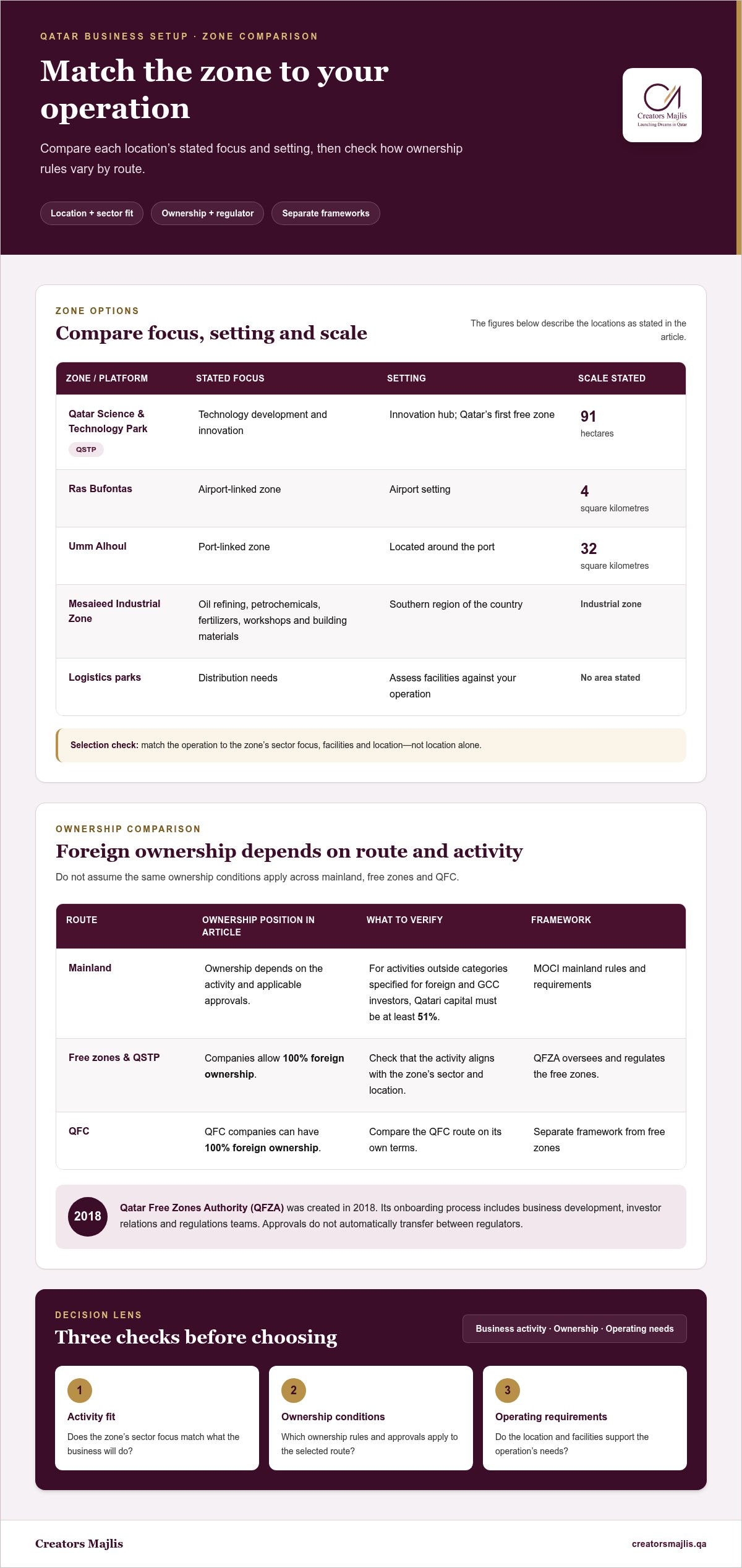
Start by matching your operations to a location, then compare its facilities and sector focus. Qatar Science & Technology Park is a 91-hectare innovation hub and Qatar’s first free zone. Ras Bufontas is a 4-square-kilometre airport zone, while Umm Alhoul spans 32 square kilometres around the port. Mesaieed Industrial Zone, located in the southern region of the country, serves oil refining, petrochemicals, fertilizers, workshops and building materials. Logistics parks serve distribution needs, so avoid choosing by location alone.
-
Check Free-Zone Eligibility
Check whether your activity fits a zone’s mandate before selecting its company structure. Qatar’s free zones suit businesses whose operations align with their sector and location, while QSTP focuses entirely on technology development and innovation. Qatar Free Zones Authority, created in 2018, oversees and regulates the free zones. Its onboarding process includes business development, investor relations and regulations teams. Compare their requirements with the QFC route, which has its own framework, rather than assuming approvals transfer between regulators.
-
Compare Ownership and Sponsorship
Decide whether mainland access or zone-based ownership better supports your operating model. Qatar Free Zone and QSTP companies allow 100% foreign ownership; QFC companies can also have 100% foreign ownership. Mainland ownership depends on the activity and applicable approvals. For activities outside categories specified for foreign and GCC investors, Qatari capital must be at least 51%, according to Qatar’s Ministry of Commerce and Industry. Don’t treat sponsorship expectations as identical across structures. Before committing, discuss your zone and company structure in light of your planned activities.
Commercial registration and trade licences
Start by matching your business activity to its registration and licensing route. Qatar’s Start Your Business service reserves a trade name and issues Commercial Registration; a Commercial License follows through the License Your Business service.
-
Arrange Commercial Registration and Licensing
Prepare the proposed activity, entity details and trade name before applying. The Start Your Business service combines trade-name reservation with Commercial Registration, creating the registration basis for the next licensing step. Then apply for a Commercial License through License Your Business. Keep the activity descriptions consistent across applications, because licensing depends on the activities recorded for the business. This sequence helps investors organize registration and compliance before operations begin.
-
Obtain Required Licences and Approvals
Identify approvals tied to your activity before treating Commercial Registration as permission to operate. The Commercial License is obtained after the required Commercial Registration, while specialized activities may involve additional approvals. For example, Qatar’s Factory Establishment service combines an application for the factory’s Commercial Registration with an application for Initial Approval from the Ministry of Commerce and Industry’s Industrial Development Department. A home business follows a separate Home License route, subject to applicable legal regulations.
- Budget for each registration, licence and permit as a separate compliance item. Qatar’s service fees vary by application, activity and entity; include any relevant commercial permit charges in your development plan. A trade name and Commercial Registration do not replace a Commercial License. If your global expansion involves a commercial agency agreement, handle it as a separate business arrangement, not as a substitute for registration or activity licensing. Confirm that the agreement’s scope aligns with the activities stated in your applications.
Steps for establishing a business in Qatar
Move from choosing a platform to operational readiness in a deliberate sequence. Each step connects the company structure, required approvals and practical arrangements needed to launch.
- Check foreign-investor eligibility. If you’re a non-resident foreign investor, use Qatar’s Foreign Investor Eligibility Check before establishing a company. Match the proposed activity to the intended ownership structure, then identify any approvals required for that activity. This early review helps shape the application route before you prepare registration documents or commit to premises.
- Choose the entity and plan its capital. Select the structure that fits your ownership and operating plans. For mainland and QFC LLCs, there is no minimum capital requirement; management can set capital according to business needs. Document the proposed activities and ownership clearly, so the registration application and later approvals reflect the same operating plan.
- Submit registration and activity applications. Reserve a trade name and obtain Commercial Registration through Qatar’s Start Your Business service. Then apply for the Commercial License required to conduct the listed activities. Keep activity descriptions aligned across submissions. Industrial projects need particular attention: eligible registrations can apply for Initial Approval from the Industrial Development Department.
- Secure site-related approvals. Select premises that suit the business activity and licensing route. A Civil Defense Certificate is required for a business site of at least 250 square metres, subject to stated exceptions and activity-specific requirements. Account for this approval while planning fit-out and launch tasks, rather than treating the premises as a separate decision.
- Arrange banking and workforce steps. Prepare the company documents required for a corporate bank account and include the account-opening stage in the launch schedule. The estimated account-opening timeline is 4 weeks. Existing business establishments can apply for approval to recruit the workforce needed for their activities; plan work-permit and family residency visa in Qatar procedures alongside operational staffing needs.
- Complete zone onboarding where relevant. For a Qatar Free Zones Authority application, follow the staged onboarding process. After initial registration, business development provides required forms and confirmations for investor relations review. Use this sequence to coordinate registration, approvals and site arrangements. Get support planning your Qatar business setup around these steps.
Creators Majlis: Company Formation
Creators Majlis supports founders planning company formation in Qatar. If you are comparing mainland, QFC and free-zone options, its Company Formation service can guide you through the setup process and help you consider the right route for your plans. PRO Services can also assist with government-related procedures.
Consider support when you are comparing structures, preparing to register or coordinating the steps between formation and launch. A clear plan helps keep ownership, activities and licensing requirements aligned while you focus on the business case and future operations.
Contact Creators Majlis to discuss your Qatar business setup.
Turn Your Qatar Business Plan Into Action
Turn your market-entry decision into a practical plan: identify the decisions that need to come first, assign responsibility for each task and connect the setup to your initial operating needs. A well-ordered process keeps administrative work focused on your commercial priorities.
Creators Majlis provides Company Formation, PRO Services and Business Set Up in Qatar. If you are ready to move from exploring options to establishing a business in Qatar, contact Creators Majlis to discuss your plans and the practical next steps.
Discuss your Qatar business setup with Creators Majlis and take the next step with a clearer foundation for growth.
Frequently Asked Questions
Common Challenges & How to Overcome Them?
Common pitfalls include choosing a platform before checking its rules, describing activities inconsistently and submitting incomplete application documents. Write a concise description of your business activities first, then use it consistently in registration and licensing paperwork. If your company plans to provide consulting and sell products, for example, identify both activities and assess the requirements that apply to each.
How many Qatar resident shareholders will I need to incorporate a Qatar LLC?
Assess ownership requirements by your business activity, rather than assuming a fixed number of resident shareholders applies to every LLC. For activities outside the categories specified for foreign and GCC investors, Qatari capital ownership must be at least 51%, according to Qatar’s Ministry of Commerce and Industry. This is an ownership-share requirement, not a count of shareholders; your proposed structure should reflect the activity’s applicable ownership rules.
Which are the entity types in Qatar that require an annual audit?
Qatar LLCs and branch offices require an annual audit. Treat the audit as a recurring compliance responsibility, not simply a registration-stage task. Build the process into your company’s annual records and reporting calendar, and keep financial documents organized as operations develop. The audit requirement applies to these entity types; don’t assume it automatically extends to every Qatar business structure.
What business structures can foreign investors establish in Qatar?
Foreign investors can consider mainland companies, QFC entities, free-zone companies, joint ventures, branch offices and representative offices. Each structure serves different commercial purposes: a representative office has 0% commercial activity, while a branch is linked to an existing foreign company. Compare the activity permissions, ownership conditions and regulator for each route before choosing a structure for your Qatar operations.
Can foreigners own 100% of a company in Qatar, and what are the exceptions?
Yes, foreign ownership can reach 100% in many approved activities, including companies registered under QFC and Qatar free zones. Exceptions depend on activity: banks and insurance companies are excluded from 100% foreign ownership unless the Cabinet decides otherwise, and commercial agencies are reserved for Qatari nationals. For activities outside categories specified for foreign and GCC investors, Qatari capital ownership must be at least 51%, according to Qatar’s Ministry of Commerce and Industry.
What are the steps to register a company in Qatar, and how long does it take?
The process of establishing a business in Qatar typically takes 2-4 weeks, depending on approvals and documentation. First settle the activity, ownership structure and entity route; then reserve the trade name, obtain Commercial Registration and apply for the required Commercial License. Include activity-specific approvals and premises requirements in the schedule. Consistent company details across submissions can help prevent avoidable document revisions during review.
Planning your own setup? Our company formation in Qatar service covers the route choice, licensing and the bank account in one process.