

A project can look worthwhile on paper and still hide costs that a spreadsheet cannot capture. In the Qatar market, cost-benefit analysis compares a project’s costs and benefits in monetary terms, but some effects cannot be measured that way. Assess benefits you cannot quantify alongside the financial results. A strong cost-benefit analysis in the Qatar market makes its assumptions and limitations clear.
That matters when weighing an investment: estimates depend on the assumptions, data and effects included, and a strong ratio alone cannot tell the whole story. A clear analysis gives you a structured way to compare options and test whether expected returns justify the resources required.
Learn how to assess costs and returns, compare a project with doing nothing, and account for risks and harder-to-measure impacts in Qatar. This guide explains where cost-benefit analysis helps business decisions, where it falls short, and how to use its findings when evaluating the Qatar market.
Key Takeaways
- Include direct, indirect, opportunity and intangible effects in your assessment, and weigh unquantified benefits qualitatively alongside financial estimates.
- Use the benefit-cost ratio and net present value to compare returns, while treating each measure as one part of the decision rather than the whole answer.
- Compare a proposed project with doing nothing to clarify what benefits and costs arise from the investment itself.
- Test key assumptions, such as labor costs and market demand, to see how changing conditions could affect your business decision.
What Are the Limitations of Cost-Benefit Analysis?
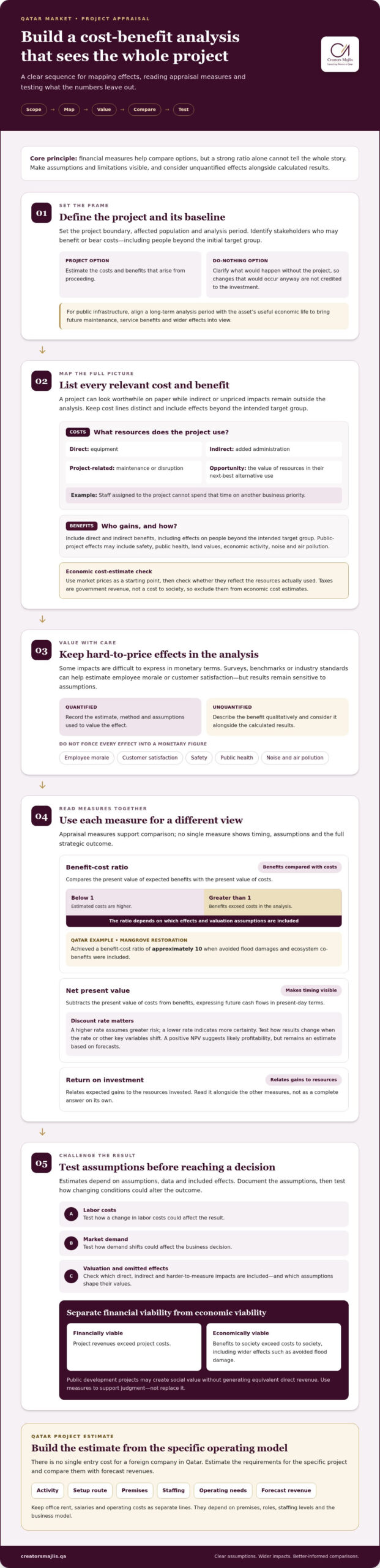
Cost-benefit analysis can miss a project’s real effects if its scope excludes indirect or unpriced impacts. Start by listing direct costs, such as equipment, and indirect costs, such as added administration. Include project-related costs like maintenance or disruption. Then identify direct and indirect benefits, including effects on people beyond the intended target group.
Opportunity cost is the value of resources in their next-best alternative use. For example, staff assigned to a project cannot spend that time on another business priority. Use market prices as a starting point for valuing benefits, then check whether they reflect the resources actually used. Taxes are government revenue, not a cost to society, so exclude them from economic cost estimates.
Some impacts are difficult to value in monetary terms. Surveys, benchmarks or industry standards can help estimate employee morale or customer satisfaction, but the results remain sensitive to assumptions. Record unquantified benefits qualitatively and consider them alongside calculated results. For public projects, include social effects such as safety, public health, land values, economic activity, noise and air pollution. Healthcare and environmental decisions cannot always be judged by monetary measures alone.
When comparing Qatar mainland with Qatar Free Zones, assess the activity, setup route, premises, staffing and operating needs for each option. The better fit depends on how these factors affect total project costs and expected benefits.
Which industries offer the strongest opportunities and returns? Assess demand in Qatar, competition, operating requirements and expected revenue for each proposed activity. An industry’s potential depends on evidence and the project’s cost structure, not its label alone.
Compare Qatar, the UAE and Saudi Arabia using the same cost categories and revenue assumptions. Entry costs and benefits depend on the chosen activity, structure, location and operating model in each market.
Foreign-ownership limits and local-partner requirements depend on the activity and chosen legal structure. Include the applicable ownership arrangement in your analysis before comparing project outcomes.
There is no single entry cost for a foreign company in Qatar. Estimate setup, premises, staffing and operating requirements for the specific project, then compare them with forecast revenues.
Office rent, salaries and operating costs depend on premises, roles, staffing levels and the business model. Record these assumptions as separate cost lines instead of relying on one blended estimate.
Key investment risks include uncertain demand, changing cost assumptions and omitted social or indirect effects. Test how labor costs or market demand could change the result, and document your assumptions before deciding.
Benefit-cost ratio, net present value, and return on investment
Use appraisal measures together to assess whether a Qatar project creates value. Each highlights a different aspect of the investment decision.
Project Appraisal Measures
A benefit-cost ratio compares the present value of expected benefits with the present value of costs. Net present value subtracts the present value of costs from benefits, expressing future cash flows in present-day terms. Return on investment relates expected gains to the resources invested. Read the measures side by side: no single ratio shows timing, assumptions and the full strategic outcome.
Interpreting Benefit-Cost Ratios
A benefit-cost ratio greater than 1 means benefits exceed costs in the analysis. A ratio below 1 means estimated costs are higher. Qatar mangrove restoration achieved a benefit-cost ratio of approximately 10 when avoided flood damages and ecosystem co-benefits were included. That example shows how including indirect benefits can change an evaluation, but the result depends on which effects and valuation assumptions the analysis includes.
Net present value makes timing visible by discounting future revenues and costs, which means the discount rate matters. A higher rate assumes greater risk, while a lower rate indicates more certainty. Test how the result changes when the rate or other key variables shift. A positive net present value suggests a project is likely to be profitable, but it remains an estimate based on forecasts.
Keep financial and economic effectiveness distinct. A project is financially viable when its revenues exceed its costs. It is economically viable when benefits to society exceed costs to society, including wider effects such as avoided flood damage. Public development projects may therefore create social value without generating equivalent direct revenue.
Use the measures to support, not replace, judgment. Review the assumptions behind each benefit, separate direct and indirect returns, and compare results across scenarios. If your Qatar project needs a structured appraisal before a wider business decision, discuss your project requirements.
Comparing project options with the do-nothing alternative
Compare each proposal with a clear baseline: what happens if the project does not proceed? This helps decision-makers distinguish benefits created by the project from changes that would occur anyway. In Qatar, the comparison can also show whether a project’s economic value justifies the resources it requires.
Start by defining the project boundary, affected population and analysis period. Identify stakeholders who may benefit or bear costs, including groups outside the initial target. For public infrastructure, use a long-term period aligned with the asset’s useful economic life. This brings future maintenance, service benefits and wider effects into view alongside the initial investment.
Then structure the comparison around consistent options:
- Do nothing: Record expected conditions without the project, including existing service levels and ongoing costs.
- Proceed: Estimate project costs, timing, resource use, and direct and indirect benefits against that baseline.
- Compare alternatives: Apply the same population, time horizon, and valuation approach to each option, so differences reflect the choices rather than inconsistent assumptions.
If technical planning has already identified a preferred option, compare proceeding with it against doing nothing. For Qatar adaptation planning, one study combined stakeholder preferences assessed through the analytic hierarchy process with indicator-based scoring and cost-benefit analysis. This approach shows how decision-makers can bring stakeholder priorities into an economic evaluation rather than relying on financial measures alone.
Timeline assumptions shape the result. A benefit delivered later contributes differently from one available earlier, while delayed construction can shift costs and expected returns. Record when each major cost and benefit occurs, then assess the project across its full analysis period. Use scenario analysis to test how changes in demand, labor costs or delivery timing affect feasibility.
Finally, distinguish financial returns to the project from economic effects on society. A public project may create wider benefits beyond direct revenue. Comparing both measures against the same baseline gives decision-makers a clearer view of value, trade-offs and the consequences of taking no action.
Benefits for business decision-making
A structured cost-benefit framework helps you test whether a business decision in Qatar supports your goals. Use past company data and outlook reports to understand cost trends, then compare them with forecast revenue. This provides a practical basis for evaluating investment instead of relying on an optimistic sales projection alone.
What are the main benefits of doing business in Qatar? Cost-benefit analysis in the Qatar market can help identify opportunities, clarify operating requirements and compare potential returns with the resources required. For example, assess projected demand alongside staffing, premises and supply needs before committing to expansion.
Apply a consistent method to each decision: define the project, estimate direct costs and revenue, include indirect effects, and test your assumptions. Account for opportunity cost by considering what the same resources could support elsewhere. Where customer satisfaction or environmental impact matters, record intangible benefits separately rather than assigning unsupported monetary values.
Use past results and outlook reports to challenge forecasts for Qatar. Test changes in market demand and labor costs, then review how each variable affects projected returns. A structured comparison shows which assumptions carry the most weight and where further evidence could improve the decision.
What are Qatar’s corporate tax, customs duties and other business taxes? Include applicable tax and duty exposure in the project model, based on the company’s activities, structure and import requirements. For cost-benefit analysis in the Qatar market, separate these items from operating costs and assess their effect on net revenue before comparing options.
Use the analysis to decide whether your next step is further research, a revised plan, or market entry. If your assessment supports establishing operations, explore Business Set Up in Qatar as a practical next step for turning the decision into an operating business.
Past data and outlook reports can help businesses understand cost trends, giving decision-makers a clearer basis for weighing projected spending.
Creators Majlis: Company Formation
Creators Majlis supports founders and investors moving from a viable project decision toward establishing a business in Qatar. When your analysis supports market entry, Company Formation and Business Set Up in Qatar can help translate your selected business model into an operating structure.
Use your project assessment to clarify the intended activity, resource needs and market-entry priorities. Creators Majlis provides Company Formation and PRO Services to support you through the setup process. This is a practical next step when you are ready to turn your decision into the foundations of a business in Qatar.
Contact Creators Majlis to discuss your Qatar business plans.
Turn a sound decision into your next step
Cost-benefit analysis for the Qatar market is most valuable when it shapes what you do next, not just what you decide today. Carry its assumptions into an implementation plan: clarify the business activity, identify the resources needed to begin, and set review points so you can respond as conditions change. This turns a financial decision into a practical path forward.
When you are ready to establish your presence, Creators Majlis supports the transition through Company Formation, PRO Services and Business Set Up in Qatar. Align your chosen direction with a workable setup plan and the administrative requirements involved.
Contact Creators Majlis to discuss your Qatar business plans and take the next step with clarity and purpose.
Frequently Asked Questions
What Are the Types of Costs and Benefits?
Project costs and benefits can be direct, indirect, opportunity-based or intangible. For a Qatar retailer, direct costs might include inventory and delivery, while indirect costs could include extra administration. Opportunity cost reflects what the invested resources could have achieved elsewhere. Benefits may include additional sales, improved customer experience or community effects. Note which can be measured and which need qualitative assessment.
What are the costs of setting up a company in Qatar, including registration and licensing fees?
Company setup costs in Qatar depend on the business activity, chosen platform, licensing requirements, premises, and operational needs. Registration and licensing fees form only part of the budget; document preparation, staffing, and ongoing administration may also affect the total. The price depends on the case and is given after a quote request. For a sound estimate, define your activity and setup route first.