

The most generous tax incentive isn’t automatically the best fit. For eligible businesses, Qatar Free Zones can offer a 20-year tax holiday, while Qatar applies a 10% corporate tax rate to locally sourced profits. The right choice among business incentives in Qatar depends on how your industry, operations and growth plans align with each setup’s benefits and obligations.
For the route itself, see how free zone company setup in Qatar works with us, from the first fit check to the licence.
It’s understandable to focus first on tax, but an incentive’s location and conditions matter just as much. This comparison explains how Qatar’s free-zone and mainland options differ, which industries the free zones target, and how investment commitments and performance milestones can affect eligibility. Use it to assess which structure supports your plans, rather than choosing on tax alone.
Key Takeaways
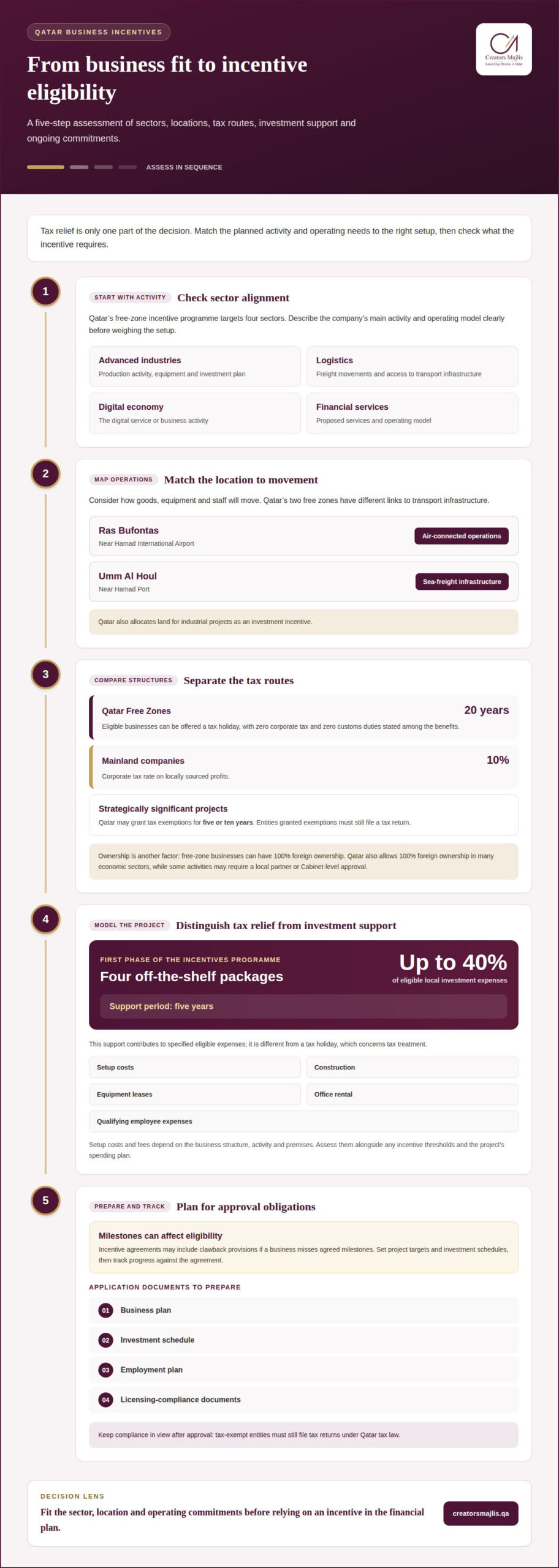
- Match your location to your operations: Ras Bufontas is near Hamad International Airport, while Umm Al Houl is near Hamad Port.
- Assess whether your business aligns with the targeted sectors, including advanced industries, logistics, the digital economy and financial services.
- Build investment and performance commitments into your plans, since incentive agreements may tie benefits to milestones.
- Prepare a business plan, investment schedule, employment plan and licensing-compliance documents to support an incentives application.
What is the Qatar Free Zones Authority (QFZ)?
The Qatar Free Zones Authority (QFZA) develops and manages Qatar’s free zones. Ras Bufontas and Umm Al Houl offer different access to air and sea infrastructure, while mainland setup follows a separate route.
Free Zone Locations and Infrastructure
A free zone is a designated business area with infrastructure and incentives suited to selected operations. QFZ was established in 2018 as an independent entity and manages Ras Bufontas Free Zone and Umm Al Houl Free Zone.
Ras Bufontas is near Hamad International Airport, a relevant factor for businesses with air-connected operations. Umm Al Houl is near Hamad Port, close to sea-freight infrastructure. Qatar also allocates land for industrial projects as an investment incentive. When comparing locations, consider how goods, equipment and staff will move.
Sector Focus and Suitable Industries
Qatar’s free-zone infrastructure and locations are developed around particular business activities. Its incentive programme targets advanced industries, logistics, the digital economy and financial services.
This sector focus helps businesses assess whether a free zone fits their operations, instead of choosing a location on tax treatment alone. A logistics business might weigh proximity to Hamad Port or Hamad International Airport; a digital-economy company might assess whether the zone’s facilities and administrative processes meet its needs. Mainland setup may better suit a business that needs to operate beyond designated zones.
Ownership, Costs, and Applications
Ownership, costs and applications are the practical conditions that shape a Qatar setup. Free-zone businesses can have 100% foreign ownership, and investors can transfer capital into and out of Qatar. Qatar also allows 100% foreign ownership in many economic sectors, although some activities may require a local partner or Cabinet-level approval.
Setup costs and fees depend on the business structure, activity and premises, so assess them alongside any incentive thresholds. Applicants should prepare a business plan, investment schedule, employment plan and licensing-compliance documents. Compare Qatar’s offer with other Gulf countries by scheme, sector, eligibility, location, incentives and performance obligations, rather than assuming one country is universally better.
Corporate tax incentives and tax holidays
A tax holiday is a defined period when an eligible business receives tax relief. Qatar Free Zones can offer businesses a 20-year tax holiday, with zero corporate tax and zero customs duties stated among the benefits. Qatar does not impose personal income tax. These incentives can make a free-zone structure attractive, but the location and operating requirements still need to fit the business.
Mainland companies face a different tax position: Qatar applies a 10% corporate tax rate to locally sourced profits. Separately, Qatar may grant tax exemptions to strategically significant projects for five or ten years. These exemptions are not the same as the QFZ tax holiday, so distinguish the applicable route before building tax relief into a financial plan. An exemption doesn’t remove every compliance duty: entities granted tax exemptions must still file a tax return under Qatar tax law.
Qatar’s first phase of its incentives programme includes four off-the-shelf packages. The programme can support up to 40% of eligible local investment expenses over five years. Eligible expenses include setup costs, construction, equipment leases, office rental and qualifying employee expenses. That support differs from a tax holiday: it contributes to specified investment expenses, while a tax holiday concerns tax treatment. Assess both against the project’s location, spending plan and forecast operations.
Performance obligations continue after approval. Qatar’s incentive agreements may include clawback provisions if a business misses agreed milestones. Set project targets and investment schedules, then track progress against the agreement. Qatar Science and Technology Park entities can be fully exempt from Qatar tax, but must still file tax returns and apply withholding tax to payments to non-residents.
Some relief applies to particular transactions. According to the General Tax Authority, gains from revalued assets contributed as in-kind shares to a Qatari joint-stock company are exempt when those assets have been held for at least five years. For a practical review of incentives and obligations, discuss incentive planning in the context of your proposed setup.
Industries suited to QFZ incentives
Sector suitability means matching a company’s main activity with the industries targeted by Qatar’s free-zone incentives: advanced industries, logistics, the digital economy and financial services. This gives foreign businesses a starting point for assessing whether their operations align with the programme’s priorities.
Advanced industries include businesses focused on industrial production or technology-led processes. A manufacturer assessing Qatar can compare its production activities, equipment needs and planned investment with this sector focus. The key question is whether the proposed activity and project plan fit the programme, not simply whether the company uses advanced technology.
Logistics businesses can assess how their operations connect with Qatar’s transport infrastructure. An air-freight company might consider Ras Bufontas, near Hamad International Airport, while a sea-freight operation might consider Umm Al Houl, near Hamad Port. Each location offers a distinct infrastructure context for assessing operational fit.
- Advanced industries: Assess the production activity, equipment and investment plan.
- Logistics: Map freight movements against airport or port access.
- Digital economy: Describe the digital service or business activity clearly.
- Financial services: Define the proposed services and operating model.
The digital economy and financial services are also target sectors. A software business can describe the digital activity it plans to conduct in Qatar; a financial-services entity can set out its intended service model. Specific descriptions help connect the company’s actual work with the relevant sector category.
Sector alignment is a useful first screen, not a substitute for assessing the full application. Qatar’s incentives programme also considers investment plans, employment and licensing compliance. Make a concise case linking the business activity to proposed local investment and operations. Then assess location, ownership structure and performance commitments together. This helps distinguish a genuine operational fit from a decision based only on incentive headlines.
How can a company apply for business incentives in Qatar, and what documents are required?
An incentives application explains how a project meets Qatar’s programme criteria. Start by defining the business activity, planned investment, jobs and licensing requirements. Then align these details with the incentive package and eligible local expenses. A clear application links each requested benefit to a specific project commitment.
The required supporting documents include a business plan, investment schedule, employment plan and licensing-compliance documents. Each has a distinct purpose:
- Business plan: Describe the company’s activity, Qatar operations and commercial purpose.
- Investment schedule: Set out planned local spending and when the project expects to incur it.
- Employment plan: Explain the workforce requirements linked to the proposed operations.
- Licensing-compliance documentation: Show how the proposed activity relates to applicable licensing requirements.
Keep the four documents consistent. The business plan’s project scope, for example, should match the investment schedule, and the employment plan should reflect the same operating model. If construction, office rental, equipment leases or qualifying employee expenses form part of the proposal, identify them in the investment schedule. These are among the eligible local investment expense categories in Qatar’s programme.
Qatar’s incentives programme requires a minimum investment size of QAR 25 million over five years. Use the schedule to connect proposed spending with that commitment and the project timeline. Applicants should also make the employment and licensing elements clear, rather than treating the business plan as a standalone document. Qatar Development Bank offers financial products tailored to small and medium-sized enterprises, a separate avenue of support for eligible businesses. For startup and small-business funding routes, see how to apply for funding from Qatar Development Bank.
Prepare the application around the project’s sector, local investment and delivery milestones. Incentive agreements may include clawback provisions when milestones are missed, so commitments should reflect a workable plan. For support organizing your Qatar setup and incentives application, discuss your application plan.
Creators Majlis: Business Set Up in Qatar
Creators Majlis helps founders turn a Qatar market-entry plan into a structured business setup. After comparing free-zone and mainland options, its Business Set Up in Qatar and Company Formation services can support the next step: shaping the setup around your activity, ownership needs and operating plans.
For businesses assessing incentive eligibility, Creators Majlis’ Incentives & Funding Access service can help connect the setup decision with relevant funding and incentive considerations. PRO Services support administrative requirements related to establishing a business. This support is useful when your project plan, licensing needs and preferred location must align, particularly before you commit to an investment schedule or application documents.
Bring your business activity and Qatar expansion plans to Creators Majlis. Get in touch to discuss your next step.
Turn Your Qatar Setup Decision Into Action
Your next decision is not simply where to register. It is how to make the chosen structure support your operations, development and changing commercial priorities. Treat business incentives in Qatar as one part of the operating model, not a standalone financial advantage.
Before moving forward, turn your preferred route into an implementation plan. Clarify the intended activity, identify commitments that need internal oversight, and align the launch sequence with your broader growth objectives. Focus on choices that shape day-to-day delivery, not only the initial approval process. This keeps incentive considerations grounded in commercial realities.
If you’re ready to move from comparison to a practical Qatar setup plan, contact Creators Majlis to discuss your next step. A considered structure gives your ambition room to grow, with clear priorities guiding each decision from the outset.
Frequently Asked Questions
QFZ vs Mainland Qatar: Which is Better?
Choose a structure based on your customers and how the company will operate. A logistics company built around international freight may value a free-zone location, while a retailer selling directly to Qatar customers may need a mainland structure. Map your customer base, supply chain, licensing needs and planned premises before deciding. The right fit is the platform that supports your actual business model, not simply the one with the most attractive incentive.
Who Can Apply for QFZ Incentives?
Businesses planning eligible activities in a Qatar free zone can assess an application for incentives. The proposal should align the company’s activity, investment commitments and operational plans with programme requirements. An applicant, for example, should explain how the project supports its proposed sector and where the investment will be made. A business plan, investment schedule, employment plan and licensing-compliance documents support the application.
What business incentives and grants are available in Qatar?
Qatar offers free-zone benefits and a separate national incentives programme. The national programme includes four packages and can support eligible local investment expenses, subject to its minimum investment commitment and application requirements. Treat this as project-linked support, not an unrestricted grant: organize expenditure by category, timing and connection to local operations. Identified categories include setup, construction, leases, office rental and qualifying employee expenses.
What tax incentives does Qatar offer to businesses and foreign investors?
Tax treatment depends on the platform, profit source and applicable exemption. Free-zone businesses may receive a tax holiday, while mainland corporate tax applies to locally sourced profits. Some strategically significant projects may receive a time-limited exemption. An exemption does not remove filing obligations: an entity granted one must still file a tax return. Assess reporting duties alongside tax treatment rather than treating a holiday as a full compliance exemption.
What incentives are available through Qatar Free Zones and the Qatar Financial Centre?
Qatar Free Zones offer a tax holiday and customs-related benefits, while the Qatar Financial Centre (QFC) has a distinct onshore framework. QFC companies can have full foreign ownership and repatriate profits, with tax applying to locally sourced profits. These platforms are not interchangeable: compare their activity scope, legal framework and operating requirements. A professional-services firm considering QFC should assess its permitted activity and compliance structure alongside tax.
Which sectors and business activities qualify for incentives in Qatar?
Qatar’s incentives programme targets advanced industries, logistics, the digital economy and financial services. Qualification depends on how the proposed activity fits the programme and its requirements, not merely on the company’s broad industry label. A technology company, for example, should describe the digital services it will deliver, while a logistics applicant should explain its freight or supply-chain operations. Specifics connect the project plan to the relevant sector.
Planning your own setup? Our company formation in Qatar service covers the route choice, licensing and the bank account in one process.