

Treating Qatar as just another regional satellite market is the quickest way to derail an otherwise viable corporate expansion. You likely already recognize that establishing genuine commercial momentum requires looking past generic regional generalizations, particularly when evaluating operational feasibility across mainland, free zone, and specialized jurisdictions. Conducting targeted Qatar business environment research provides the empirical clarity required to decode rapidly evolving non-hydrocarbon regulations, validate market demand, and establish a compliant, resilient enterprise.
This guide delivers the strategic data and regulatory insights you need to navigate Qatar’s national marketplace in 2026. You’ll discover prime growth sectors aligned with Third National Development Strategy initiatives, evaluate foreign ownership protections under Law No. 1 of 2019, and master key fiscal benchmarks, including corporate tax parameters and digital compliance standards. What follows is a disciplined research methodology built to de-risk your capital commitment and turn national ambition into sustainable commercial success.
Key Takeaways
- Pinpoint high-growth commercial clusters across digital technology, logistics, and advanced manufacturing expanding rapidly under national economic programs.
- Differentiate operational advantages, compliance rules, and foreign ownership parameters between mainland registration and specialized free zone jurisdictions.
- Implement a structured framework for Qatar business environment research that effectively stress-tests market demand, pricing power, and competitor positioning.
- Navigate statutory registration workflows seamlessly by integrating certified translation, government agency approvals, and administrative compliance from day one.
- De-risk enterprise capital deployment by converting comprehensive feasibility data directly into an actionable national launch roadmap.
Understanding the Qatar Business Environment: 2026 Macroeconomic Foundations
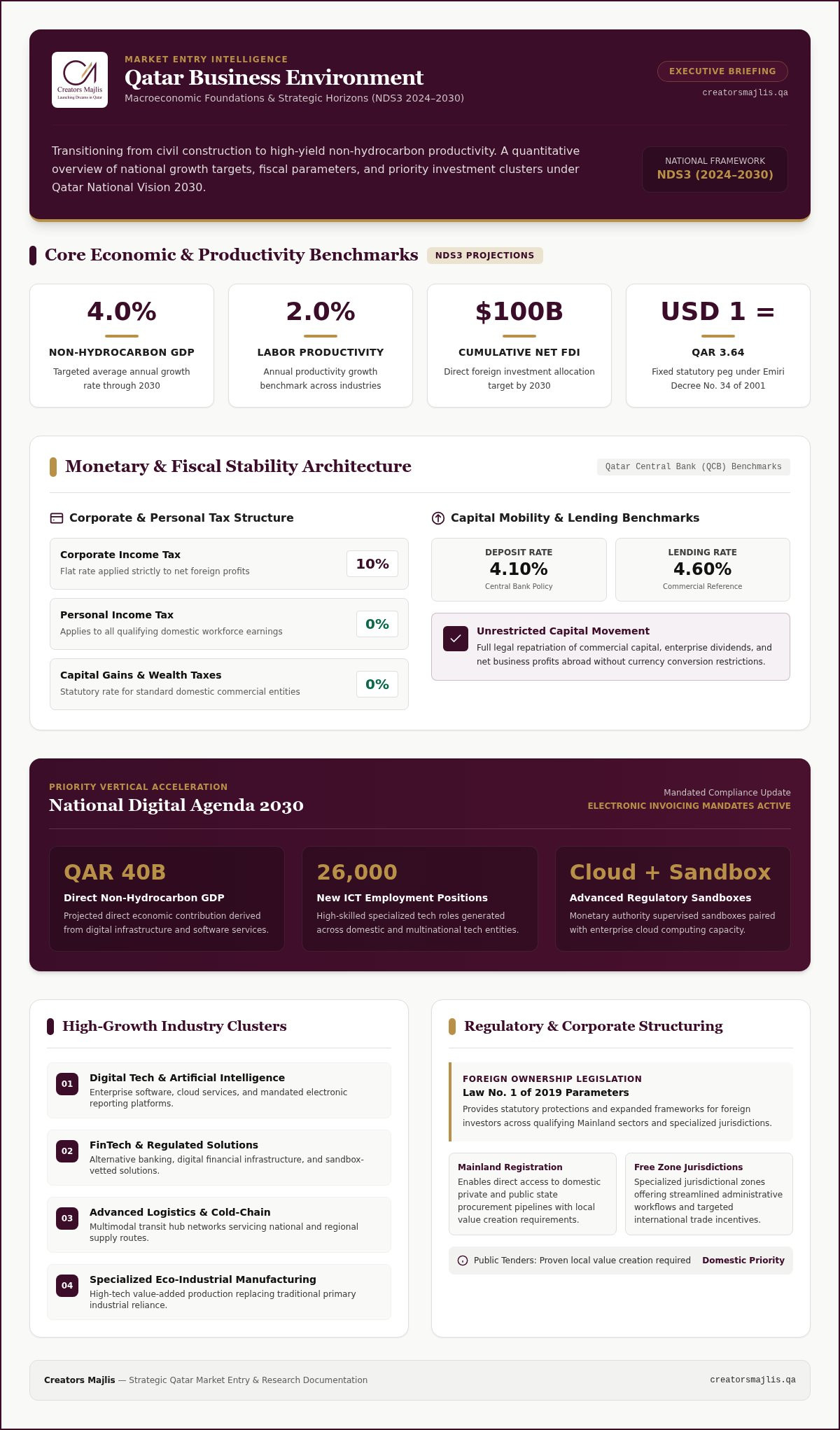
National economic planning has shifted firmly away from event-driven construction toward sustained private-sector productivity. Any rigorous Qatar business environment research must evaluate the country’s strategic transition, driven by the Third National Development Strategy (NDS3 2024–2030). The state has established a 4% average annual non-hydrocarbon GDP growth target alongside a 2% annual labor productivity growth benchmark, actively channelling resource windfalls into sustainable enterprise ecosystems.
Understanding the broader macroeconomic structure of Qatar reveals how state procurement pipelines deliberately favor domestic manufacturing, digital services, and knowledge-based supply chains. Rather than treating local enterprise as an afterthought, public tenders increasingly require proven local value creation. This approach insulates the wider commercial market from cyclical energy shifts while unlocking immense commercial headroom for agile foreign investors.
The Influence of Qatar National Vision 2030
Qatar National Vision 2030 serves as the primary blueprint for long-term state modernization. Under NDS3, public allocations are targeting $100 billion in cumulative net Foreign Direct Investment by 2030. Priority clusters include logistics, fintech, artificial intelligence, and specialized industrial manufacturing. These focus areas receive targeted incentives, streamlined regulatory treatment, and accelerated licensing paths designed to empower innovative commercial operators entering the national ecosystem.
Economic Stability and Sovereign Credit Strength
Monetary predictability protects your long-term capital deployment across the state. The national currency remains pegged to the US Dollar at a fixed rate of USD 1 = QAR 3.64 under Emiri Decree No. 34 of 2001, effectively eliminating foreign exchange volatility. Supported by exceptional sovereign credit ratings and deep sovereign wealth liquidity, the fiscal environment delivers structural stability that few emerging markets can match.
- Unrestricted Capital Movement: Commercial frameworks allow full repatriation of capital, dividends, and profits abroad without currency conversion barriers.
- Predictable Corporate Taxation: A flat 10% corporate income tax applies to net foreign profits, while domestic entities face 0% personal income, capital gains, or wealth taxes.
- Disciplined Monetary Policy: The Qatar Central Bank maintains a 4.10% deposit rate and a 4.60% lending rate, closely mirroring global benchmark shifts to preserve systemic liquidity.
Executing comprehensive Qatar business environment research ensures you capitalize on these macroeconomic stabilizers, transforming high-level fiscal advantages into measurable operational growth for your business.
Emerging Sector Trends: High-Growth Industries Expanding Across Qatar
State spending has moved past general civil engineering into high-impact vertical development. Modern investors need granular visibility into specific sector mechanics rather than high-level macro projections. When performing dedicated Qatar business environment research, evaluating private-market incentives reveals expanding demand across digital commerce, smart logistics, and eco-industrial technology. Aligning your operational scope with these prioritized verticals lets you access substantial public procurement pools.
Digital Infrastructure, Cloud Computing, and FinTech
Qatar’s National Digital Agenda 2030 targets a direct QAR 40 billion economic contribution to non-hydrocarbon GDP, creating 26,000 new ICT jobs. This aggressive transformation is supported by national cloud capacity and advanced regulatory sandboxes supervised by monetary authorities. Enterprise software demand is surging rapidly as incoming mandates for electronic invoicing take effect, requiring businesses across all sectors to modernize their financial and reporting software stacks.
Advanced Logistics, Cold-Chain, and Specialized Manufacturing
Multimodal transit networks give light manufacturers an exceptional regional staging ground. Establishing an agile market entry strategy for Qatar allows industrial producers to leverage state-of-the-art port facilities and air cargo hubs. Key domestic growth niches include:
- Pharmaceutical and Medical Consumables: High demand for domestic medical packaging, specialized reagents, and sterile consumables supported by national healthcare priorities.
- Cold-Chain Fleet Logistics: Advanced temperature-controlled transport networks safeguarding high-value perishables, pharmaceuticals, and sensitive chemical products.
- Precision Assemblies: Component fabrication, specialized polymer processing, and electrical hardware distribution enjoying regional tariff exemptions under GCC trade pacts.
Sustainable Technology and Energy Transition
Industrial sustainability is transitioning from a corporate governance preference into a statutory requirement. Large-scale utility projects and commercial developments now enforce rigid environmental benchmarks covering greywater recovery, thermal insulation performance, and solar array integration. Companies delivering localized water desalination improvements, industrial recycling solutions, or clean-energy servicing enjoy preferred vendor status across institutional supply tenders.
Capitalizing on these sector shifts requires validating your operational feasibility against actual market conditions before deploying resources. If you are assessing domestic commercial viability, you can schedule a market advisory consultation to review current regulatory guidelines, identify local procurement openings, and refine your expansion roadmap.
Regulatory Frameworks and Corporate Jurisdictions: Structuring Market Entry
Selecting the right corporate jurisdiction defines your commercial reach, tax posture, and regulatory compliance burden. Through disciplined Qatar business environment research, decision-makers can look beyond historical assumptions about mandatory local shareholding and identify the exact framework that fits their operational scope. The ongoing institutional reforms highlighted in recent IMF macroeconomic surveillance for Qatar reflect a modern legal environment that prioritizes investor protection, robust dispute resolution, and contract certainty across all national platforms. Conducting a detailed business feasibility analysis Qatar early in the evaluation process clarifies which corporate vehicle aligns with your target revenue model.
Evaluating Mainland Operations versus Specialized Jurisdictions
Your choice between mainland registration and specialized commercial platforms depends on who you intend to serve. Mainland licensing through the Ministry of Commerce and Industry allows unrestricted commercial engagement with all national clients, private vendors, and public procurement tenders.
- Qatar Financial Centre (QFC): Operates under an English common law legal structure with independent regulatory and dispute bodies, permitting full profit repatriation and 100% foreign equity for professional, tech, and financial services.
- Free Zone Platforms: Emphasize export processing, advanced manufacturing, and logistics with customs exemptions, zero import duties, and extended tax relief periods.
- Dual-Licensing Protocols: Enable eligible entities in specialized platforms to tender directly for mainland government contracts without incorporating entirely separate commercial companies.
Foreign Ownership Protections and Statutory Rights
Foreign investment protections are codified under Law No. 1 of 2019, which permits international corporate entities to own up to 100% of foreign capital in most commercial sectors. This framework eliminates the historic mandate for a majority domestic partner in fields such as manufacturing, consulting, information technology, distribution, and healthcare. Statutory exceptions remain narrow, primarily limited to commercial agency representation and state-regulated banking or insurance activities.
Understanding these statutory mechanisms is essential when structuring an LLC company formation Qatar. Modern regulations secure your equity rights, preserve intellectual property protections under national registries, and give your enterprise the legal autonomy needed to scale confidently across the country.
A Step-by-Step Methodology for Conducting Rigorous Qatar Business Environment Research
Theoretical economic models won’t protect your capital. Executing effective Qatar business environment research demands an empirical, ground-level framework that links national priorities to day-to-day balance sheet realities. Following a structured due diligence sequence keeps your expansion grounded in verified facts:
- Map Strategic Demand: Pinpoint state procurement pipelines and priority sectors under the national development agenda to quantify sustainable demand.
- Benchmark Incumbents: Analyze competitor concentration, pricing thresholds, and delivery gaps across both established domestic operators and incoming foreign brands.
- Audit Compliance Benchmarks: Identify ministry prerequisites, operational capital standards, and municipal clearances specific to your licensed commercial activity.
- Validate Field Data: Collaborate with verified market research companies in Qatar to test end-user price sensitivity and verify distributor margins through primary interviews.
- Stress-Test Commercial Models: Synthesize raw market intelligence into a multi-scenario financial model before initiating administrative registration.
Gathering Primary and Secondary Local Market Intelligence
Desk research provides baseline context, but commercial success hinges on primary field validation. Audit published ministry statistical releases and national planning documents while conducting structured interviews with target enterprise buyers. Evaluating competitor pricing models alongside active commercial contracts reveals real payment terms and sales cycles, keeping your margin expectations realistic before you deploy capital.
Risk Mitigation and Commercial Sensitivity Modeling
Operational financial models must account for localized compliance requirements. Scenario-test your working capital against corporate onboarding timelines, banking documentation schedules, and statutory labor mandates, including the national baseline minimum wage of QAR 1,800 per month (inclusive of mandatory food and housing allowances). Before leasing corporate facilities or submitting formal articles of association, consult with market entry specialists to stress-test your strategic hypotheses.
Ready to validate your expansion plans against verified commercial intelligence? Request a tailored feasibility review to de-risk your investment and build a resilient operating model.
Translating Research into Operational Expansion: Your 2026 Market Entry Roadmap
Data without execution is an expensive distraction. The true value of comprehensive Qatar business environment research lies in how effectively it shapes your commercial registration, legal architecture, and operational rollout. Turning strategic intelligence into a functioning corporate entity requires synchronizing legal documentation, state attestations, and ministry submissions into an orderly, milestone-driven process.
From Commercial Analysis to Entity Formation
Moving from theoretical validation to a legal enterprise begins with drafting tailored articles of association. These founding documents must reflect your chosen shareholding structure while incorporating clear governance terms, dispute mechanisms, and management authority. Securing your commercial registration requires coordinating certified translation for constitutional corporate documents, obtaining official embassy attestations for foreign parent entities, and completing formal filings with the Ministry of Commerce and Industry.
Once your commercial registration is issued, operational setup moves swiftly across essential administrative workflows:
- Tax Portal Registration: Register your legal entity on the national Dhareeba tax portal to secure your tax identification number and establish compliance readiness for corporate income tax and incoming electronic invoicing standards.
- Corporate Banking Integration: Complete institutional know-your-customer verification with local corporate banks, presenting verified business plans and shareholder profiles to establish operational corporate accounts.
- Commercial Space Licensing: Finalize dedicated office lease agreements that satisfy municipal licensing prerequisites and civil defense clearances.
Building Operational Readiness and Administrative Momentum
Establishing legal existence is only the baseline. Sustainable success demands administrative momentum across every operational facet of your organization. Early execution requires securing commercial signage permits, establishing computer cards for government relations, and securing employment quota allocations through national labor portals. Implementing structured PRO workflows ensures timely issuance of corporate residency authorizations, health insurance coverage, and labor contract registrations for incoming management teams.
Safeguarding enterprise value also means protecting intellectual property before commercial launch. Formal trademark registration protects your brand identity, proprietary software, and trade assets under national intellectual property frameworks. Grounding your commercial launch in verified Qatar business environment research and partnering with dedicated advisory support turns complex administrative requirements into clear operational wins, positioning your business for long-term growth across the country. Sustaining that growth over time requires a structured business growth strategy Qatar that unites regulatory compliance with active commercial scaling across every corporate jurisdiction.
Transform Strategic Intelligence into Commercial Reality
Expanding across Qatar offers an exceptional balance of sovereign monetary stability, modern foreign ownership laws, and high-growth sector priorities under the national development agenda. Grounding your investment in rigorous Qatar business environment research ensures you choose the right jurisdiction, avoid costly regulatory delays, and align your enterprise directly with active public procurement pipelines.
Creators Majlis acts as your strategic partner on the ground, bridging empirical market insights with decisive corporate execution. We guide multinational organizations and expanding businesses across mainland, QFC, and free zone platforms through comprehensive feasibility studies, business setup, certified translation, and corporate PRO navigation. Your path from visionary planning to operational launch is straightforward when supported by verified local intelligence. Connect with Creators Majlis today to de-risk your market entry and build an enduring, profitable presence across the country.
Frequently Asked Questions
What are the main sectors driving economic growth in Qatar for 2026?
The primary sectors driving national expansion include digital technologies, financial technology, advanced cold-chain logistics, and specialized light manufacturing. Guided by the Third National Development Strategy, state spending prioritizes domestic supply chain resilience and industrial sustainability. These target verticals benefit from streamlined licensing, dedicated incubation frameworks, and preferred access to public tenders, offering substantial commercial potential for private operators across the country.
Can foreign investors own 100% of a company in Qatar in 2026?
Yes, foreign investors can legally hold 100% equity in commercial enterprises across most economic sectors under Law No. 1 of 2019. This framework applies to mainland company formations without requiring a local partner, as well as setups within the Qatar Financial Centre and specialized free zones. Statutory exclusions remain strictly limited to commercial agencies and state-regulated banking and insurance activities.
What is the standard corporate tax rate applied to foreign businesses in Qatar?
The standard corporate income tax rate is a flat 10% applied to net taxable profits attributable to foreign ownership. Qualifying free zone entities may access extended tax holidays, while multinational groups with consolidated annual revenues exceeding €750 million fall under the 15% domestic minimum top-up tax framework. There is currently no value-added tax in effect, and personal income remains completely tax-free.
How does Qatar National Vision 2030 influence private commercial opportunities?
Qatar National Vision 2030 directs public spending and legislative reform toward building a diversified, knowledge-based economy. For incoming enterprises, this means public procurement heavily favors localized value creation, technological innovation, and private-sector productivity. Conducting rigorous Qatar business environment research helps leadership identify active government initiatives, align their business models with national diversification targets, and capitalize on high-priority commercial programs.
What is the difference between setting up on the mainland versus the Qatar Financial Centre?
Mainland commercial registration operates under civil commercial law through the Ministry of Commerce and Industry, granting unrestricted access to national retail markets and public tenders. The Qatar Financial Centre operates under an English common law legal regime with an independent judicial court, primarily serving financial, digital, and professional service firms. Both jurisdictions allow 100% foreign equity, but each serves distinct operational scopes.
Why is conducting professional market research essential before entering the Qatari market?
Dedicated market research prevents costly missteps by pressure-testing commercial viability before capital deployment. Performing comprehensive Qatar business environment research validates domestic pricing elasticity, reveals competitor market share, and verifies specific municipal licensing prerequisites. Empirical field research ensures your legal structure, working capital projections, and operational models match actual regulatory practices rather than generic regional assumptions.
How long does a thorough market feasibility and business environment study usually take?
A comprehensive feasibility and business environment study typically spans several weeks, depending on project complexity, sector licensing requirements, and field data requirements. The process involves auditing secondary economic reports, conducting primary stakeholder interviews, and modeling operational sensitivities against current regulatory benchmarks. This methodical timeline provides a solid, defensible roadmap that allows your team to move into legal incorporation with complete confidence.