
Did you know that recent regulatory shifts have slashed official government licensing fees in Qatar by up to 95 percent? While these headline figures are incredibly inviting, you likely still worry about the “fine print” that often accompanies international market entry. It’s natural to feel concerned about hidden administrative charges or the perceived complexity of securing 100 percent foreign ownership. You want to focus on your vision and scaling your impact, not get bogged down in the minutiae of document attestation and government liaison.
We’re here to turn that uncertainty into a strategic advantage. This guide unlocks a transparent, data-driven breakdown of qatar mainland company formation costs for 2026, providing the predictable roadmap you need to budget with absolute confidence. We’ll explore the latest statutory fee structures, clarify the nuances of foreign ownership eligibility, and detail the operational expenses required to establish a high-impact presence. By the end, you’ll have the clarity and security to transition from an ambitious idea to a fully functioning reality in the Qatari market.
Key Takeaways
- Identify the three primary pillars of your investment, including statutory fees, physical infrastructure requirements, and professional advisory services.
- Unlock a transparent breakdown of qatar mainland company formation costs to ensure your budget accounts for both initial licensing and ongoing operational overhead.
- Navigate the complexities of 100 percent foreign ownership eligibility to determine the most cost-effective and compliant structure for your specific industry.
- Understand the vital role of physical office space and municipal permits in securing your right to trade within the local market.
- Learn how partnering with a boutique consultancy for PRO services and feasibility studies can transform bureaucratic hurdles into predictable milestones.
The Architecture of Qatar Mainland Company Formation Costs
Establishing a mainland presence, often structured as a Limited Liability Company (LLC or W.L.L.), represents the ultimate gateway to the local Qatari economy. Unlike free zones, which are often restricted to specific geographic boundaries or export-oriented activities, a mainland license allows you to trade directly with any entity across the nation. Understanding the architecture of qatar mainland company formation costs is the first step toward building a sustainable foundation. We view these costs through three primary pillars: statutory fees paid to the government, operational overhead such as physical office space, and professional advisory services that ensure your setup is compliant from day one.
We encourage investors to adopt a mindset of “Strategic Capital Allocation.” This means viewing your initial outlay as an investment in market access rather than a mere administrative burden. It’s vital to recognize that qatar mainland company formation costs vary significantly based on your chosen business activity. A specialized engineering firm faces different regulatory hurdles and permit requirements than a retail boutique or a digital consultancy. This variability is why mandatory subscriptions to the Qatar Chamber of Commerce and Industry and specific ministry approvals are integrated into the core cost structure.
The Value Proposition of a Mainland License
Choosing a mainland structure offers unparalleled scalability. You’ll gain the right to bid for lucrative government tenders, which are the heartbeat of Qatar’s national development projects. There are no geographic restrictions on where you can conduct business or provide services. Additionally, mainland companies typically enjoy greater flexibility in workforce planning, allowing you to hire the talent necessary to meet growing demand. This integration into the national economic vision provides long-term stability that specialized zones can’t always match.
Pre-Setup Costs: Feasibility and Market Research
Before you pay a single riyal in registration fees, the most critical expense is a comprehensive business feasibility analysis Qatar. Rushing into a sector without understanding local demand or regulatory nuances often leads to expensive pivots later. Market research helps you identify the exact activity codes that qualify for 100 percent foreign ownership, potentially saving you the cost of a local partner retainer. Budgeting for professional advisory at this stage ensures you don’t just start a business, but you launch a venture designed to thrive within the unique competitive landscape of the GCC.
Statutory and Regulatory Fees: The Licensing Core
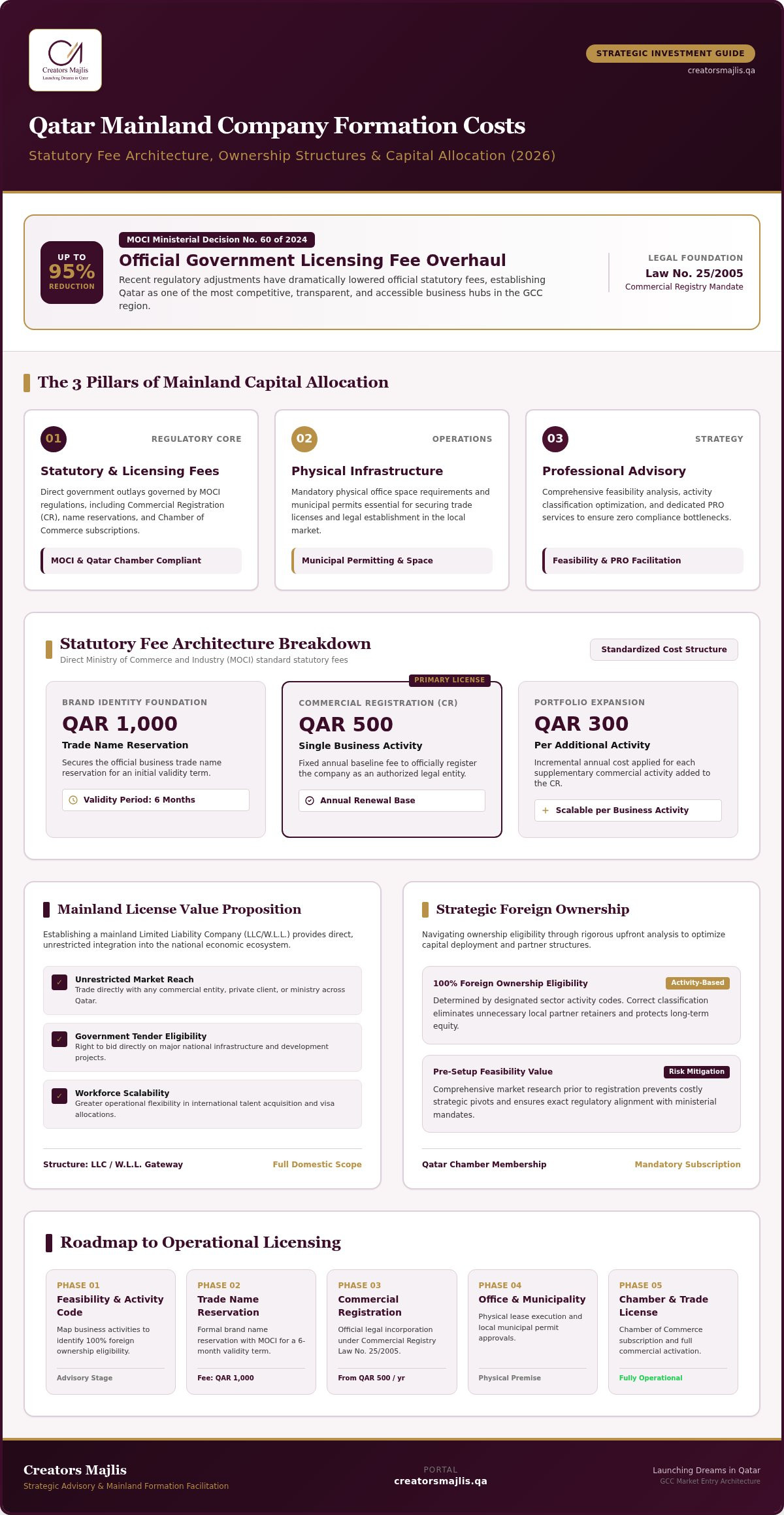
The legal heartbeat of your new venture lies within its statutory registrations. While many investors once viewed government fees as a significant barrier, MOCI Ministerial Decision No. 60 of 2024 fundamentally shifted the landscape. This regulation slashed standard licensing fees by up to 95 percent, making the 2026 investment environment one of the most competitive in the GCC. Understanding the breakdown of qatar mainland company formation costs at this level allows you to see the administrative journey as a series of manageable, high-value milestones rather than a bureaucratic maze.
The process begins with the Ministry of Commerce and Industry (MOCI). Here, you’ll secure your Commercial Registration (CR), which officially recognizes your business as a legal entity. Under current regulations, the annual CR fee for a single business activity is fixed at QAR 500. If your vision requires a more complex structure, each additional activity adds QAR 300 to the annual cost. You’ll also need to account for the International Trade Administration guide on establishing an office in Qatar which outlines the necessity of adhering to Commercial Registry Law No. 25/2005. To ensure your regulatory foundation is secure, we recommend you connect with a strategic partner to navigate these filings accurately.
Commercial Registration (CR) and Trade Name Reservation
Securing your CR is the primary step in your administrative journey. Factors such as the number of partners and the specific classification of your business activities will dictate the final fee structure. Reserving your trade name is the foundation of your brand identity. This reservation carries a fee of QAR 1,000 for a six-month validity period, giving you the window needed to finalize your Articles of Association. Authenticating these documents through the Ministry of Justice Single Window system typically costs QAR 500 per application.
Municipality Licensing and Signage Regulations
Once your CR is in hand, you must obtain a Commercial Permit, often referred to as a Trade License or Rukhsah. This permit is inextricably linked to your physical office location. Following the reforms of Law No. 8 of 2026, registering your municipal lease now costs a flat fee of QAR 250, a significant reduction from previous variable rates. The annual licensing fee for the premises itself is QAR 500. You must also budget for external signage, which must comply with national branding and language guidelines to avoid compliance penalties. Maintaining these licenses requires an annual renewal cycle, which includes a mandatory QAR 500 membership fee for the Qatar Chamber of Commerce and Industry.
Operational and Infrastructure Expenses
Once you’ve secured your Commercial Registration, your focus shifts to the physical and human infrastructure that brings your brand to life. Unlike some jurisdictions where a virtual address might suffice, mainland Qatar requires a tangible presence to secure your final trade license. This phase of qatar mainland company formation costs covers everything from the floor you walk on to the specialists who manage your government relations. It’s a stage where strategic decisions about office type and administrative support directly influence your operational speed. You aren’t just paying for space; you’re investing in the legitimacy required to trade with national giants.
Physical Office and Lease Requirements
Securing a municipality lease registration is a non-negotiable step in the mainland journey. Your budget here depends heavily on whether you opt for a serviced office, which offers immediate infrastructure, or a “shell and core” unit that allows for bespoke branding but requires higher initial fit-out capital. You’ll also need to account for utility deposits and the mandatory flat QAR 250 lease registration fee established under Law No. 8 of 2026. Reviewing Invest Qatar’s overview of company structures can help you align your office scale with your specific entity type, ensuring you don’t over-commit capital before your revenue streams stabilize.
PRO Services and Government Liaison
Maintaining momentum in the Qatari market requires expert navigation of the Hukoomi government portals. This is where professional PRO services become a vital operational investment. They handle the complexities of document attestation with the Ministry of Foreign Affairs (MOFA) and ensure every filing meets strict Arabic-language mandates through certified translation services. Beyond documentation, your operational budget must include the Establishment Card (QAR 200) and the costs for staff residency permits and Qatar IDs (QIDs). These administrative milestones are the gears that keep your business moving. By delegating this administrative heavy lifting, you ensure your team remains compliant while you focus on the visionary work that brought you to Qatar in the first place.
Ownership Structures and Their Cost Implications
Choosing your legal structure is one of the most consequential decisions you’ll make. It dictates not just your degree of control but also the long-term trajectory of your qatar mainland company formation costs. While the 100 percent foreign ownership law has opened doors for international investors, the choice between full control and a traditional partnership requires a nuanced cost-benefit analysis. You’re balancing the administrative investment of specialized approvals against the strategic value of local market integration. It’s about finding the equilibrium between autonomy and the benefits of a local footprint.
100% Foreign Ownership vs. Local Sponsorship
Under Foreign Investment Law No. 1 of 2019, many sectors like IT, healthcare, manufacturing, and consultancy allow for 100 percent foreign equity. However, this path involves a specific approval process through the MOCI Foreign Investment Committee. While you bypass the need for a Qatari partner, you must account for the administrative time and potential advisory fees to secure this status. In contrast, professional branches often require a local service agent (LSA). The LSA doesn’t own equity but facilitates government relations for an annual fee. Despite these evolving options, the LLC company formation Qatar model remains the most versatile structure for those seeking broad commercial rights and scalable operations within the mainland.
Asset Protection and Trademark Costs
Securing your brand is just as vital as securing your license. Budgeting for trademark registration is a non-negotiable expense for any visionary entrepreneur. In a competitive national market, your intellectual property is a core asset that requires legal shielding from day one. Beyond the registration itself, you should allocate capital for legal advisory to draft robust shareholder agreements. These documents act as a stabilizing force, preventing future disputes and protecting your investment’s integrity. When you view these as protective measures rather than mere costs, you’re building a foundation that can withstand market fluctuations. It’s the difference between a temporary setup and a lasting institution.
Navigating these choices alone can lead to regulatory delays or misaligned structures that become expensive to correct later. We help you identify the most efficient path for your specific sector, ensuring your ownership model supports your growth rather than hindering it. If you’re ready to define your legal framework with precision, reach out to our strategic advisors today.
Optimizing Your Market Entry with Creators Majlis
Success in the Qatari market is rarely a matter of chance; it’s the result of meticulous planning and local expertise. While the regulatory environment has become significantly more accessible, navigating the complexities of qatar mainland company formation costs requires more than just a checklist. You need a partner who understands that every riyal invested should serve a strategic purpose. We position ourselves as that high-level strategic partner, handling the administrative heavy lifting so you can focus on the foreground of your business. Our boutique approach ensures that your market entry isn’t just a transaction, but the start of a sustained growth journey.
Bespoke Market Entry Strategies
Every business possesses a unique DNA, and your formation process should reflect that. We don’t believe in one-size-fits-all solutions. Instead, we provide a transparent cost roadmap tailored to your specific industry, whether you’re launching a tech startup or a specialized consultancy. By identifying the exact activity codes and ownership structures that align with your goals, we reduce administrative friction and prevent the hidden cost surprises that often plague international investors. Creators Majlis acts as a visionary guide for international founders, illuminating the path from initial inquiry to market leadership. This proactive navigation ensures your capital is allocated where it generates the most value, securing a foundation that is both lean and legally robust.
Operational Continuity and Growth
Our commitment to your success extends far beyond the issuance of your first license. We provide end-to-end support that covers the entire lifecycle of your business, from initial feasibility studies to daily operational excellence. This includes managing the ongoing requirements of Hukoomi government portals and ensuring your corporate governance remains impeccable. We facilitate the critical administrative milestones that keep your team moving, such as:
- License Renewals: Managing the annual cycle for your Commercial Registration and Trade Permits.
- PRO Services: Streamlining document legalization and Ministry of Interior filings.
- Residency Assistance: Handling the complexities of investor visas and team Qatar IDs (QIDs).
- Strategic Advisory: Providing market research that informs your next phase of expansion.
By delegating these complexities to a dedicated navigator, you ensure that your business remains agile and compliant in a dynamic economy. We invite you to a strategic consultation where we can provide a personalized assessment of your formation requirements. Let’s work together to transform your ambition into a functioning reality, providing the security of a steady, knowledgeable hand throughout your journey in Qatar.
Building Your Legacy in the Qatari Market
Establishing a mainland presence in Qatar is more than a registration process; it’s a strategic move toward long-term stability and national integration. You’ve seen how the regulatory environment has evolved to favor the visionary investor, from significantly reduced government fees to expanded 100 percent ownership rights. Understanding the nuances of qatar mainland company formation costs allows you to budget with precision, ensuring that every riyal spent supports your broader growth objectives. Whether you are navigating the complexities of sector-specific approvals or establishing a robust physical office, the key is a foundation built on local expertise and strategic foresight.
As a boutique consultancy, Creators Majlis acts as your bridge between ambition and achievement. We provide the comprehensive Hukoomi and PRO support necessary to turn administrative milestones into exciting markers of progress. With our proven track record in market entry and deep local navigation, you can focus on the foreground of your business while we handle the complexities of the background. Begin your strategic market entry with Creators Majlis today and step into the future of your business with confidence. Your journey to success in Qatar is ready to begin.
Frequently Asked Questions
How much does it cost to register a mainland company in Qatar in 2026?
Total statutory fees for a standard single-activity mainland LLC range between QAR 2,700 and QAR 3,200. This package includes QAR 1,000 for trade name reservation, QAR 500 for Commercial Registration, and QAR 500 for the Trade License. You must also account for the QAR 500 Chamber of Commerce membership and the QAR 200 Establishment Card fee. These figures reflect the significant 95 percent reduction in government fees implemented recently.
Can I own 100% of my mainland company in Qatar?
Yes, you can own 100 percent of your mainland entity in major economic sectors such as IT, manufacturing, healthcare, and consultancy. This is permitted under Foreign Investment Law No. 1 of 2019, subject to approval by the MOCI Foreign Investment Committee. While certain sectors like banking or commercial agency still require a local partner, the majority of service and industrial sectors are now open to full foreign equity.
What are the hidden costs of starting a business on the Qatar mainland?
Beyond statutory fees, your budget should account for document attestation, certified translations, and professional PRO service fees. Document legalization through the Ministry of Foreign Affairs involves specific administrative charges that vary by document type. Additionally, utility deposits for your office and external signage fees are often overlooked. Planning for these ancillary qatar mainland company formation costs ensures your market entry remains predictable and free from unexpected financial hurdles.
Is a physical office mandatory for a mainland license in Qatar?
Yes, a physical commercial lease is mandatory to obtain a Commercial Permit in mainland Qatar. You must register this lease through the municipality’s “Tawtheeq” system, which now carries a flat registration fee of QAR 250. While some sectors allow for flex-desk or serviced office solutions, you must have a registered municipal address to legally conduct business and sponsor employee visas under a mainland corporate structure.
How long does the mainland company formation process take?
You can obtain a Commercial Registration (CR) in as little as two to three days through the MOCI Single Window system. However, the full operational setup, including finalizing your municipal lease and receiving your Commercial Permit, typically takes between three and six weeks. This timeline depends on the speed of document attestation and the specific ministry approvals required for your business activity, which we help you navigate efficiently.
What are the annual renewal costs for a Qatar mainland company?
Annual renewal costs are primarily composed of the QAR 500 Commercial Registration fee and the QAR 500 Trade License fee. You must also renew your Qatar Chamber of Commerce membership for QAR 500 and your Establishment Card for QAR 200. It’s important to note that qatar mainland company formation costs for renewals can be paid for up to five years upfront through the Single Window system, offering long-term administrative convenience.
Do I need a local sponsor to start an LLC in Qatar?
You no longer strictly need a Qatari partner for many business activities due to current foreign ownership regulations. While the traditional 51/49 partnership model still exists, most international investors now opt for full ownership or a local service agent (LSA) for professional branches. An LSA facilitates government relations but holds no equity in your company, allowing you to maintain full operational and financial control of your venture.
What is the minimum share capital required for a Qatar mainland company?
There is no longer an arbitrary minimum share capital requirement for a standard mainland LLC in Qatar. The previous mandate of QAR 200,000 was abolished under the amended Commercial Companies Law. Founders are now free to determine their capital in the Articles of Association. While the Single Window system has a baseline transaction level of QAR 1,000, you aren’t required to block large sums of capital in a bank account.