

What if the greatest risk to your expansion isn’t the local competition, but the data you haven’t yet uncovered? Many investors look at the 2026 horizon and see only the high cost of entry or a confusing maze of licensing regulations. You’re right to feel cautious, as launching without a bulletproof strategy is a gamble that few can afford in such a sophisticated market. A professional business feasibility analysis Qatar doesn’t just check a box for regulators; it serves as your strategic compass through the economic momentum of the coming years.
We’ve designed this guide to bridge the gap between your ambition and a functioning reality. You’ll gain a comprehensive blueprint that transforms localized data into a sustainable growth strategy. We’ll explore how to validate your project for bank loans and determine whether a QFC or Mainland structure aligns best with your goals. By the end of this article, you’ll have a clear roadmap to enter the market with total confidence, moving past administrative hurdles to focus on your long-term vision.
Key Takeaways
- Understand why a feasibility study is the essential bridge between a visionary concept and a fully compliant, sustainable Qatari entity.
- Discover the four critical pillars of a business feasibility analysis Qatar, covering everything from local consumer demand to technical infrastructure.
- Learn how to identify lucrative market gaps in sectors like fintech and logistics while choosing between greenfield startups or branch expansions.
- Gain the insights needed to align your project with the strict requirements of Qatari financial institutions and regulatory frameworks.
- Explore the seamless transition from strategic analysis to active company formation through the guidance of a dedicated local navigator.
Understanding Business Feasibility Analysis in the Qatar Context
Launching a venture in a high-growth market requires more than just an idea; it demands a bridge between your visionary concept and a compliant Qatari entity. A professional business feasibility analysis Qatar acts as this bridge. It’s the critical first step that validates your assumptions before you commit significant capital. You aren’t just checking boxes to satisfy a regulator. You’re building a foundation for long-term sustainability. By assessing viability early, you protect your investment from unforeseen market shifts and regulatory bottlenecks. It’s the difference between a speculative gamble and a calculated strategic entry.
Feasibility Study vs. Business Plan: Key Differences
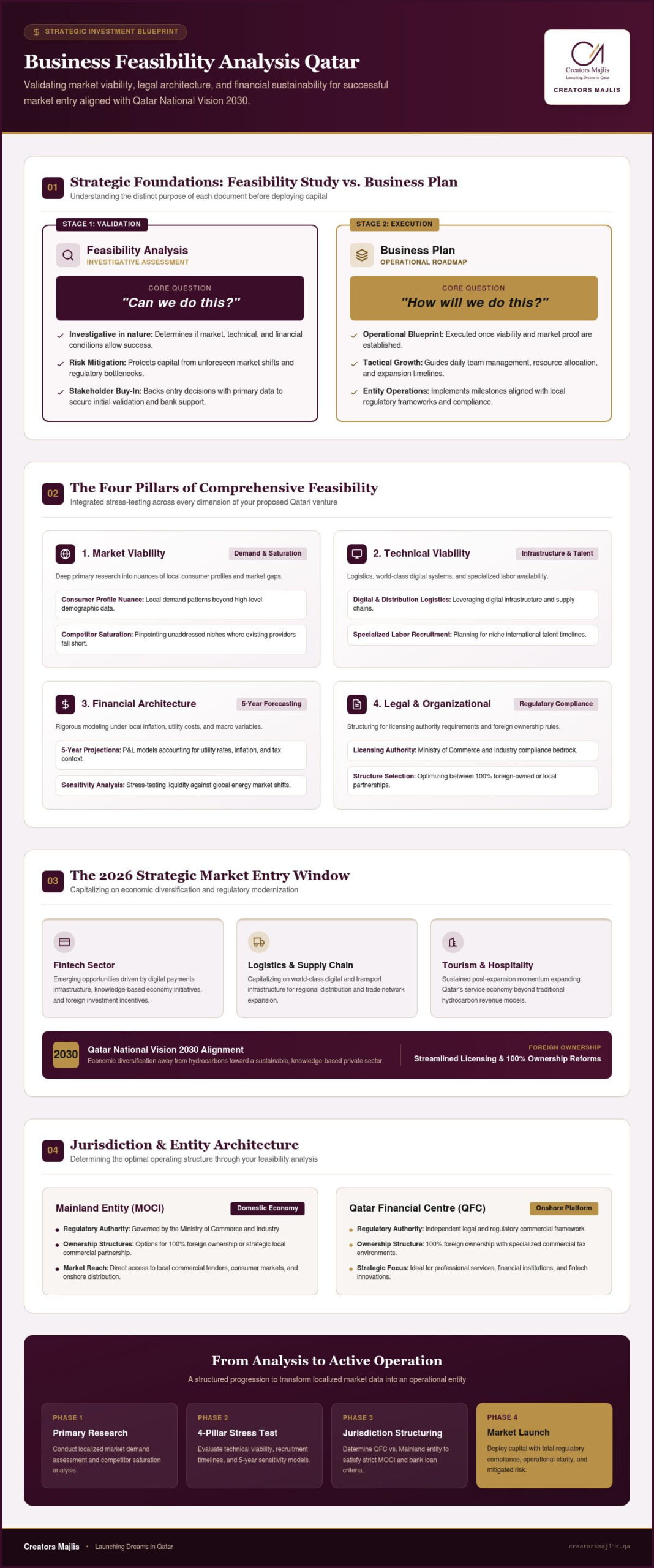
Many entrepreneurs confuse these two documents, but they serve distinct purposes in your journey. A feasibility study asks the fundamental question: “Can we do this?” It’s investigative by nature, focusing on whether the market, technical, and financial conditions allow the project to succeed. In contrast, a business plan asks: “How will we do this?” It’s an operational roadmap used once viability is already proven. For international investors, conducting a business feasibility analysis Qatar ensures that your market entry is backed by hard data rather than optimistic projections. You’ll need the investigative depth of the feasibility study to secure initial buy-in and the operational focus of the business plan to manage daily growth. Local banks and stakeholders often require both to prove you understand the unique local landscape.
The Strategic Value for 2026 Market Entry
The year 2026 represents a pivotal window for investors. As Qatar’s economy continues to diversify away from hydrocarbons, new opportunities in fintech, tourism, and logistics are emerging. This momentum is directly aligned with Qatar National Vision 2030, which prioritizes a knowledge-based and sustainable private sector. Entering the market now allows you to capitalize on recent regulatory updates that favor foreign ownership and streamlined licensing. You shouldn’t rely on outdated data from previous years. The post-expansion landscape is more competitive and sophisticated than ever before. Success requires a “local navigator” perspective that understands how to translate high-level economic goals into specific business opportunities. Feasibility is the essential risk-mitigation tool for Qatari investment. It provides the quiet confidence you need to move from an abstract vision to a functioning reality, ensuring your capital is deployed where it has the highest potential for impact.
The Four Pillars of a Comprehensive Qatar Feasibility Study
Success in the Qatari market isn’t accidental. It’s the result of a structured deep dive into the variables that define your operational environment. A comprehensive business feasibility analysis Qatar evaluates four distinct pillars: market, technical, financial, and organizational. Each pillar serves as a stress test for your concept, ensuring it can withstand local pressures while scaling effectively. By looking at these factors in isolation and as an integrated system, you build a project that stakeholders can trust.
Deep Dive: Market and Technical Viability
Understanding local demand requires more than a cursory glance at demographics. You need primary research that captures the nuances of the Qatari consumer profile. This involves analyzing competitor saturation and identifying where existing services fall short. Working with market research companies in Qatar can provide the granular, localized data needed to validate your assumptions and uncover hidden opportunities. Technically, you must evaluate if your model can sustain itself as a 100% foreign-owned entity or if a local partnership offers better access to supply chains. According to data from Qatar’s official investment promotion authority, the nation’s digital infrastructure is world-class, yet you must still account for the specific logistics of local distribution. Assessing the availability of specialized labor is also vital. While the talent pool is growing, certain niche roles may require international recruitment strategies that impact your initial timeline.
Deep Dive: Financial and Legal Architecture
Your financial forecast must go beyond simple profit and loss statements. A reliable 5-year projection accounts for local inflation, utility costs, and the specific tax environment of your chosen jurisdiction. Whether you’re looking at the Qatar Financial Centre or the Mainland, your legal architecture must be airtight. Compliance with the Ministry of Commerce and Industry isn’t optional; it’s the bedrock of your license. We also recommend a rigorous sensitivity analysis. Since the global energy market can influence local liquidity, your model should remain viable even under fluctuating economic conditions. This level of preparation transforms a risky venture into a secure, bankable project.
Navigating these requirements can feel complex, but you don’t have to do it alone. If you’re ready to move from planning to action, you can connect with a strategic partner who understands the local terrain intimately. This ensures your organizational structure is optimized for both legal compliance and long-term human capital retention.
Evaluating Market Entry vs. Expansion Strategies
Choosing how to enter the Qatari market is as vital as the decision to enter at all. A professional business feasibility analysis Qatar provides the data needed to weigh a greenfield startup against an international branch expansion. Each path carries distinct regulatory weights and capital requirements. A greenfield approach allows for total brand control from day one. Others find that an international branch leverages an existing global reputation to secure local trust faster. Your feasibility study will reveal which model aligns with your long-term vision and risk tolerance.
Identifying the right jurisdiction is the next milestone. While the Qatar Financial Centre (QFC) offers a familiar legal framework for service-oriented firms, many businesses require a Mainland presence for direct trading. This decision shouldn’t be based on intuition. It requires a deep dive into the specific activities your license will cover. Protecting your brand is equally critical. Integrating trademark registration and intellectual property safeguards into your initial entry strategy ensures that your market share remains yours as you scale.
Identifying Growth Opportunities in 2026
The 2026 investment landscape is defined by specific market gaps in fintech, tourism, and logistics. International expertise is highly valued when it brings innovative technology that local players haven’t yet adopted. By using your feasibility data, you can out-position established competitors who may be slower to pivot. Your value proposition must resonate with the goals of Qatar’s official investment promotion authority. This means aligning your business model with national development objectives like digital transformation and economic diversification. When you solve a local problem with international standards, you create a compelling case for stakeholders and regulators alike.
Risk Mitigation for International Brands
Successful market entry requires more than just financial readiness. It demands an understanding of cultural nuances and consumer behavior patterns that only localized research can provide. You must develop contingency plans based on economic scenario modeling to handle global market shifts. If your analysis points toward a Mainland presence, understanding LLC Company Formation Qatar is essential. This structure remains a popular choice for those seeking to build a robust, permanent presence across the country. By addressing these risks early, you transition from a state of inquiry to a state of readiness with a clear, actionable roadmap. This proactive stance handles the complexities in the background so you can focus on the foreground of your business.
Navigating Regulatory and Financial Requirements
Moving from a strategic vision to a functioning reality requires a disciplined approach to the Qatari regulatory framework. Your business feasibility analysis Qatar is the primary document that translates your ambitions into the language of local authorities and financial institutions. It isn’t just a internal guide; it’s a formal validation tool. By following a structured four-step alignment process, you ensure that your data meets the high standards of the Ministry of Commerce and Industry and local lenders.
- Step 1: Align your financial projections with the specific reporting formats required by Qatari banks to facilitate smoother loan processing.
- Step 2: Incorporate the logistical timelines and costs of PRO and Hukoomi services directly into your organizational plan to avoid administrative delays.
- Step 3: Use your technical data to apply for government-backed incentive programs or specific free zone benefits that align with your sector.
- Step 4: Present your finalized study to secure local sponsorship or to provide the necessary evidence for 100% foreign ownership applications.
Securing Capital and Stakeholder Buy-In
Banks in Qatar demand more than optimism. They require a granular breakdown of how your business model interacts with the current fiscal environment. To secure buy-in, your report must demonstrate transparency and local context, proving you’ve accounted for every operational variable. Accuracy is paramount. We’ve found that stakeholders respond best to a “clear path to profit” that is backed by hard evidence rather than generic industry trends. Since many official reviews require documentation in Arabic, utilizing professional translation services is a critical step in preparing your dossier for government or bank scrutiny. This ensures your strategic intent isn’t lost in translation and maintains the professional authority of your proposal.
Compliance with Qatari Licensing Authorities
The success of your application often hinges on how well your study addresses specific activity codes. Each activity under the Ministry of Commerce has unique requirements that your feasibility findings must satisfy. These findings also dictate your future human resources strategy, as they directly influence your residency and work permit (QID) projections based on the scale of your operations. Technical feasibility serves as the definitive proof that your operational setup meets the rigorous standards required for final trade license approval. When your data is airtight, the transition through the licensing phase becomes a milestone rather than a hurdle. If you’re ready to align your vision with these local requirements, you can consult with our strategic advisory team to ensure every regulatory detail is handled with quiet confidence.
Partnering for Success: From Analysis to Operation
A successful market entry is more than a collection of data points; it’s a living transition from strategy to operation. A professional business feasibility analysis Qatar provides the logic, but a strategic partner provides the momentum. While large global firms often offer generic reports, a boutique consultancy brings the “quiet confidence” that comes from intimate local knowledge. This partnership ensures that your visionary concept doesn’t stall at the administrative gate. Instead, it evolves into a functioning Qatari entity with a clear, sustainable growth trajectory. We don’t just hand you a report and walk away. We stay by your side as you navigate the specific mechanics of the 2026 landscape.
Beyond the Document: Strategic Implementation
Translating feasibility recommendations into immediate operational milestones is where many investors struggle. You need to move beyond the theory and begin the practical work of company formation and licensing. This is where localized expertise becomes invaluable. By leveraging PRO services, you can execute your organizational plan efficiently, handling the complexities of government filings and labor approvals in parallel with your business setup. Unlike generic advisors, a local navigator identifies subtle market nuances that unlock potential, ensuring your first year in operation is defined by progress rather than bureaucratic hurdles. This methodical approach builds trust incrementally, moving you from a state of inquiry to a state of readiness.
Your Launchpad in Qatar
At Creators Majlis, we view your business feasibility analysis Qatar as the baseline for a long-term partnership. Our commitment is to transform your ambition into a functioning Qatari reality through end-to-end support. We handle everything from initial market research and trademark registration to ongoing Hukoomi government e-services. This comprehensive approach means your study remains a dynamic tool for annual growth audits rather than a static document gathering dust on a shelf. We act as your stabilizing force, managing the background complexities so you can focus on the foreground of your business. Our team provides the steady, knowledgeable hand you need to turn exciting milestones into a permanent market presence. If you are ready to secure your place in the 2026 investment landscape, partner with Creators Majlis for your Qatar market entry and take the first step toward a successful, compliant future.
Building Your Future in Qatar
The 2026 investment landscape offers a rare moment to align your vision with Qatar’s economic transformation. Success isn’t about avoiding risk; it’s about mastering it through data and local insight. A rigorous business feasibility analysis Qatar ensures your capital is deployed with precision, turning complex regulatory hurdles into manageable milestones. You’ve seen how the right legal structure and a clear path to profit provide the foundation for sustainable growth. This strategic preparation is what separates a speculative idea from a resilient, bankable venture.
Now is the time to transition from observation to action. With boutique expertise in market entry and deep alignment with local frameworks, Creators Majlis provides the quiet confidence you need to scale. We offer end-to-end support, from initial licensing to complex PRO services, acting as your dedicated local navigator. Begin your Qatari success story with a strategic feasibility analysis by Creators Majlis. Your ambition deserves a functioning reality, and we’re here to ensure you reach it with ease. We look forward to building this future with you.
Frequently Asked Questions
What is the primary difference between a business plan and a feasibility study in Qatar?
A feasibility study is an investigative tool that determines if a project is viable before you commit capital. In contrast, a business plan is an operational roadmap used once you’ve confirmed the idea works. For those conducting a business feasibility analysis Qatar, the study focuses on market gaps and technical constraints. The business plan then details how you’ll manage daily operations, marketing, and sales. You need the study to validate the “if” and the plan to execute the “how.”
Do I need a feasibility study to open a 100% foreign-owned company in Qatar?
While not always a legal prerequisite for the initial trade license, a study is often essential for opening corporate bank accounts or securing specific sector approvals. It provides the quiet confidence that your 100% foreign-owned entity is sustainable within the local economy. Most investors find that skipping this step leads to unforeseen regulatory hurdles. A robust analysis ensures your chosen legal structure aligns with your long-term operational goals across the country.
How long does a comprehensive business feasibility analysis typically take?
A comprehensive business feasibility analysis Qatar typically takes between four to eight weeks to complete. This timeline depends on the complexity of your industry and the depth of primary market research required. We gather data on competitor saturation, consumer behavior, and technical requirements to ensure accuracy. Rushing this process can lead to overlooked risks. A methodical approach allows us to translate complex data into a clear, actionable roadmap for your market entry.
Are feasibility studies mandatory for obtaining a business loan from Qatari banks?
Yes, Qatari financial institutions require a detailed feasibility study before approving any business loan or credit facility. Banks use this document to assess your project’s risk profile, projected ROI, and break-even point. Without a professionally prepared report, securing capital becomes significantly more difficult. Your study must demonstrate transparency and local context to prove that your venture can meet its financial obligations while contributing to the national economic landscape. This ensures lenders feel secure in their investment.
Can a feasibility study help me choose between the QFC and the Qatar Mainland?
Choosing the right jurisdiction is a core component of the analysis. A feasibility study evaluates your specific business activities against the regulations of the Qatar Financial Centre and the Mainland. It analyzes tax implications, ownership requirements, and the physical office space needs for each. This data-driven approach ensures you select the structure that offers the best path to profit. It removes the guesswork, allowing you to focus on your vision instead of administrative confusion.
What are the most critical financial metrics to include in a Qatar-based study?
Your study must include a granular breakdown of Capital Expenditure (CAPEX) and Operating Expenditure (OPEX) tailored to the local market. Critical metrics include:
- Internal Rate of Return (IRR)
- Net Present Value (NPV)
- Break-even analysis and sensitivity modeling
This data proves to stakeholders that your business model is resilient and capable of delivering sustainable growth within the national cost environment. It provides the financial clarity needed for secure decision-making.
How does the Qatar National Vision 2030 impact business feasibility today?
Qatar National Vision 2030 serves as the primary driver for economic diversification and sustainable development across the nation. It prioritizes sectors like technology, tourism, and logistics, creating unique market gaps for innovative international firms. Your feasibility study should align with these national goals to increase your chances of government support or free zone incentives. This alignment demonstrates that your business isn’t just a startup but a strategic partner in the country’s long-term growth and success.
Is it possible to conduct a feasibility study remotely, or do I need local consultants?
While you can gather some data from abroad, partnering with local consultants is vital for obtaining accurate, localized market insights. Local experts understand the nuances of national regulations and have direct access to the latest data from authorities. This local navigator perspective helps you avoid the coldness of generic global reports. We handle the background complexities and administrative hurdles, ensuring your study reflects the functioning reality of the national business environment with total precision.
Related services: Feasibility Study in Qatar · Market Research in Qatar · Business Consultancy in Qatar