

With the non-hydrocarbon economy generating over 60% of Qatar’s GDP, the race for commercial market share is moving at unprecedented speed. Yet, turning initial market entry into sustained commercial momentum is rarely straightforward. You already know the friction: managing complex post-setup regulatory requirements, coordinating corporate licensing amendments, and carving out distinctive positioning against entrenched competitors. Executing an effective business growth strategy Qatar demands far more than ambitious sales targets; it requires uniting rigorous feasibility data with active, proactive operational compliance across every corporate jurisdiction.
You shouldn’t have to choose between swift commercial momentum and ironclad regulatory protection. In this guide, you’ll discover the complete framework to structure, scale, and accelerate your commercial expansion across Qatar. We break down the exact operational roadmap you need to unlock high-yield market vectors, resolve administrative bottlenecks, and align your commercial enterprise directly with national development priorities for durable competitive advantage.
Key Takeaways
- Aligning active regulatory compliance with commercial execution is essential to build an enduring business growth strategy Qatar that captures emerging non-hydrocarbon market share.
- Rigorous feasibility studies and primary market intelligence serve as the bedrock for validating expansion hypotheses and protecting corporate capital.
- Selecting the right corporate jurisdiction across mainland, Qatar Financial Centre (QFC), or specialized free zones dictates your operational scope, ownership parameters, and long-term tax efficiency.
- Establishing structured government liaison and licensing workflows prevents operational friction from stalling your commercial scaling velocity.
- A phased 90-day implementation sprint with defined governance checkpoints bridges the gap between high-level expansion vision and sustainable bottom-line results.
Defining Your Business Growth Strategy in Qatar: Market Dynamics and Economic Catalysts
Formulating a robust business growth strategy Qatar requires much more than maintaining an active commercial license. True strategic growth means synchronizing your commercial, regulatory, and operational levers into a unified operational engine. Many international firms fall into the trap of administrative passivity, assuming that securing corporate documentation equates to capturing market share. By contrast, an active expansion framework continuously aligns your commercial footprint with evolving national policies and consumer demands.
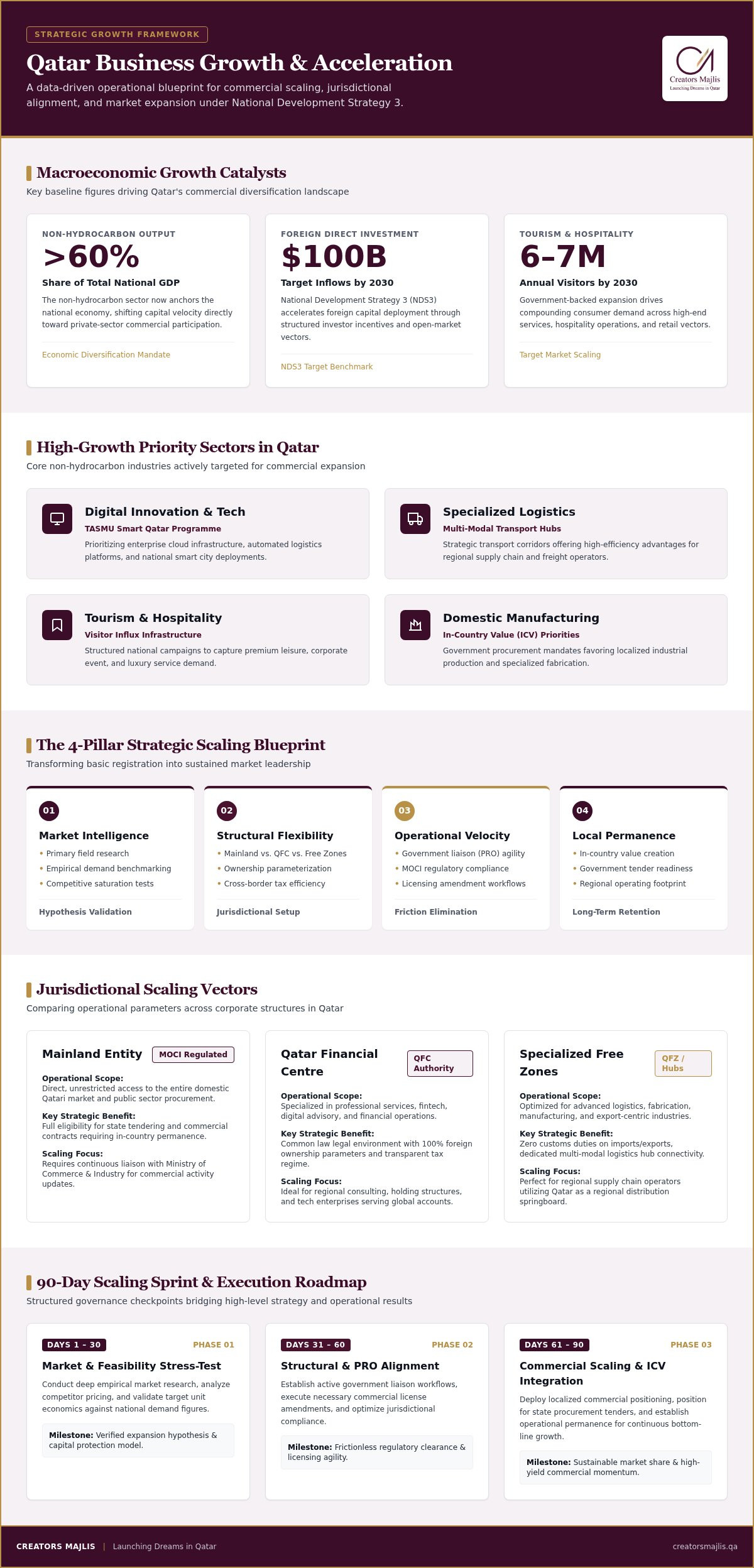
Qatar’s Third National Development Strategy (NDS3) accelerates this momentum, targeting USD 100 billion in foreign direct investment by 2030. Understanding Qatar’s economic fundamentals reveals how national prioritization shifts capital directly toward non-hydrocarbon diversification. However, committing substantial capital without field validation exposes your business to unexpected operational roadblocks. Conducting thorough, data-driven market research in Qatar provides the empirical baseline necessary to identify genuine demand, benchmark competitive saturation, and safeguard your strategic investments before committing major capital.
Macroeconomic Drivers and High-Growth Sectors in Qatar
Targeted non-hydrocarbon sectors are expanding rapidly under structured government mandates. National programs actively prioritize private-sector participation across several key commercial vectors:
- Digital Innovation and Tech: Initiatives like the TASMU Smart Qatar Programme prioritize enterprise cloud services, automated logistics, and smart city applications.
- Specialized Logistics: Advanced multi-modal transport hubs offer significant advantages for regional supply chain operators.
- Tourism and Hospitality: Structured initiatives aim to attract 6 to 7 million international visitors annually by 2030, fueling ongoing demand for premium services.
- Domestic Manufacturing: In-country value frameworks prioritize localized production and specialized fabrication over imported alternatives.
Government procurement systems heavily favor entities that demonstrate local economic value and active corporate permanence. Establishing strong domestic roots unlocks preferential tendering terms, while bilateral trade agreements expand your reach into surrounding regional markets directly from a secure Qatari operating base.
The Shift from Entity Setup to Commercial Acceleration
Obtaining your commercial registration is merely the baseline of market entry. Scaling successfully requires treating Qatar as a sophisticated, standalone ecosystem rather than an export satellite. Foreign operators often stumble when they assume external playbooks translate directly without localization. Premature expansion without assessing regulatory shifts, such as commercial activity updates by the Ministry of Commerce and Industry, quickly triggers administrative halts. Commissioning comprehensive business environment research allows leaders to stress-test their models, resolve compliance vulnerabilities, and build a scalable foundation for durable profitability.
The 2026 Qatar Business Growth Blueprint: A 4-Pillar Strategic Framework
Most commercial guides end the moment your commercial registration certificate arrives. That setup-centric mindset leaves emerging enterprises stranded right when scaling friction starts. A sustainable business growth strategy Qatar requires an interconnected, post-incorporation operational blueprint built across four essential disciplines: Market Intelligence, Structural Flexibility, Operational Velocity, and Brand Equity. By managing these four pillars together, you transform static legal compliance into a dynamic engine for long-term commercial dominance.
Evaluating verified market opportunities in Qatar helps identify where private-sector gaps exist. Tracking true market penetration means looking beyond raw monthly billing to monitor core operational indicators: regulatory amendment lead times, quota utilization efficiency, customer acquisition costs within localized tender networks, and brand asset defensibility.
Pillar 1: Data-Driven Market Feasibility and Demand Modeling
Scaling without empirical validation burns capital fast. Conducting a structured business feasibility analysis in Qatar stress-tests your operating model before you expand overhead. You need to analyze localized pricing elasticity, map distribution bottlenecks, and evaluate real competitor capacity across target segments. Clear financial and operational hurdle rates keep your capital deployment disciplined through every expansion stage.
Pillar 2: Corporate Structuring and Commercial Activity Optimization
As your commercial footprint widens, your licensing architecture must adapt. Introducing new revenue streams often requires adding official commercial activities under the Unified Classification of Economic Activities, or setting up dedicated branch entities. Under Law No. 1 of 2019, up to 100% foreign ownership is permissible across most sectors subject to Ministry of Commerce and Industry approval. Applying refined LLC company formation principles ensures your corporate structure accommodates new shareholding arrangements, localized subsidiary lines, and joint ventures without operational disruption.
Pillars 3 & 4: Operational Agility and Intellectual Property Defense
Scaling speed hinges on how fast you mobilize critical human talent and protect corporate goodwill. Navigating the third pillar, Operational Velocity, requires proactive Public Relations Officer (PRO) workflows to manage visa allocations, corporate renewals, and Hukoomi portal filings before administrative friction halts growth. The fourth pillar, Brand Equity, protects your enterprise by securing registered trademarks through official national registries, ensuring competitors cannot dilute your market position as your visibility grows. If you’re looking to fortify these foundational pillars, partnering with an experienced advisory team through a tailored strategic consultation can clarify your regulatory roadmap and keep expansion timelines on track.
Jurisdictional Expansion Vectors: Comparing Mainland, QFC, and Free Zone Scaling
Selecting the appropriate legal home serves as the cornerstone of any sustainable business growth strategy Qatar. Corporate jurisdictions are not interchangeable. Each environment carries distinct parameters regarding target client access, governing law, and fiscal structuring. Deciding where to scale requires balancing operational proximity to local buyers against international operational flexibility.
| Jurisdiction | Primary Market Access | Foreign Ownership | Corporate Tax Baseline | Governing Legal Framework |
|---|---|---|---|---|
| Mainland (MOCI) | Direct access to local retail, domestic private sector, and public tenders | Up to 100% in approved sectors (Law No. 1 of 2019) | Flat 10% on foreign share of profits | Qatari Civil and Commercial Law |
| Qatar Financial Centre (QFC) | Unrestricted onshore professional and financial services | 100% permitted across eligible activities | 10% on locally sourced profits; non-Qatar income exempt | English Common Law |
| Qatar Free Zones (QFZA) | Export trade, regional logistics, tech, and light industrial | 100% permitted across designated zones | Corporate tax holiday for up to 20 years | Free Zone Regulations and International Arbitration |
Progressive operators often deploy hybrid architectures instead of confining themselves to a single entity. For instance, a firm might position its intellectual property holding company or regional consultancy arm within the QFC under English common law, while maintaining a mainland subsidiary to execute on-the-ground public-sector tenders. This dual-track approach unlocks institutional capital while preserving direct access to local commercial channels.
Mainland (MOCI) Operations: Maximizing Direct National Market Reach
Mainland registration through the Ministry of Commerce and Industry provides unrestricted entry into the domestic economy. You can open commercial retail locations, compete directly for ministry procurement contracts, and serve national corporate accounts without intermediation. This direct access requires continuous operational governance, including annual commercial registration renewals, dedicated municipal signage licenses, approved physical premises inspections, and active corporate banking relationships to manage routine operational flows.
Qatar Financial Centre (QFC) & Free Zones: Professional and Global Gateways
QFC offers an exceptional onshore platform for management consultancies, financial institutions, and professional services firms wanting an English common law environment. For logistics, distribution, and manufacturing enterprises, specialized free zones provide up to 20-year corporate tax holidays and automated customs facilitation. However, selling physical goods or on-site services directly into the mainland domestic market from a free zone typically requires partnering with an authorized mainland distributor or establishing a registered mainland operating branch.
Overcoming Scaling Roadblocks: Regulatory Compliance, PRO Agility, and Risk Mitigation
Commercial ambition frequently hits friction when administrative mechanics fail to keep pace. In Qatar, an unresolved corporate filing, a delayed labor quota, or a mismatched licensing code can stall expansion instantly. Treating government liaison as an afterthought exposes your enterprise to operational freezes and costly regulatory fines. A mature business growth strategy Qatar treats compliance as an active growth accelerator, embedding streamlined administrative workflows directly into daily commercial execution.
Eliminating Administrative Latency via Strategic PRO and Government Services
Public Relations Officer (PRO) services represent your operational engine rather than mere document courier tasks. Expanding companies regularly encounter hiring delays when corporate immigration accounts stall. Active management of corporate Hukoomi portals keeps your enterprise moving by streamlining visa approvals, work residency renewals, and labor balance requirements.
Growth milestones demand swift administrative precision:
- Securing certified legal translation and embassy attestations for cross-border corporate resolutions and board appointments.
- Processing commercial registration amendments through the Ministry of Commerce and Industry whenever capital structures or operational activities expand.
- Managing mandatory municipality license updates when leasing new corporate facilities.
Safeguarding Commercial Value Through Trademark and Asset Protection
Scaling aggressively magnifies public visibility, which naturally increases exposure to intellectual property risks. Winning tenders and expanding distribution networks without registered brand protections invites trademark squatting and market dilution. Registering your corporate trade names, logos, and proprietary marks directly with the Ministry of Commerce and Industry establishes unambiguous ownership and shields your commercial goodwill across national markets.
Pairing formal trademark registration with structured governance protocols creates a defensive moat around your business. Clear non-disclosure agreements, localized commercial agency covenants, and defined shareholder terms prevent legal disputes that could otherwise derail your strategic progress. If administrative friction or regulatory shifts are slowing your expansion momentum, connect with our corporate advisory team to streamline your operational compliance and secure your market position.
Executing Your Strategy: Building the Sustainable Growth Roadmap for Qatar
Transforming high-level ambition into a sustained national presence requires a disciplined sequence of execution. Even the best market data fails if implementation lacks structure and operational accountability. A successful business growth strategy Qatar pairs strategic vision with concrete operational checkpoints, giving leadership full visibility over regulatory status, capital allocation, and commercial traction at every milestone.
The 90-Day Market Scaling Sprint
Executing your expansion within a structured 90-day sprint prevents resource diffusion and builds immediate momentum. Dividing the rollout into three distinct 30-day phases ensures legal foundations and commercial initiatives advance together:
- Days 1–30 (Validation and Regulatory Alignment): Consolidate primary market research, audit current commercial activities against planned service lines, and stress-test unit economics with updated feasibility modeling.
- Days 31–60 (Structural and Operational Enablement): Finalize licensing amendments, register vital corporate trademarks with national authorities, and establish automated government liaison channels for document attestations and labor approvals.
- Days 61–90 (Market Activation and Commercial Scale): Mobilize key operational personnel via streamlined Hukoomi portal workflows, activate domestic partner networks, and deploy commercial bids across targeted public and private pipelines.
Setting formal governance reviews at Day 30 and Day 60 ensures your executive team resolves administrative hurdles before committing expansion capital into full-scale delivery.
Partnering with Creators Majlis for Strategic Scale
Bridging the gap between commercial ambition and day-to-day administrative execution demands a partner who understands boardroom strategy as intimately as ground-level procedures. Building an enduring business growth strategy Qatar works best when you don’t have to manage back-office complexities alone. Creators Majlis operates as a strategic expansion partner, providing the steady guidance needed to transform market entry into scalable commercial success.
Our advisory capabilities cover the complete corporate expansion lifecycle across Qatar. We support your growth journey through rigorous feasibility studies, primary market research, streamlined company formation across mainland and specialized jurisdictions, certified translation services, trademark registration, and dedicated PRO management. When you align your operational engine with proven local expertise, compliance becomes your strongest competitive edge. Connect with the corporate advisory team at Creators Majlis to activate your strategic expansion roadmap.
Turning Expansion Ambition into Sustainable Market Leadership
Building an enduring commercial presence across Qatar requires more than securing an initial license; it demands transforming baseline legal presence into active market leadership. A truly effective business growth strategy Qatar pairs data-driven market feasibility with proactive operational agility. When you harmonize your jurisdictional model, whether mainland, QFC, or specialized free zones, with disciplined governance, regulatory compliance shifts from a recurring hurdle into your strongest competitive moat.
You don’t have to navigate these structural complexities alone. Creators Majlis bridges the gap between executive vision and ground-level execution. From integrated primary market research and rigorous feasibility studies to streamlined PRO administration, Hukoomi processing, and national trademark protection, our advisory team provides the steady guidance required to expand smoothly.
Your next phase of commercial scaling is ready to take shape. Take the decisive step toward sustainable market acceleration and accelerate your business expansion with Creators Majlis today.
Frequently Asked Questions
What are the most effective business growth strategies for foreign companies in Qatar?
The most effective strategy combines primary market validation with an agile operational structure. Successful foreign operators don’t rely on generic regional playbooks. Instead, they tailor their commercial offerings to national procurement priorities, establish direct mainland or dual-entity operational channels, and maintain proactive government relations to prevent regulatory delays. Aligning your commercial development with local economic diversification programs creates a sustainable business growth strategy Qatar that wins high-value enterprise contracts.
Can an existing company in Qatar expand into new commercial activities without creating a new entity?
Yes, established companies can expand their operational scope by amending their existing Commercial Registration (CR) through the Ministry of Commerce and Industry. This process involves selecting aligned business activities under the Unified Classification of Economic Activities, updating the company’s Articles of Association, and securing corresponding municipal approvals. A comprehensive corporate review ensures your expanded activities remain fully compliant without the overhead of forming a separate corporate entity.
How does market research in Qatar differ between mainland and free zone enterprises?
Mainland market research evaluates domestic consumer behavior, local retail footfall, and direct government procurement criteria across the national economy. In contrast, free zone research concentrates heavily on regional export potential, cross-border customs logistics, and international trade corridors. Mainland operators require clear visibility into domestic pricing elasticity and local competitor density, while free zone entities prioritize regional supply chain efficiency and international regulatory alignment.
Why is a feasibility study necessary before expanding business operations in Qatar?
A rigorous feasibility study stress-tests your operational model against verified market conditions before you commit major capital. It objectively evaluates customer demand, barrier-to-entry costs, labor quota requirements, and localized supply chain risks. Conducting this validation prevents premature scaling, identifies your optimal pricing thresholds, and establishes clear financial hurdle rates that protect your capital reserves throughout every phase of commercial expansion.
What role do PRO services play in accelerating enterprise growth across Qatar?
Public Relations Officer (PRO) services serve as the administrative engine of your commercial scaling speed. Expanding enterprises regularly face operational halts when visa quotas stall or corporate licensing amendments fall behind schedule. Dedicated PRO management streamlines corporate Hukoomi processing, accelerates certified legal translation workflows, and manages ministry documentation, keeping your key personnel focused on commercial execution rather than bureaucratic red tape.
How can a company protect its brand and trademarks while expanding in Qatar?
Protecting your brand requires registering all corporate trademarks, logos, and proprietary trade names directly with the Intellectual Property Rights Protection Department at the Ministry of Commerce and Industry. Trademark rights are strictly jurisdictional and operate on a first-to-file principle. Securing formal registration early prevents third parties from registering your brand assets and ensures clear legal recourse across national courts.
What are the key foreign ownership rules governing commercial expansion in Qatar?
Under Law No. 1 of 2019, foreign investors can own up to 100% of capital in most economic sectors, subject to Ministry of Commerce and Industry approval. Certain regulated activities, such as commercial banking and insurance, remain subject to specific national ownership restrictions. Structuring your business growth strategy Qatar around verified foreign investment parameters ensures full statutory protection while maintaining total operational control over your commercial expansion.