

A QFC license is more than permission to operate. It can give your business a route into Qatar with 100% foreign ownership, provided your activities and operating model meet the Centre’s requirements. Getting the QFC license requirements right from the outset matters: if your proposed services do not fit the permitted activity categories, you may need to revise your application and compliance plans.
Before committing time and resources, clarify which activities qualify, whether QFCRA standards apply, and what local substance your operating model may need to demonstrate. This 2026 roadmap explains how to assess eligibility, distinguish regulated from non-regulated activities, and prepare for licensing and ongoing compliance.
It also outlines practical steps for planning your market entry, from testing the business case to preparing supporting documents. Feasibility work and trademark considerations can help inform that plan. Creators Majlis supports company formation and market entry in Qatar, helping international businesses assess their options and prepare for setup.
Key Takeaways
- Check the QFC’s permitted activity categories before drafting your application, and describe the services your business will actually provide.
- Identify whether your proposed activities are regulated or non-regulated, since the licensing route and compliance obligations differ.
- Prepare a business plan that connects your activities, customers, ownership, management, and Qatar operating model.
- Check premises and substance expectations early so they are reflected in your budget and application planning.
- Consider how feasibility studies, trademark registration, and PRO support fit into your market-entry and operational plans.
The Strategic Advantage of a QFC License in 2026
Choosing an entry structure involves more than securing permission to operate. The Qatar Financial Centre (QFC) is an onshore business and financial hub with its own legal and regulatory framework, courts, and regulatory tribunal. Its English common law foundation offers a familiar legal reference point for many international firms operating in a region where civil law systems are common. For background on its history and role, see the Qatar Financial Centre (QFC).
The QFC’s appeal includes the opportunity for 100% foreign ownership and full profit repatriation, alongside a 10% corporate tax rate on locally sourced profits. Licensed firms can also access Qatar’s network of more than 80 double taxation agreements. Eligibility for particular treaty benefits depends on the relevant circumstances. These features may support an international growth strategy, but they do not replace the need to confirm that your activities and operating plan fit the Centre’s framework.
Why Choose QFC Over Mainland or Other Free Zones?
The QFC is an onshore platform, not a free zone, and can provide a route for licensed firms to operate in Qatar and serve the local market. Its distinct legal framework and channels for legal recourse may suit businesses seeking a common law environment. The right structure depends on your activities, customers, and operating model. Compare the relevant licensing and compliance obligations instead of assuming one route is right for every company.
The QFC’s focus also aligns with Qatar National Vision 2030 and the country’s economic diversification priorities. To assess this fit, consider how your services relate to sectors such as technology, professional services, or financial activity, and whether the QFC’s permitted activities cover your plans.
Eligibility: Is Your Business Model a Fit?
The QFC may be relevant to international brands offering financial or non-financial services, but the licensing route depends on the precise activities proposed. Financial services may fall within a regulated framework, while non-financial services follow a different licensing path. Avoid relying on broad labels such as “consultancy” or “technology.” Describe the actual services, customers, and revenue model so the activity can be classified accurately.
Before applying, prepare to explain your commercial rationale, ownership structure, governance, and planned Qatar operations. These are practical starting points, not a substitute for checking activity-specific criteria. A feasibility study can help test market fit and clarify your proposed scope. This groundwork makes the QFC license requirements easier to assess and helps you decide whether the Centre supports your business goals.
Permitted Activities: Defining Your Licensing Scope
Your proposed services, not just your company name, determine the licensing route. The QFC distinguishes between non-regulated activities, including many professional and business services, and regulated financial activities overseen by the QFC Regulatory Authority (QFCRA). Correctly classifying your work is central to the QFC license requirements. For example, a consultancy providing general business advice may follow a different route from a firm managing investment assets.
Professional firms may be able to apply for activities that include consultancy, IT, public relations, and certain legal services, subject to the QFC’s permitted activity scope and approval. Financial activities can include banking, asset management, and insurance, but the exact service matters. Holding companies and Special Purpose Companies (SPCs) may also be relevant where the proposed purpose and structure fit QFC rules. Check the QFC Application and Setup Process as you define your activities and entity structure.
Non-Regulated Activities for Professional Firms
For non-financial ventures, the licensing route generally does not involve the same QFCRA authorization as regulated financial services. That does not make approval automatic or mean operational planning can wait. State what the firm will provide, who it will serve, and how it will generate revenue. Be ready to explain management responsibilities and the company’s planned local presence in line with applicable QFC expectations.
- Consultancy: Define the advisory services and client groups.
- IT and technology: Specify whether the firm provides development, support, or other services.
- Public relations: Describe the communications work the business will undertake.
- Legal services: Confirm that the intended services fit the permitted scope and applicable requirements.
Precise activity wording gives reviewers a clearer basis to assess your proposal. Avoid broad descriptions that combine distinct services without explaining what the business will actually do.
Regulated Activities and QFCRA Oversight
If your business will conduct regulated financial activities, expect additional scrutiny. The QFCRA oversees authorization and ongoing supervision for firms within its remit. Requirements depend on the activity and can include governance, risk controls, compliance systems, and reporting. Capital adequacy is also activity-specific, so do not assume one minimum applies to every financial firm. Confirm the relevant standards before finalizing your business plan or funding model.
Map every planned service to the correct category before submitting. A feasibility study can help test the commercial scope, while local guidance can help you assess how the proposed activities align with the licensing route. Creators Majlis supports QFC setup and feasibility planning. You can discuss your QFC activity scope as you shape your entry plan.
The QFC Application Roadmap: From Vision to License
A well-prepared application starts before you complete a form. In 2026, your business model, proposed activities, ownership details, and local operating plan should tell one consistent story. The QFC license requirements vary by activity and structure, so use the QFC’s official QFC Application Process as a reference while preparing.
Plan your entry in four practical phases:
- Phase 1: Assess strategic fit. Confirm that your services align with permitted activities, define your Qatar market opportunity, and build a feasible business plan.
- Phase 2: Submit and undergo review. Provide the application and supporting information. Relevant individuals may be assessed for suitability, particularly where regulated activities are involved.
- Phase 3: Complete incorporation. Once approvals are secured, progress the entity’s legal incorporation and commercial registration through the applicable QFC process.
- Phase 4: Prepare to operate. Put suitable governance, premises, records, and compliance arrangements in place, then maintain the obligations that apply to your license.
Drafting a Compliant QFC Business Plan
Make the plan specific enough to explain how the business will work, not just what it hopes to achieve. Cover the proposed services, target customers, revenue model, ownership and management structure, expected resources, and operating approach. Connect the commercial case to Qatar’s market and explain the value your firm aims to contribute, such as specialist expertise, services, or capabilities that support local demand. Confirm the QFC’s current application guidance for the information required for your activity.
Strategic fit in 2026 means showing that your proposed activities are permitted by the QFC and that your business has a credible commercial rationale for operating in Qatar.
A feasibility study can help test assumptions before submission. International brands may also consider trademark registration as part of protecting their identity while planning market entry.
Navigating the “Fit and Proper” Assessment
Prepare clear, consistent records for directors, beneficial owners, and shareholders. Depending on the application and activity, reviewers may request identity, ownership, professional background, or corporate documents. International shareholders should allow time to gather documents in the requested format and arrange translations where needed. Requirements can differ, so verify the current checklist rather than relying on a generic document pack.
There is no single approval timeline to assume. Review duration can depend on the licensing route, application completeness, and whether further information is requested. Build flexibility into your launch plan, respond promptly to follow-up questions, and treat incorporation and operational readiness as connected milestones. A license alone does not necessarily mean the business is ready to trade.
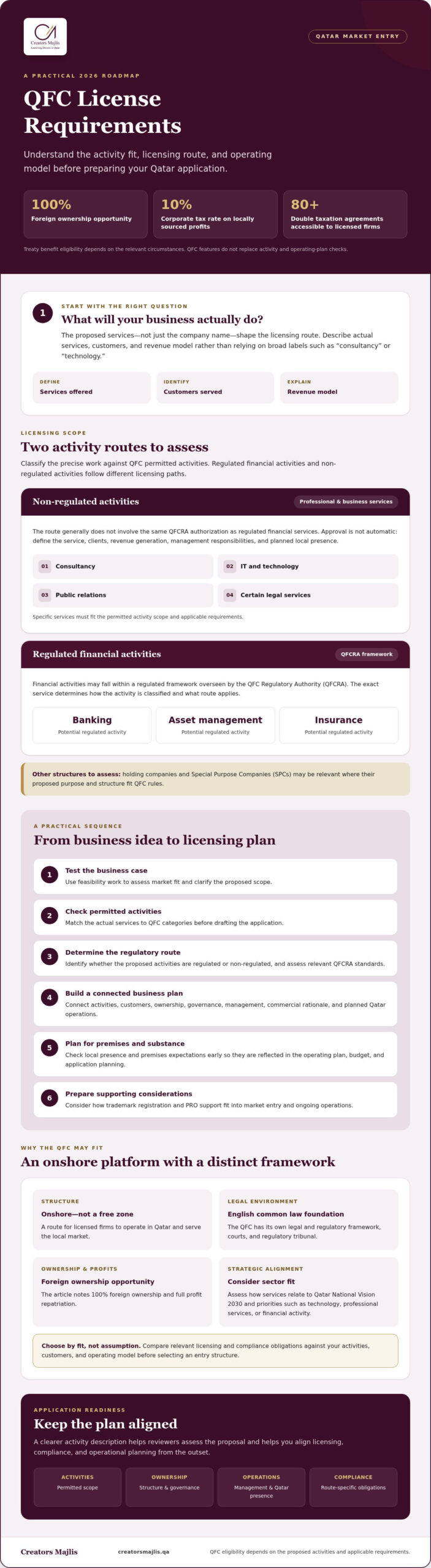
QFC License Requirements: Compliance and Substance in 2026
A license is the start of your regulatory responsibilities, not the finish line. Plan for ongoing compliance alongside initial setup. This may include maintaining records, meeting applicable reporting and filing obligations, and keeping your operating model consistent with the activities you are authorized to conduct. Economic substance expectations also belong in your planning: your business should be prepared to demonstrate genuine operations that align with its stated purpose and activities. The precise obligations depend on the entity and its regulatory scope, so confirm which rules apply before committing to a structure.
Regulated firms may also need approved individuals in specific roles. Positions such as Senior Executive Officer (SEO) and Money Laundering Reporting Officer (MLRO) carry responsibilities that depend on the relevant QFCRA requirements. AML/CFT rules also warrant current attention: Council of Ministers’ Decision No. 8 of 2026 amended provisions of the implementing regulations for Qatar’s anti-money laundering and counter-terrorism financing law. Check the current rules that apply to your business instead of relying on an old compliance checklist.
Securing Approved Office Space
Before signing an office agreement, confirm that the premises and arrangement meet the QFC’s current requirements for your license. Ask whether your proposed setup needs dedicated commercial space, whether a registered address or flexible workspace is acceptable, and what evidence the QFC expects. Do not assume a virtual address meets every firm’s needs. If an office lease is part of your application, verify when it must be in place and whether it affects final license issuance. This helps align your budget, application documents, and operating plan.
Appointing Key Officers and Compliance Personnel
Map required roles to your activity before deciding how to staff them. An SEO generally leads the firm’s executive operations, while an MLRO oversees relevant financial crime reporting arrangements where required. Confirm whether each position needs regulatory approval, what qualifications or experience are expected, and whether responsibilities can be combined for your business type. Outsourcing may be an option for some support functions, but it does not automatically transfer the firm’s accountability. Check the applicable rules and retain clear oversight.
Build a compliance calendar around the obligations that apply to your entity, including financial statements, annual filings, tax submissions where relevant, and regulated reporting. Deadlines can depend on the reporting period and firm type, so maintain a current schedule rather than relying on dates from prior years. The QFC license requirements are easier to manage when office planning, responsible officers, and reporting processes are considered together. For support with QFC setup and related PRO services, discuss your QFC compliance setup with Creators Majlis.
Operational Success with Creators Majlis
A QFC license establishes your business, but day-to-day operations still involve administrative tasks, government procedures, and decisions about growth. Creators Majlis supports founders with company formation and related services, including PRO Services, Hukoomi Services, and Translation Services. Coordinating these needs can help keep administrative work organized as your business gets established.
Preparation starts before incorporation. A strategic business feasibility analysis in Qatar can help you assess market demand, test assumptions, and refine your proposed activities before committing to an operating structure. Market research can further clarify who you intend to serve and how your offer fits the local context. The QFC license requirements define the regulatory route, while this early groundwork helps you prepare for the commercial realities that follow.
End-to-End Support for International Founders
After licensing, founders may need to coordinate government portal procedures, company documentation, and employee-related administrative steps. PRO Services can support relevant visa and residency processes, subject to applicable requirements and approvals. Hukoomi Services can help with government portal tasks, while Translation Services can assist with documents that need translation. Check the specific attestation and certification rules for each document, since accepted formats and providers may vary.
For a lean leadership team, organizing these tasks into a clear sequence can reduce administrative distraction. Creators Majlis supports company formation and related setup needs, helping you keep responsibilities and documentation on track while maintaining focus on operational priorities.
Your Partner in Qatari Market Growth
Setup is a foundation, not a growth strategy. As your business develops, use market insights to review customer needs, refine your positioning, and identify sensible next steps. Trademark Registration can help protect your brand identity in Qatar, so consider it alongside feasibility planning rather than treating it as an afterthought. Confirm the appropriate protection and filing approach for your mark before proceeding.
With a practical plan and local guidance, you can move from incorporation toward sustainable operations with greater clarity. Explore how Creators Majlis can support your Qatar business setup as you plan the next stage of your market entry.
Make Your Qatar Entry Plan Actionable
A strong QFC entry begins with clarity: confirm that your activities fit the right licensing route, prepare a credible business plan, and build compliance and operational needs into your launch strategy. The QFC license requirements are only one part of the picture. Feasibility, brand protection, and practical setup planning can help turn an approved structure into a business ready to operate and grow.
Creators Majlis supports Qatar market entry with company formation, feasibility studies, and PRO Services. The firm can help connect licensing preparation with the administrative steps that follow, so your leadership can focus on its wider objectives.
Take the next step with a plan shaped around your business model and goals. Contact Creators Majlis to discuss your Qatar company formation and market-entry plans.
Frequently Asked Questions
Can a QFC company operate anywhere in Qatar?
A QFC-licensed company can operate in Qatar and serve the local market, subject to its approved activities and applicable rules. The QFC is an onshore business platform, but a license does not authorize every type of business activity or remove other regulatory requirements. Before expanding services or changing your operating model, check whether the activity falls within your license scope and whether additional approvals apply.
What is the minimum capital requirement for a QFC license?
There is not one minimum capital figure that applies to every QFC company. Capital requirements can depend on the proposed activity and entity type, with regulated financial firms potentially subject to activity-specific QFCRA requirements. Confirm the current rules for your precise licensing category before finalizing your business plan or funding arrangements. Do not assume that the capital requirement for a non-regulated firm applies to a regulated business.
How long does the QFC licensing process take in 2026?
The process does not have one guaranteed timeline for every applicant. The time required can depend on the activity, application completeness, review requirements, and how quickly you provide any requested information. Regulated applications may involve additional scrutiny. For a more predictable plan, confirm the current steps for your proposed activity, prepare supporting documents in advance, and allow flexibility for review and incorporation rather than relying on an assumed approval date.
Do I need a local Qatari partner for a QFC company?
No, a local Qatari partner is not generally required to establish a QFC company, and the structure can allow 100% foreign ownership. Your proposed activities and company structure must still qualify under the relevant QFC rules, and ownership information will form part of the application. Review the requirements for your specific license category before choosing an entity structure or making commitments to investors and shareholders.
What are the annual fees associated with maintaining a QFC license?
For 2026, the verified fee information lists annual firm license fees of QAR 10,000 to QAR 30,000, tiered by activity and size, and annual registration fees starting at USD 3,250. These are distinct fee categories, and the amount applicable to your firm depends on its circumstances. Check the current official schedule for your entity and activity, and budget separately for other operating and compliance costs.
Can a QFC company sponsor employees for residency visas?
A QFC company may be able to apply for employee visas and residency processing, subject to the relevant immigration procedures, approvals, and company requirements. Sponsorship should not be treated as automatic upon receiving a license. Plan for the administrative steps and supporting documents involved, and confirm current eligibility for your company and employees. PRO Services can help businesses coordinate applicable government processes, while the responsible authorities determine approvals.
Is a feasibility study mandatory for QFC applications?
A feasibility study is not established as a universal mandatory requirement for every QFC application. However, assessing market demand, commercial viability, and the fit between your activities and Qatar’s market can strengthen your planning before submission. The information required may vary by activity and application, so check the current QFC guidance. A feasibility study can also help you make a clearer decision about your proposed business scope and operating model.
What is the difference between QFC and Qatar Science and Technology Park (QSTP)?
The QFC is an onshore business and financial centre with a broad range of permitted regulated and non-regulated activities under its legal and regulatory framework. QSTP is associated with science, technology, and innovation-focused businesses. The right platform depends on your business model, intended activities, and eligibility. Compare each organisation’s current licensing scope and requirements before selecting a route, especially if your company combines technology services with financial or professional activities.