

Before choosing company formation qatar free zone, check whether your business activity and operating model fit the Qatar Free Zones Authority (QFZA) framework. QFZA has specific features, but they matter only if they suit the way you plan to operate.
If you’re unsure what to compare, which QFZA provisions apply to your plans, or what to confirm before applying, start with the facts. This guide explains the main characteristics of the QFZA route, the practical questions to consider, and how to compare it with other Qatar setup options.
You’ll learn how to assess business fit, what details to verify with QFZA, and how the free-zone route differs from the Qatar Financial Centre (QFC) and MOCI Mainland. Creators Majlis supports company formation across QFZA, QFC, and Mainland Qatar, helping you consider your options in light of your business objectives.
Key Takeaways
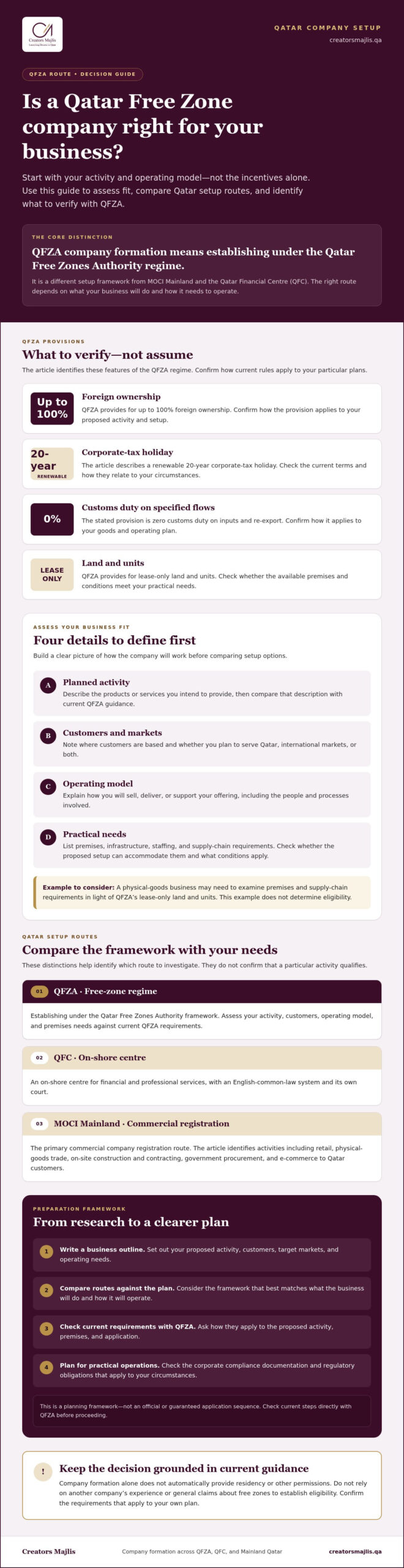
- Company formation qatar free zone means establishing under the QFZA regime. It is distinct from setting up through QFC or MOCI Mainland.
- Assess your proposed activity, customer base, operating model, and premises needs before deciding whether to explore QFZA.
- QFZA provides for up to 100% foreign ownership, a renewable 20-year corporate-tax holiday, zero customs duty on inputs and re-export, and lease-only land and units. Confirm how the current rules apply to your plans.
- Prepare a clear business outline and ask QFZA to confirm current requirements before submitting an application.
- Creators Majlis supports company formation across QFZA, QFC, and Mainland Qatar.
What Does Company Formation in a Qatar Free Zone Involve?
Company formation in a Qatar free zone means establishing a business under the Qatar Free Zones Authority (QFZA) regime. This is a different setup framework from MOCI Mainland or the Qatar Financial Centre (QFC). The right route depends on what your business will do and how it needs to operate, not simply on the incentives associated with a particular structure.
In short, a QFZA company is established under the free-zone regime, while a mainland company is registered through the MOCI Mainland framework. Start by defining your proposed activity, customers, target markets, and operating needs. Those details give you a practical basis for comparing routes and questions to confirm with the relevant authority.
What is the Qatar Free Zones Authority?
QFZA oversees Qatar’s free-zone regime. Its current guidance is the place to check requirements that apply to your proposed activity and application. For broader context on Qatar’s economic diversification strategy, you can read Qatar’s economic diversification strategy. That background does not replace QFZA guidance or establish whether a particular business qualifies.
What does setting up a free-zone company mean in practice?
Think of formation as a set of decisions rather than a single registration form. Define your business and operating model, assess whether QFZA may suit them, confirm current requirements with the authority, and prepare for the company’s practical operations. This is a planning framework, not an official or guaranteed application sequence. Check the current steps directly with QFZA before proceeding.
Establishing a company does not automatically settle every responsibility that follows. Check which corporate compliance documentation and regulatory obligations apply to your circumstances. Do not assume that company formation alone provides residency or other permissions.
For an initial assessment, write down your planned activity, customer base, intended markets, and operational requirements. A business that trades physical goods may need to examine different practical questions from a professional services business. These examples do not determine eligibility. Check the proposed activity and its requirements against current QFZA guidance rather than relying on another company’s experience or general claims about free zones.
Is QFZA Company Formation a Good Fit for Your Business?
An ownership or tax provision does not, by itself, show that a free-zone structure fits your operations. For company formation qatar free zone, compare your activity, customers, and day-to-day needs with the QFZA framework. Treat your initial research as preparation. Confirm current requirements and how they apply to your circumstances before deciding on a route.
Which business details should you assess first?
Build a clear picture of how the company will work before comparing setup options. Record:
- Planned activity: Describe the products or services you intend to provide, then compare the description with current guidance from the Qatar Free Zones Authority (QFZA).
- Customers and markets: Note where your customers are based and whether you plan to serve Qatar, international markets, or both.
- Operating model: Explain how you will sell, deliver, or support your offering, including the people and processes involved.
- Practical needs: List any premises, infrastructure, staffing, or supply-chain requirements. Check whether the proposed setup can accommodate them and what conditions apply.
For example, a business handling physical goods should check whether its premises and supply-chain requirements work with QFZA’s lease-only land and units. A professional services business may focus more on its activity, customers, and how it will deliver its services. Neither example confirms eligibility. The proposed activity and operating needs still need to be assessed against current QFZA requirements.
How should you compare QFZA with other Qatar routes?
Compare the routes by matching their stated scope to your business needs. QFZA is the free-zone regime. MOCI Mainland is the primary commercial company registration route and applies to activities including retail, physical-goods trade, on-site construction and contracting, government procurement, and e-commerce to Qatar customers. QFC is an on-shore centre for financial and professional services, with an English-common-law system and its own court. These distinctions can help you identify which frameworks to investigate, but you should verify what applies to your proposed activity.
Market validation can sharpen the comparison. Check whether your intended customers, offer, and route to market support your plan before settling on a structure. The guide Strategic Business Feasibility Analysis in Qatar can provide a next step for that assessment. Keep your conclusion provisional until you have confirmed current requirements with the relevant authority.
If you’d like guidance comparing company formation routes, discuss your setup objectives with Creators Majlis. Its company formation support covers QFZA, QFC, and Mainland Qatar, so you can assess the routes against your business plans.
Qatar Free Zone Benefits and Limitations: What Should You Verify?
QFZA’s ownership, tax, customs, and premises provisions may affect your plans, but each has a defined scope. For company formation qatar free zone, treat these provisions as points to understand and verify, not as a substitute for checking how the rules apply to your business. Consult the Qatar Free Zones Authority (QFZA) for current guidance before relying on a provision in your planning.
How should you understand ownership and tax claims?
The QFZA regime provides for up to 100% foreign ownership and a renewable 20-year corporate-tax holiday at 0%. These are provisions of the QFZA framework, not general rules for every business in Qatar. Confirm the current requirements and how they apply to your proposed company and activities before factoring them into your plans.
QFZA also provides for zero customs duty on inputs and re-export. Check how this provision applies to the inputs and re-export arrangements relevant to your business. Avoid assuming it covers every product, transaction, or movement of goods.
| Feature | What the source confirms | What to verify |
|---|---|---|
| Foreign ownership | Up to 100% foreign ownership under the QFZA regime. | How the current rules apply to your proposed company and activity. |
| Corporate tax | A renewable 20-year corporate-tax holiday at 0% under the QFZA regime. | How the provision applies to your business and activities. |
| Customs | Zero customs duty on inputs and re-export. | How the provision applies to your inputs and re-export arrangements. |
| Premises | QFZA land and units are lease-only. | Whether a lease arrangement suits your operating needs. |
What operational trade-offs belong in your decision?
Lease-only land and units are an important planning point. Consider whether your business needs premises, infrastructure, or particular supply-chain arrangements, then check whether the available lease model works for those needs. Do not assume a specific facility or arrangement will be available.
Keep the decision tied to your business plan. Confirm the current rules, assess the ownership, tax, and customs provisions against your intended operations, and check that lease-only premises suit your needs. This gives you a clearer basis for deciding whether to explore QFZA further.
How to Prepare for Company Formation in a Qatar Free Zone
A preparation plan helps you ask focused questions before starting company formation qatar free zone. Use the steps below to organize your information. They are practical preparation guidance, not an official QFZA procedure or a promise of approval. Confirm current instructions directly with the authority before submitting an application.
What should you clarify before making an application?
Start with a concise description of the proposed activity and how the company will operate. Be ready to explain what it will offer, who its customers are, and how it plans to deliver its products or services. Then identify the points you need QFZA to clarify:
- Activity and requirements: Does the planned activity fit the current QFZA framework, and what activity-specific requirements should you understand?
- Ownership: What ownership structure are you proposing, and which current rules apply?
- Premises and operations: What facilities or arrangements does the business need, and what should you confirm about lease options and terms?
- Application materials: Which forms and supporting documents are currently required, and what submission channel should you use?
Check these points against QFZA’s current official guidance instead of relying on an old checklist or another company’s experience. Keep a record of your questions and the answers you receive. That gives you a more reliable basis for preparing an application and helps prevent plans from depending on unverified assumptions.
How should you plan for operations after setup?
Company formation is one step; operating the business is another. Identify the corporate compliance documentation and regulatory obligations that may apply, then confirm the requirements for your specific circumstances. Plan how the company will manage its records and responsibilities rather than treating registration as the end of the setup process.
Consider other practical matters separately. Corporate banking, residency, or Qatar ID requirements may be relevant to some businesses or individuals, but they are distinct from company formation. Do not assume that establishing a company automatically provides banking access, residency, or other approvals. Check the applicable requirements through the relevant channels.
Before applying, bring together your business description, operating plan, ownership questions, premises needs, and a verified document checklist. This preparation can also help you compare QFZA with another setup route if your plans suggest a different framework. For company formation guidance in Qatar, discuss your setup requirements with Creators Majlis.
Move from QFZA Research to a Clear Company Formation Plan
A considered decision starts by checking whether your activity and operating model suit the QFZA framework. Verify the current provisions and requirements, organize your business details, and then decide which setup route to pursue. This keeps company formation qatar free zone focused on your business needs rather than on incentives alone.
What should you bring to an initial formation discussion?
Prepare a short description of your proposed activity, target customers, ownership objectives, and expected operating model. You do not need to have every answer. A list of open questions can make the discussion more useful:
- How does the proposed activity fit with the current QFZA framework?
- Which forms and supporting documents should you prepare?
- What premises or operating arrangements might the business need?
- Which ownership or activity-specific requirements should you confirm?
Mark any unverified points clearly. The appropriate route, application requirements, and next steps depend on your circumstances and current authority guidance. Do not assume a particular structure or approval before those details have been assessed.
How can tailored setup support help you move forward?
Creators Majlis supports company formation across QFZA, QFC, and Mainland Qatar. Each route has a different framework, so compare your objectives and operating needs before settling on a direction. Support with company formation can help you organize questions around your proposed activity and assess which details to clarify before moving forward.
If you’re weighing more than one route, the QFC Qatar: A 2026 Guide to Choosing the Right Business Setup Route offers broader context for comparing setup options. Use it alongside current authority guidance, then identify which questions still depend on your particular business. A focused discussion can help clarify those questions and next steps without assuming in advance which structure is right.
Discuss your Qatar company formation plans
Turn Your QFZA Research into a Confident Next Step
A sound company formation qatar free zone decision starts with business fit, not incentives alone. Assess your proposed activity and operating needs, check the current QFZA framework and the scope of its provisions, then prepare your business details and questions before proceeding.
The right route depends on your objectives. Creators Majlis supports company formation across QFZA, QFC, and Mainland Qatar, helping you consider each option in light of your plans.
Bring your proposed activity, target customers, ownership objectives, and open questions into the discussion. You can assess the routes without assuming which structure is right or that approval is guaranteed. Discuss your Qatar company formation plans with Creators Majlis to consider a setup route that fits your business.
Frequently Asked Questions
What is company formation in a Qatar free zone?
Company formation in a Qatar free zone means establishing a business under the Qatar Free Zones Authority (QFZA) regime. The phrase company formation qatar free zone refers to this route, not every way to register a business in Qatar. Your proposed activity and operating model are useful starting points for assessing the route. Check current QFZA guidance and distinguish the free-zone framework from QFC and MOCI Mainland before deciding.
Can a foreign investor own 100% of a QFZA company?
The QFZA regime provides for up to 100% foreign ownership. Confirm the current rules and how they apply to your proposed company and activity before relying on this provision. Ownership rules differ across Qatar setup frameworks, so compare the relevant route rather than treating one framework’s provisions as universal.
What types of businesses can set up in a Qatar free zone?
Check how your proposed activity fits the current QFZA framework before deciding whether to apply. Do not assume that every activity qualifies or rely on a broad sector label as confirmation. Describe the products or services you plan to offer, who your customers are, and how the business will operate. Then confirm the applicable requirements with QFZA.
How does the QFZA company formation process work?
Begin by defining the activity and operating model, then assess whether the QFZA route may suit your plans. Confirm current requirements, application forms, supporting documents, and submission instructions through official QFZA guidance. Prepare the requested information and follow the current instructions. This is a preparation framework, not a guaranteed or exhaustive official procedure. Requirements and outcomes depend on current guidance and the authority’s assessment, so do not assume a timeline or approval.
What documents are required to establish a QFZA company?
Confirm the current document list with QFZA, since requirements may depend on the application and proposed activity. A generic checklist is not a definitive list. Prepare a clear description of your business and operating model, then ask which forms and supporting documents are currently required and how to submit them. Keep planning notes separate from documents formally requested by the authority.
Does a QFZA company receive a corporate tax holiday?
The QFZA regime provides for a renewable 20-year corporate-tax holiday at 0%. This is a QFZA provision, not a tax rule for every business in Qatar. Confirm the current requirements and how the provision applies to your company and activities before relying on it in your planning. The provision alone does not establish that a particular business meets all applicable requirements.
Is a Qatar free zone company suitable for every business activity?
No. Consider whether your activity fits the QFZA framework and whether the free-zone model suits your customers and operating needs. Think through where your customers are based, how you will deliver your offering, and whether lease-only land and units suit your premises needs. Check the relevant requirements, then compare QFZA with QFC and MOCI Mainland based on your intended operations rather than incentives alone.