

The best QFC structure isn’t simply the one that looks easiest to establish. It’s the one that fits who owns the business, how decisions are made, and how the company will operate. That’s the practical purpose of qatar financial center corporate structuring: aligning the company’s foundations with its business objectives before committing to a setup.
If you’re unsure how to organize ownership and responsibilities, or which guidance applies to the QFC rather than to Qatar generally, start by clarifying those questions. A structure can affect more than the company’s legal form. Governance, licensed activities, and operational needs also deserve careful consideration.
This guide explains what corporate structuring involves and what to clarify before selecting an approach. You’ll learn how to assess ownership, decision-making, and operations, and which QFC-specific details to verify through current official sources. The aim is to help you compare your options, identify questions that need confirmation, and prepare for your next decision.
Key Takeaways
- Corporate structuring brings ownership, responsibilities, governance, and operating arrangements into a clear framework.
- Start your planning brief with your intended activities, customer base, and operational priorities.
- Use the qatar financial center corporate structuring checklist to identify questions about ownership, governance, and operations that need confirmation.
- Check whether a potential structure aligns with your plans without assuming eligibility or guaranteed approval.
- Before deciding, clarify your objectives, map key decisions, verify current QFC requirements through official sources, and prepare unresolved questions for tailored guidance.
What Does Qatar Financial Center Corporate Structuring Actually Cover?
A business in Qatar needs more than a strong offer. It also needs an organizational foundation that supports how the owners intend to make decisions, assign responsibilities, and run day-to-day operations.
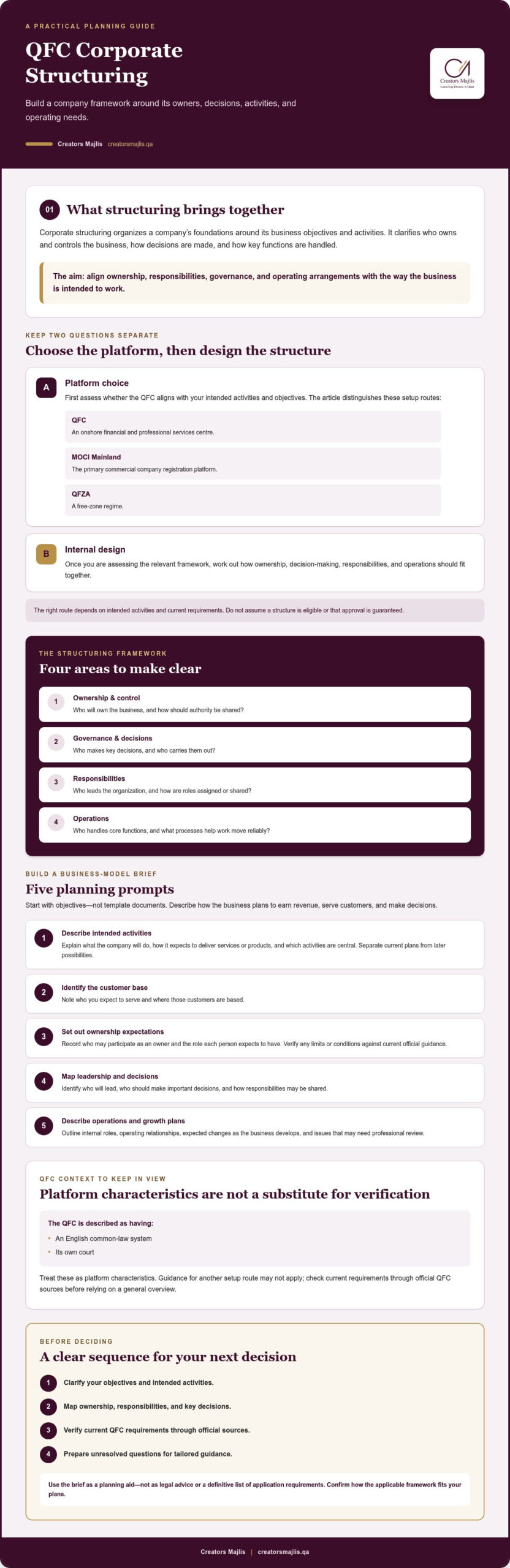
Qatar Financial Center corporate structuring is the process of organizing a company’s ownership, responsibilities, governance, and operating arrangements around its business objectives and activities. It helps clarify who owns and controls the business, how decisions are made, and how key functions are handled. The appropriate arrangement depends on the business model and the official requirements that apply.
Keep two decisions distinct. Choosing the QFC is a business-platform decision; structuring concerns how the company is organized within the relevant framework. The QFC is an onshore financial and professional services centre. By comparison, MOCI Mainland is the primary commercial company registration platform, while QFZA is a free-zone regime. The right route depends on the intended activities and current requirements, so verify that the QFC fits your plans before focusing on internal structure. For more context on platform selection, see this QFC Qatar setup-route guide. If you want to compare the free-zone option, this company formation guide for the Qatar free zone (QFZA) explains how that route works.
Which decisions are part of corporate structuring?
Start with ownership and control: who will own the business, and how should authority be shared? Next, map governance: who makes key decisions, and who is responsible for carrying them out? Finally, look at operations: who handles core functions, and what internal processes help work move reliably? These are planning questions, not a recommendation to choose a particular legal structure.
How does the QFC context shape the discussion?
The QFC has its own framework, so don’t assume that guidance for another setup route applies. The QFC is described as using an English common-law system and having its own court. Treat these as platform characteristics, not a substitute for checking the rules that apply to your company. Verify current requirements through official QFC sources before relying on a general overview. You can read a broad background overview of the Qatar Financial Centre (QFC), then confirm the details relevant to your business through official guidance.
That distinction gives you a practical starting point: first assess whether the QFC aligns with your activities and objectives, then map how ownership, decision-making, and operations should work within the applicable requirements. This keeps the platform choice separate from the internal design questions that corporate structuring needs to answer.
How to Build a QFC Structuring Brief Around Your Business Model
Before comparing possible arrangements, put your business model on paper. Start with your objectives rather than template documents, because the way you plan to earn revenue, serve customers, and make decisions shapes the questions you need to resolve. Use the steps below as a planning aid, not as legal advice or a definitive list of QFC application requirements.
- Describe the intended activities. Explain what the company will do, how it expects to deliver its services or products, and which activities are central to the business. Be specific enough to distinguish planned activities from possibilities for later.
- Identify the customer base. Note who you expect to serve and where those customers are based. This provides useful context when assessing the appropriate setup route and requirements.
- Set out ownership expectations. Record who may participate as an owner and what each person expects their role to be. Confirm any ownership limits or conditions against current official guidance.
- Map leadership and decisions. Identify who will lead the organization, who should make important decisions, and how responsibilities may be shared.
- Describe operations and growth plans. Outline key internal roles, operating relationships, expected changes as the business develops, and any issues that may need professional review.
What should founders clarify before discussing a structure?
Make the brief specific enough for another person to understand how the business is meant to work. Distinguish planned activities from future possibilities, describe the intended customer base, and note who expects to own, lead, or make decisions. Add operational priorities and growth intentions, and label assumptions clearly. This gives you a useful foundation for discussion without treating a preliminary plan as a final structure.
Which QFC questions require official confirmation?
Keep business facts separate from regulatory questions. Your plans may be clear, while eligibility, permitted activities, licensing details, and current requirements for ownership or governance still need confirmation through official QFC sources. Check proposed organizational arrangements rather than inferring what is allowed from general business guidance. For governance context, consult the QFCRA’s QFC corporate governance rules and verify which current materials apply to your circumstances.
A well-prepared brief makes qatar financial center corporate structuring more focused: it shows what you know, what you intend, and what remains to verify. For personalized guidance reviewing your objectives and open questions, you can discuss your structuring questions with Creators Majlis.
QFC Structuring Considerations: Ownership, Governance, and Operations
Separate your questions into three areas before weighing possible arrangements. Ownership concerns who participates in the business and how control is shared. Governance covers who makes decisions and how responsibilities are overseen. Operations concern how the company carries out its work. This turns qatar financial center corporate structuring into a practical set of questions rather than a search for a one-size-fits-all answer.
| Structuring area | Question to resolve | Detail to verify |
|---|---|---|
| Ownership and control | Who are the proposed owners, and how should decision rights be shared? | Confirm current QFC rules relevant to the intended activity and proposed ownership arrangement through official guidance. |
| Governance | Who will lead the company, approve important decisions, and oversee responsibilities? | Check current governance requirements and whether proposed arrangements or documents need to meet specific QFC standards. |
| Operations | Who will handle key functions, and how will everyday work and internal processes connect? | Verify any QFC requirements that apply to the intended activities and planned operating arrangements. |
Ownership and control: what should you map?
List each proposed owner, their expected contribution, and the decisions they expect to influence. Note questions about control, ownership conditions, or how a change in participation could affect the plan. QFC materials describe a framework that permits 100% foreign ownership, but don’t assume that a general ownership statement settles eligibility for every activity or proposed arrangement. Confirm the current official rules relevant to your proposal before relying on them.
If your plan involves a company holding shares or assets in other entities, treat that as a separate structuring question to review. Explore the Qatar holding company setup guide for context, then verify whether that approach fits your circumstances and applicable requirements.
Governance and operations: how should responsibilities connect?
At the planning stage, map roles, approval points, and everyday responsibilities. For example, identify who leads the business, who can approve significant commitments, and who manages core operational functions. The aim isn’t to prescribe a structure; it’s to check that governance supports how the company plans to operate.
Keep proposed governance documents and formal requirements on your verification list. Check current official QFC guidance before treating any document, approval process, ownership condition, or repatriation statement as applicable to your case. A clear map of decisions and responsibilities gives you a stronger basis for focused questions and for refining the structure around your objectives.
How to Assess Whether a QFC Structure Fits Your Plans
A useful fit assessment doesn’t promise approval or determine eligibility. It helps you compare your actual activities and priorities with current QFC requirements, then identify what still needs confirmation. Keep commercial preferences, such as how you want decisions made, separate from legal or regulatory questions that require authoritative answers.
What signals that you need more structuring guidance?
Pause before settling on an arrangement if owners have different expectations, no one is sure who will make key decisions, or the company’s intended activities aren’t clearly described. Uncertainty about whether those activities fit the chosen setup route is another reason to check official guidance. Don’t rely on copied templates or assumptions when an answer could affect the proposed structure.
How can you compare objectives with QFC requirements?
Use this two-column check to separate what your business wants from what you need to verify. General information about the QFC can provide context, but it doesn’t establish which requirements apply to a particular company.
| Business priority | Question to verify officially |
|---|---|
| Carry out specific business activities | Are the intended activities within the current scope of the proposed QFC route, and what licensing details apply? |
| Serve a defined customer base | Do the planned customer relationships raise any QFC-specific requirements to confirm? |
| Meet ownership expectations | What current rules apply to the proposed owners and ownership arrangement for these activities? |
| Set clear decision-making responsibilities | What governance expectations or requirements should be checked for the proposed arrangement? |
| Operate through planned roles and processes | Are there current requirements relevant to the company’s intended operating arrangements? |
Mark each item as a confirmed business fact, a commercial preference, or an open regulatory question. For example, your preferred way of sharing decisions is a planning preference; whether a proposed arrangement meets current requirements needs verification. Record assumptions and seek qualified advice where an unanswered question could change your structure.
If you’re comparing the QFC with an LLC setup, this LLC company formation guide offers a separate overview. Use it as background, then confirm the rules relevant to your plans. A careful qatar financial center corporate structuring assessment connects your activities, customers, ownership priorities, governance needs, and operations without treating general platform characteristics as a decision about your eligibility.
Ready to review your priorities and open questions? Discuss your QFC structuring plans with Creators Majlis.
Plan Your Next QFC Structuring Step with Clear Advice
Turn your planning into a focused next step. Clarify what the business aims to achieve, map ownership and decision-making, and set out operational responsibilities. Then verify relevant requirements through current official QFC information and seek tailored guidance on questions that remain open. This sequence supports informed decisions, but it doesn’t promise approval or a particular outcome.
What should you prepare for a structuring conversation?
A concise brief is more useful than a stack of generic templates. Prepare a short description of your business model, intended activities, customer base, and objectives. Then list the points that still need discussion:
- Who may own the business, and what ownership questions remain unresolved?
- Who is expected to lead the company and make important decisions?
- How do you expect the business to operate, and what roles or relationships need clarification?
- Which assumptions about QFC requirements need confirmation through current official information?
Keep facts, preferences, and open questions distinct. An intended activity is a business fact; a preferred way to share decisions is an objective; whether a proposed arrangement meets current requirements is something to verify. This gives a guidance conversation a clear starting point.
How can Creators Majlis support an informed decision?
Creators Majlis LLC provides Company Formation and Corporate Structuring & Organization guidance. Company Formation covers the QFC, QFZA, and Mainland Qatar. Corporate Structuring & Organization guidance can help you consider structure, processes, responsibilities, and operational frameworks in light of your objectives. The aim is to help you understand the questions and information relevant to your plans, not to guarantee a particular structure or result.
Support is available in German, English, and Arabic. Whether you’re still shaping your business plan or have specific ownership and governance questions, bring your brief and identify what needs official confirmation. That keeps the discussion practical and focused on your circumstances.
With a clear picture of your objectives, proposed activities, ownership questions, and operating plans, you’ll be better prepared to consider qatar financial center corporate structuring carefully. Discuss your QFC structuring questions with Creators Majlis to explore the next step for your plans.
Build Your QFC Plan on Clear Decisions
A sound approach to qatar financial center corporate structuring starts with your business objectives, then connects ownership, governance, and operations to the activities you intend to carry out. Keep commercial priorities separate from regulatory questions, and confirm current QFC requirements through official sources before relying on assumptions.
Prepare a concise brief covering your business model, proposed activities, ownership questions, decision-making responsibilities, and operating plans. This gives you a practical foundation for assessing what fits and where tailored guidance could help.
Creators Majlis LLC is a QFC-licensed corporate advisory firm. Its confirmed services include Company Formation and Corporate Structuring & Organization, with personalized support in German, English, and Arabic. Guidance can help you consider your objectives and open questions without promising approval or a particular outcome.
Take the next step with a clearer brief and focused questions. Discuss your QFC structuring questions with Creators Majlis.
Frequently Asked Questions
What is corporate structuring in the Qatar Financial Centre?
Corporate structuring in the QFC means organizing a company’s ownership, responsibilities, governance, and operating arrangements around its objectives and intended activities. It helps clarify who owns and controls the business, how important decisions are made, and how the company will operate. The QFC is a specific business platform, so confirm current official requirements for your proposed activities rather than assuming general Qatar setup guidance applies.
Is the QFC suitable for every type of business?
No. The QFC is not automatically the right route for every business or activity. Assess whether your intended activities fit the QFC’s current scope, along with your customer base, operational plans, and business objectives. Check permitted activities and licensing details through current official QFC sources before deciding. A general description of the QFC can help you understand the platform, but it cannot determine whether it fits your specific proposal.
Can foreign investors own 100% of a QFC company?
QFC materials describe a framework that permits 100% foreign ownership. Confirm current official rules and how they apply to your intended activity and proposed arrangement. Don’t treat a general ownership statement as a guarantee of eligibility or approval. Identify the proposed owners and the control they expect, then verify the relevant requirements through official QFC guidance.
How do I choose a corporate structure for a QFC business?
Start with the business, not a template. Set out your intended activities, customers, ownership priorities, decision-making responsibilities, and operating plans. Then check current QFC requirements relevant to those facts and identify unanswered legal or regulatory questions for professional review. This approach to qatar financial center corporate structuring helps you compare options against your objectives without assuming that one arrangement suits every applicant.
Does QFC corporate structuring include governance and operational planning?
Yes. Structuring can include planning how governance and operations connect with the company’s objectives. Map who leads, who makes key decisions, who handles core responsibilities, and how everyday processes are expected to work. This planning doesn’t replace confirmation of applicable QFC requirements. Verify current governance or operational requirements through official sources before treating a proposed arrangement or document as suitable for your company.
What should I prepare before discussing QFC company structuring?
Prepare a concise description of your business model, intended activities, customer base, and objectives. Note proposed owners, expected decision-makers, operational roles, and unresolved questions. Separate confirmed business facts from assumptions about QFC requirements, then mark which points need official confirmation. This preparation helps make a discussion more focused and gives an adviser a clearer picture of your priorities without treating your initial notes as a final structure.
Is QFC corporate structuring advice the same as legal advice?
No. Corporate structuring guidance can help you organize business questions, understand how ownership, governance, and operations relate to your objectives, and identify details to verify. It isn’t automatically legal advice or a substitute for advice from a qualified legal professional. Confirm current QFC rules through official sources, and seek qualified legal advice where an unresolved legal question could affect your proposed structure or business decisions.